What Is Pork Cushion Meat? Flavor, Uses & Cooking Tips
Most people walk right past it at the grocery store. Sitting there in the meat case with a slightly odd name — “pork cushion meat” — it doesn’t exactly scream “buy me.” There’s no fancy marketing behind it. No celebrity chef pushing it on Instagram. And honestly? That’s what makes it such a hidden gem.
If you’ve ever picked up a package of pork cushion meat and wondered what part of the pig it comes from, how it tastes, or what on earth you’re supposed to do with it, you’re not alone. It’s one of the most searched yet least understood pork cuts out there. People see it at a great price, get curious, and then freeze up because they don’t know if it’s good for grilling, braising, or something else entirely.
Here’s the thing — pork cushion meat is genuinely delicious when you cook it right. It’s affordable, versatile, and packed with the kind of deep pork flavor that more expensive cuts sometimes lack. You just need to understand what you’re working with.
That’s exactly what we’ll cover here. Where this cut comes from, what makes it unique, the best ways to cook it, and a few practical tips that’ll help you nail it the first time.
Where Does Pork Cushion Meat Come From?
Let’s start with the basics. Pork cushion meat comes from the picnic shoulder — the lower portion of the pig’s front leg, sitting just below the traditional pork butt (which, confusingly, also comes from the shoulder area). More specifically, it’s a boneless cut taken from the area just above the front leg, nestled between the skin and the shoulder blade.
Think of it this way: if the whole pork shoulder is a neighborhood, the pork butt is the upscale part, and the picnic shoulder is the working-class section right next door. The cushion meat is a specific “house” within that picnic shoulder neighborhood — a triangular-shaped, boneless muscle that sits on the exterior.
It typically weighs between 2 to 4 pounds, which makes it significantly smaller than a full pork butt or picnic roast. That smaller size is actually a big advantage for home cooks who don’t need to feed a crowd of twenty.
If you’ve ever cooked with other pork shoulder or butt cuts, you already have a sense of the flavor profile. Cushion meat has a similar richness, though with its own texture and cooking quirks that set it apart.
What Does Pork Cushion Meat Look and Taste Like?
Pull a piece of pork cushion meat out of its packaging and you’ll notice a few things right away.
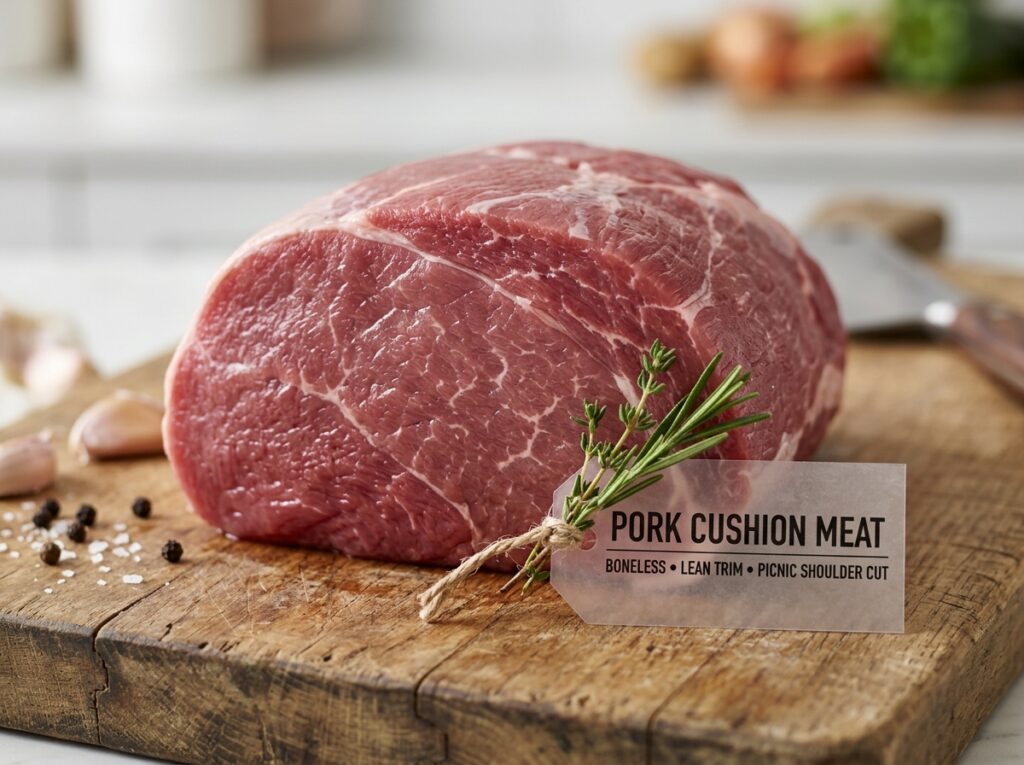
It has a somewhat irregular, triangular shape — not a neat rectangle like a pork loin. There’s usually a decent layer of fat on one side (the fat cap), and you’ll see some marbling running through the meat itself. It’s not as heavily marbled as pork belly, but there’s enough intramuscular fat to keep things juicy during cooking.
The color is a deep pinkish-red, similar to what you’d see in pork butt. If you’re wondering whether cooked pork can still have a little pink to it, this guide on pork tenderloin explains why that’s often totally normal.
As for flavor? Pork cushion meat tastes rich, porky, and slightly more intense than leaner cuts like tenderloin or loin chops. That fat content is doing the heavy lifting here. When cooked low and slow, the connective tissue breaks down and the fat renders, giving you meat that’s tender, moist, and full of depth. It won’t be as buttery-soft as the best pork belly, but it punches way above its price point.
Quick fact: Pork cushion meat usually costs 30–50% less than pork butt at most supermarkets, and significantly less than premium cuts like tenderloin or chops. For budget-conscious cooks, it’s honestly one of the best deals in the entire meat department.
Pork Cushion Meat vs. Pork Butt — What’s the Difference?
This is probably the most common point of confusion, so let’s clear it up.
Both cuts come from the shoulder area. Both have good fat content. Both work well with slow cooking methods. So what’s actually different?
Size is the biggest distinction. A full pork butt can weigh anywhere from 5 to 10 pounds. Pork cushion meat? Usually 2 to 4 pounds. That means shorter cooking times and less leftovers — which is great if you’re cooking for a smaller group.
Connective tissue is another difference. Pork butt has more collagen and connective tissue running through it, which is why it needs many hours of slow cooking to fully break down and become pull-apart tender. Cushion meat has connective tissue too, but less of it, so it reaches that sweet spot of tenderness a bit sooner.
Fat distribution varies as well. Pork butt tends to have fat distributed more evenly throughout the entire cut. Cushion meat has a concentrated fat cap on one side with moderate marbling in the rest. This means you might want to adjust your cooking approach slightly — more on that below.
Here’s a practical way to think about it: if pork butt is the “all-day project” that fills your kitchen with smoke and feeds a party, cushion meat is the “weeknight hero” that gives you similar flavors in less time and with less fuss.
If you enjoy comparing similar cuts, you might also find this breakdown of shank vs. butt ham interesting — it covers a similar “two cuts from the same area, very different results” situation.
Best Ways to Cook Pork Cushion Meat
Here’s where it gets fun. Pork cushion meat is surprisingly flexible, but it does have a clear preference: it loves low and slow cooking. That’s where it truly shines. The fat renders, the connective tissue melts, and you end up with something fork-tender and deeply satisfying.
That said, you’ve got several great options depending on your equipment and how much time you have.
Smoking
If you own a smoker, pork cushion meat is basically calling your name. Its size makes it way more approachable than a massive pork butt for a weekend smoke session.
Set your smoker to 225°F–250°F and plan for roughly 1 to 1.5 hours per pound. A 3-pound cushion can be done in about 4 to 5 hours, compared to the 10+ hours a full pork butt might need. You’re looking for an internal temperature of 195°F–205°F if you want it shreddable and pull-apart tender.
Use a reliable meat thermometer — guessing just doesn’t work with cuts like this. If you need a quick refresher on how to use one properly, this guide on reading meat thermometers is genuinely helpful.
For wood, apple and cherry give you a sweeter, milder smoke. Hickory and oak push things in a bolder direction. Either way works beautifully with pork.
Pro tip: Wrap the cushion meat in butcher paper once it hits an internal temp of around 160°F. This helps push through the temperature stall (that frustrating period where the meat’s temp just plateaus) while still letting some smoke penetrate. Foil works too, but butcher paper gives you a better bark.
Braising
No smoker? No problem. Braising is arguably the most forgiving way to cook this cut, and you can do it in a regular oven with a Dutch oven or any heavy, lidded pot.
Sear the cushion meat on all sides in a hot pan until you get a nice brown crust — that Maillard reaction is where a ton of flavor lives. Then place it in your pot with some liquid. Stock, beer, apple cider, or even a mix of stock and salsa all work. You don’t need to submerge the meat; about halfway up is plenty.
Cover it, slide it into a 300°F–325°F oven, and let time do the work. You’re looking at roughly 2.5 to 3.5 hours for a typical-sized cushion. The meat is ready when it pulls apart easily with a fork.
Slow Cooker / Crockpot
This is the “set it and forget it” method. Season the meat, toss it in the slow cooker with some liquid, aromatics, and maybe a few chunks of onion, and cook on low for 6 to 8 hours.
The result? Incredibly tender pulled pork that’s perfect for sandwiches, tacos, rice bowls, or just eating straight from the pot (no judgment). This is the ideal approach for busy weekdays when you want a real meal waiting at dinnertime without babysitting anything.
Oven Roasting
You can also roast pork cushion meat at a moderate temperature, similar to how you’d handle a pork tenderloin in the oven. The key difference is that cushion meat needs longer cooking at a slightly lower temperature because of its higher fat and connective tissue content.
Roast at 325°F for about 40–50 minutes per pound, aiming for an internal temp of at least 195°F for tender, shreddable meat. If you’d rather have sliceable (not pull-apart) pork, you can pull it at 145°F–160°F, but you’ll want to slice it thin against the grain for the best texture.
Seasoning and Flavor Pairings That Work
Pork cushion meat takes seasoning incredibly well. The fat content and surface texture give rubs and marinades something to cling to, and the long cooking times let those flavors really penetrate deep.
A simple dry rub is hard to beat. Think salt, black pepper, garlic powder, paprika (smoked if you have it), a touch of brown sugar, and a pinch of cayenne. Apply the rub generously the night before and let the meat sit uncovered in the fridge. The salt draws out some surface moisture, which then gets reabsorbed along with all those spices. This also helps create a better crust when you cook it.
If you like a little sweetness, a glaze made with apple cider vinegar, mustard, and brown sugar brushed on during the last hour of cooking adds a gorgeous layer of sticky, tangy flavor.
For braised cushion meat, don’t underestimate the power of something as simple as a can of beer, a sliced onion, and a few cloves of garlic. Sometimes the simplest combinations let the natural pork flavor stand out the most.
One approach that’s been gaining popularity — especially in southern and Tex-Mex cooking circles — is treating cushion meat like you’d treat carnitas. Season with cumin, oregano, chili powder, and citrus juice, then braise until fall-apart tender. Shred it, crisp up the edges in a hot cast-iron skillet, and stuff it into tacos. It’s genuinely one of the best uses for this cut.
How to Tell When Pork Cushion Meat Is Done
Temperature is your best friend here, and it honestly depends on what you’re going for.
For pull-apart, shreddable meat: You want an internal temperature between 195°F and 205°F. At this range, the collagen has fully broken down and the fat has rendered. The meat will practically fall apart when you push a fork into it.
For sliceable roast pork: Pull the meat at 145°F to 160°F. The USDA updated its minimum safe temperature for whole pork cuts to 145°F back in 2011, so you don’t need to cook it to the dry, grey state that older recipes often suggest. Just make sure you use a meat thermometer and let the meat rest for at least 10 minutes after removing it from heat.
Here’s something people often don’t realize: the internal temperature guidelines for pork vary depending on the cut and the cooking method. What works for chops is different from what works for shoulder cuts like cushion meat.
Did you know? During the “stall” phase of smoking (around 150°F–170°F), evaporative cooling on the meat’s surface can cause the temperature to plateau for hours. Don’t panic. This is completely normal with any fatty shoulder cut. Just be patient or wrap the meat to push through it.
Storing and Handling Pork Cushion Meat
Raw pork cushion meat keeps well in the refrigerator for 3 to 5 days as long as it stays at or below 40°F. If you’re not planning to cook it within that window, wrap it tightly in plastic wrap and then aluminum foil, and freeze it. It’ll hold up in the freezer for 4 to 6 months without significant quality loss.
Once cooked, store any leftovers in an airtight container in the fridge. They’ll be good for 3 to 4 days. And honestly, leftover pulled pork cushion meat might be even better than the fresh version — the flavors keep developing as it sits.
Reheating is straightforward. Add a splash of stock, apple juice, or even water to keep things moist, cover the container loosely, and warm it in the oven at 300°F or in the microwave. If you’ve crisped it up for tacos or sandwiches, a quick pass in a hot skillet brings back that texture beautifully. For more general reheating guidance on meats, this piece on reheating steak has some principles that apply across the board.
Why Is Pork Cushion Meat So Affordable?
You might wonder — if this cut tastes so good, why is it so cheap?
A few reasons. It’s not a “glamour” cut. Pork tenderloin and baby back ribs get all the magazine covers and restaurant menu spots. Cushion meat doesn’t have that recognition, so demand stays low, and price follows. It also requires longer cooking times, which puts off people who want dinner ready in 30 minutes.
There’s also a supply-and-demand factor at play. Every pig has a cushion in each picnic shoulder, but butchers don’t always separate it out as its own cut. Sometimes it gets left as part of the larger picnic roast, and sometimes it gets ground into sausage or used for processed pork products. When it does get sold on its own, stores often price it aggressively just to move it.
For you, the home cook, all of this is great news. You’re getting a flavorful, well-marbled cut for a fraction of what you’d pay for trendier options.
Common Mistakes to Avoid
Even though pork cushion meat is forgiving, a few common errors can trip you up.
Cooking it too fast at high heat. This isn’t a steak. If you try to grill it hot and fast, you’ll end up with a tough, chewy piece of meat. The connective tissue and fat need time to break down. Low temperatures and patience are your best tools. If you’ve ever dealt with chewy meat in any protein, the underlying principle is the same — give tough cuts the slow, gentle heat they need.
Skipping the rest period. After cooking, let the meat rest for at least 15 to 20 minutes before cutting or shredding. This lets the juices redistribute throughout the meat. Cut into it immediately and those juices run right out onto your cutting board instead of staying where you want them.
Not trimming the fat cap properly. You want to leave about ¼ inch of fat on the surface. Too much and the rub can’t penetrate the meat, and you’ll end up with a thick layer of unrendered fat. Too little and the meat dries out during cooking. That quarter-inch sweet spot gives you the best of both worlds — flavor, moisture, and a nice bark on the outside.
Underseasoning. This is a thick, fatty piece of meat. It can handle — and needs — more seasoning than you might expect. Don’t be shy with your rub. Get it on all sides, including into any folds or crevices.
Recipe Idea: Simple Smoked Pulled Pork Cushion Meat
Here’s a straightforward approach that works every time.
Take a 3-pound pork cushion meat and pat it dry with paper towels. Mix together 2 tablespoons of brown sugar, 1 tablespoon each of smoked paprika, garlic powder, and kosher salt, plus 1 teaspoon each of black pepper, onion powder, and cumin. Rub this all over the meat, wrap it in plastic, and refrigerate overnight (or for at least 2 hours if you’re short on time).
Fire up your smoker to 225°F. Place the cushion fat-side up on the grate and let it smoke undisturbed for about 3 hours. At that point, check the internal temp. When it hits 160°F, wrap it in butcher paper and return it to the smoker.
Continue cooking until the internal temperature reaches 200°F–203°F. This usually takes another 1.5 to 2 hours. Remove the wrapped meat and let it rest for 30 minutes — still in the butcher paper.
Unwrap, shred with two forks, and toss the pulled pork with a little of your favorite vinegar-based sauce. Pile it on buns, stuff it in tortillas, or just eat it over properly cooked rice.
That’s it. Nothing complicated. Nothing fancy. Just really, really good pork.
FAQ
Is pork cushion meat the same as pork butt?
No, they’re different cuts, though they’re from the same general area of the pig. Pork butt comes from the upper shoulder and is larger (typically 5–10 lbs). Pork cushion meat is a smaller boneless cut (2–4 lbs) from the picnic shoulder, which sits below the butt. They have similar flavors but different sizes, cooking times, and fat distribution.
Can you grill pork cushion meat?
You can, but it’s not the ideal method. Grilling works best for quick-cooking cuts, and cushion meat has too much connective tissue for that approach. If you really want to use the grill, set it up for indirect heat at a low temperature (around 225°F–275°F) and treat it more like a barbecue session than a grilling one. You’ll still need a few hours.
What’s the best internal temperature for pork cushion meat?
It depends on your goal. For pull-apart, shreddable meat, aim for 195°F–205°F. For a sliceable roast, you can pull it off heat at 145°F–160°F, though the texture will be firmer and the connective tissue won’t be fully broken down. Use a reliable meat thermometer every time — don’t guess.
How long does it take to cook pork cushion meat?
At 225°F (smoking), expect about 1 to 1.5 hours per pound. Braising at 300°F–325°F typically takes 2.5 to 3.5 hours total. In a slow cooker on low, you’re looking at 6 to 8 hours. The cut’s smaller size compared to pork butt means it finishes significantly faster regardless of the method.
Is pork cushion meat healthy?
Pork cushion meat is a solid source of protein, B vitamins (especially B6 and B12), zinc, and phosphorus. It is higher in fat than leaner cuts like pork tenderloin, so it’s more calorie-dense. A 3-ounce cooked serving has roughly 180–220 calories depending on how much visible fat you eat. If you trim the fat cap before eating (rather than before cooking), you get the moisture benefits during cooking with a leaner bite at the table.
Your Next Move
Pork cushion meat isn’t a mystery cut or some butcher’s leftover. It’s a legitimate, flavorful, budget-friendly piece of pork that just hasn’t gotten the recognition it deserves. Now that you know what it is, where it comes from, and how to cook it properly, there’s really only one thing left to do — pick one up the next time you’re at the store and give it a shot.
Start with the smoking or braising method if it’s your first time. Keep the seasoning simple so you can actually taste the meat itself. Pay attention to temperature, give it time, and let the fat do its job.
You’ll probably wonder why you’ve been walking past this cut for years. And the best part? While everyone else is paying top dollar for trendier options, you’ll be eating just as well — maybe better — for a whole lot less.