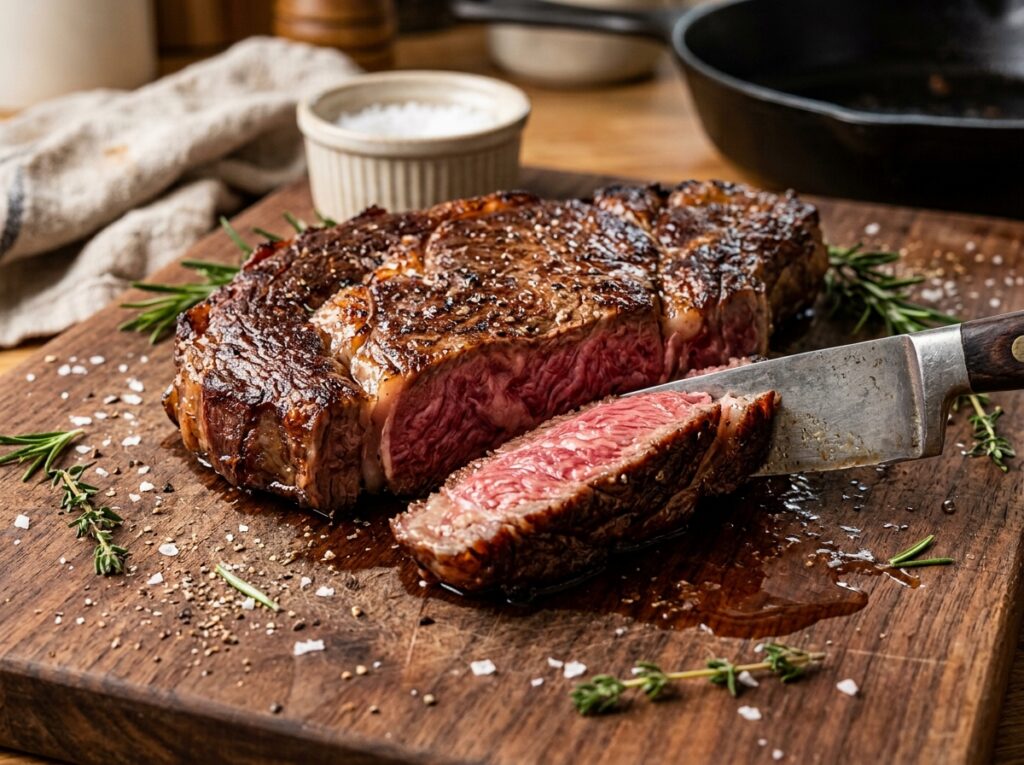
Delmonico Steak Explained in Simple Terms
Here’s the strange part: Delmonico steak isn’t one fixed cut of beef. Two butchers can sell two different steaks under that same name, and both may think they’re right. That’s why this label confuses so many shoppers. If you want the plain answer, plus what to buy and how to cook it, you’ll get it here without the steakhouse jargon.
What Is Delmonico Steak?
The short answer is simple: Delmonico steak is a name used for a thick, premium-style beef steak, often a ribeye or boneless ribeye, but not always the exact same cut everywhere.
That one sentence clears up most of the confusion.
Unlike names such as ribeye, sirloin, or filet mignon, Delmonico doesn’t point to one exact part of the cow in every shop. It works more like a historical steakhouse label that later spread into butcher shops, grocery stores, and restaurant menus.
So if you see “Delmonico steak” on a package, you still need one more piece of information: what cut is it actually?
Most of the time, you’re looking at a steak that aims to be:
- thick-cut
- rich in marbling
- tender enough for grilling or pan-searing
- sold as a steakhouse-style piece of beef
Quick fact: The word “Delmonico” comes from a famous New York restaurant, not from a body part of the animal.
That’s why the name can feel slippery. Think of it like ordering a “house special” burger. You know it should be good, filling, and signature to the place. But you won’t know the exact blend unless you ask.
A real-world example makes this easier. One butcher may label a boneless ribeye as Delmonico because it’s richly marbled and thick. Another may use a chuck eye steak and still call it Delmonico because that’s the local tradition. Same name. Different eating experience.
If you only remember one thing from this article, remember this: Delmonico steak is more of a style name than a single universal cut.
Why Is It Called Delmonico Steak?
The Delmonico’s restaurant connection
The name goes back to Delmonico’s, the famous restaurant in New York City, which became a big deal in the 19th century. It was known for luxury dining and helped shape early American steakhouse culture.
At some point, a steak served there became famous enough that the name stuck. People started using “Delmonico steak” to mean a special, thick, high-end steak.
That sounds clear enough, right? The trouble starts when you ask a harder question: Which exact cut did the original restaurant use?
That answer isn’t fully settled.
Food writers, butchers, and historians have argued about it for years. Some connect the original steak to the rib section. Others point toward short loin cuts. That old disagreement still affects how the name gets used now.
Why the name stayed but the cut changed
Once a famous food name leaves its original restaurant, it often starts to shift. Different regions adopt it. Different butchers teach it their own way. Grocery chains simplify it for shoppers. Menus use it because it sounds classic and upscale.
That’s how a historic steak name turns into a modern label with fuzzy edges.
You’ve probably seen this kind of thing in beef before. Premium-sounding names can create confusion fast, which is one reason people also compare labels like Wagyu vs Kobe beef. The words sound exact, but the real meaning depends on source, standards, and how the seller uses the term.
Did you know? Some restaurants use “Delmonico” almost like a signature steak title, not a strict butcher’s description.
So the history matters, but it doesn’t solve the buying problem by itself. For that, you need to know what cuts are commonly sold under the name today.
What Cut Is a Delmonico Steak, Really?
The most common modern answer
If you ask ten meat sellers, you may hear a few different answers. Still, the most common modern Delmonico steak is a ribeye or boneless ribeye.
That makes sense. Ribeye has the kind of rich marbling, soft texture, and steakhouse appeal people expect from a Delmonico. It also looks the part: thick, meaty, and built for a strong sear.
If your butcher says the Delmonico is cut from the rib primal, you’re usually in very good shape.
Other cuts that may be sold as Delmonico
Here’s where the confusion grows. Depending on the butcher, region, or store, Delmonico may also refer to:
- Chuck eye steak: often called the “poor man’s ribeye,” with good beef flavor and decent marbling
- Top loin or strip-style cuts: firmer than ribeye, with a beefy bite
- Rib-end steaks: close in feel to ribeye, though naming can vary
- Other thick boneless steaks sold under a house label
Chuck eye deserves a quick mention because it pops up often in this conversation. It sits near the rib section, which is why it can look and eat a bit like ribeye. Still, it usually has a little more chew and a little less luxury.
That doesn’t make it bad. It just means the name alone doesn’t tell the whole story.
Is Delmonico steak the same as ribeye?
Sometimes yes. Sometimes no.
If a butcher uses Delmonico as another name for boneless ribeye, then yes, they’re basically the same in that shop. If another seller uses chuck eye or a strip-related cut, the answer becomes no.
That’s the biggest reason people get mixed up online. One article says Delmonico equals ribeye. Another says it doesn’t. Both can be describing real market usage.
A better way to think about it is this:
Ribeye is a specific cut. Delmonico is a variable label.
That’s also why Delmonico feels different from cuts with a clear identity. A tomahawk steak, for example, has a very recognizable look and cut style. Delmonico doesn’t give you that same visual certainty.
Where does Delmonico steak come from on the cow?
There isn’t one fixed answer because the cut can vary. Still, the rib area is the safest modern guess, since many Delmonico steaks are sold as ribeye or boneless ribeye.
If the version in front of you is a chuck eye, it comes from the shoulder area close to the rib. If it’s a strip-style version, it comes from the short loin.
So if you want a clean answer for quick shopping, use this:
Delmonico steak usually comes from the rib section, but the label can also be used for nearby or similar steakhouse cuts.
That one line will keep you from making the most common mistake, which is assuming every Delmonico is identical.
Where Does Delmonico Steak Come From and What Does It Taste Like?
Flavor depends on the actual cut
A Delmonico steak often tastes rich, beefy, and full because sellers usually reserve the name for steaks with some steakhouse appeal. But flavor still depends on what’s under the label.
If it’s a ribeye-style Delmonico, expect:
- strong beef flavor
- noticeable marbling
- a juicy bite
- a softer, almost buttery texture
If it’s a chuck eye Delmonico, expect a deeper beef taste with slightly more chew.
If it’s a strip-style Delmonico, you’ll likely get a firmer texture and a cleaner, leaner bite.
So yes, Delmonico usually tastes good. It just doesn’t always taste the same.
Is Delmonico steak tender?
Often, yes. Guaranteed, no.
That’s another place people get tripped up. Ribeye versions are usually very tender because of the fat and muscle structure. Chuck-based versions can still be enjoyable, but they may not melt as easily in your mouth.
Here’s the easiest rule: more marbling usually means a richer and more tender Delmonico.
Look for thin white fat lines spread through the meat instead of one big chunk of fat sitting on the edge. That’s a good sign you’re getting the kind of steak most people expect from the name.
Is Delmonico steak expensive?
It can be, though price should follow the actual cut, not just the label.
A Delmonico that’s really a boneless ribeye may cost close to ribeye prices. A chuck eye version should usually cost less. If two steaks have the same “Delmonico” name but very different marbling, thickness, or source cuts, they shouldn’t be priced the same.
Warning: Don’t pay a premium just because the package says Delmonico. Pay for the cut, grade, and marbling.
Also keep quality grades separate in your mind. Delmonico is not a USDA grade. Prime, Choice, and Select are quality grades. Delmonico is a market name.
That’s a key difference, and missing it can lead to overpaying.
How to Buy and Cook Delmonico Steak
What to ask at the butcher counter
This is where you save yourself money and disappointment.
You don’t need to sound like a meat expert. Just ask a few direct questions:
- What cut is this exactly: ribeye, chuck eye, or something else?
- Is it boneless or bone-in?
- How thick is it?
- Is it USDA Prime, Choice, or another grade?
- How would you cook this cut?
That short conversation tells you far more than the Delmonico label ever will.
If you want the best chance at a great result, ask for a steak that’s about 1¼ to 1½ inches thick. That thickness gives you time to build a good crust without overcooking the center.
Best way to cook Delmonico steak
Most Delmonico steaks do best with high heat and simple seasoning. You don’t need to bury a well-marbled steak under a heavy marinade.
Salt, black pepper, and a hot pan or grill will do a lot of the work.
Here’s a simple method that works well for a ribeye-style Delmonico:
- Salt the steak early. Give it at least 40 minutes, or salt it the night before and leave it uncovered in the fridge.
- Pat it dry. Dry surface means better browning.
- Use high heat. A cast-iron skillet or hot grill works best.
- Sear both sides well. Let the crust form before flipping.
- Finish to your target temperature. Use a thermometer instead of guessing.
- Rest the steak for 5 to 10 minutes. That helps the juices settle.
A little butter, garlic, and rosemary near the end can add flavor, though a good steak doesn’t need much help.
Pro tip: If you’re still learning steak temperatures, this guide on how to read a meat thermometer makes the process much easier.
Grill or pan-sear?
Both work.
Use the grill if you want smoky flavor and strong char marks. Use a cast-iron pan if you want a darker, more even crust and better control indoors.
A thick ribeye-style Delmonico handles either method well. A leaner or smaller Delmonico needs a little more attention so you don’t overshoot the temperature.
If your steak has a lot of fat, be ready for flare-ups on the grill. Keep a cooler zone open so you can move it if flames get wild.
What internal temperature should you aim for?
For the best eating texture, many home cooks prefer Delmonico around medium-rare to medium.
A simple target guide:
- Rare: about 125 to 130°F
- Medium-rare: about 130 to 135°F
- Medium: about 140 to 145°F
- Medium-well: about 150°F
As of 2026, USDA guidance for whole cuts of beef is 145°F with a 3-minute rest. Many steak lovers still choose lower temperatures for texture and flavor, especially with quality beef. If you’re cooking for older adults, pregnant people, or anyone with a weaker immune system, it makes sense to be more cautious.
If you enjoy very rare steak, you may also want to read about is blue steak safe before you decide.
What about leftovers?
If you spend good money on a thick steak, don’t ruin it the next day with a microwave blast.
Slice it and warm it gently in a pan, or reheat it low and slow. This guide on how to reheat steak can help you keep it tender instead of turning it gray and tough.
Common Confusion About Delmonico Steak
Is Delmonico a USDA grade?
No.
A lot of shoppers mix up steak names and beef grades. Delmonico is not the same thing as Prime, Choice, Select, Angus, Wagyu, or Kobe.
It doesn’t tell you the cattle breed. It doesn’t guarantee marbling level. It doesn’t promise tenderness on its own.
That’s why the package needs a second look.
Is Delmonico always boneless?
No again.
Many Delmonico steaks are boneless because boneless ribeye is a common version. Still, some sellers may use the name on bone-in steaks too, especially on restaurant menus where the word acts more like a signature title.
If boneless or bone-in matters to you, ask before you order.
Is Delmonico better than ribeye?
Not by default.
A great ribeye is a great ribeye because of the cut, marbling, and quality. A steak labeled Delmonico can be excellent, but the name alone doesn’t make it better.
That’s the real takeaway here. Delmonico is not a magic upgrade. It’s a label with history.
Should you order Delmonico at a restaurant?
Sure, but ask one quick question first: “What cut do you use for your Delmonico?”
That single question tells you more than the menu description.
If the answer is boneless ribeye, you know what to expect. If the server says it’s a chuck-based or house-cut steak, then you can decide whether that sounds worth the price.
Menus do this all the time. They use classic names to create a steakhouse feel. There’s nothing wrong with that. You just want the facts before you commit.
Did you know? Some of the best restaurant steaks aren’t the ones with the fanciest names. They’re the ones with clear cut details, solid marbling, and proper cooking.
Is Delmonico Steak Worth Buying?
Yes, if you buy it with your eyes open.
A Delmonico steak can be a fantastic choice if:
- the butcher tells you the exact cut
- the marbling looks good
- the thickness suits high-heat cooking
- the price matches the actual cut
For many people, the best-case Delmonico is basically a thick ribeye experience under a classic old-school name. That’s not a bad thing at all.
You may want to skip it if the seller can’t explain what cut it is, or if the price feels too high for the quality in front of you.
Here’s a simple way to judge value:
If the steak looks like a well-marbled ribeye and is priced like a ribeye, fine.
If it looks leaner or tougher but still carries a premium “Delmonico” price, pause and ask more questions.
That small habit separates smart steak buyers from disappointed ones.
4. FAQ Section
FAQs About Delmonico Steak
What cut of meat is Delmonico steak?
Delmonico steak doesn’t refer to one exact cut everywhere. In many butcher shops, it’s a ribeye or boneless ribeye. In other places, it may be a chuck eye or another thick steak sold in a steakhouse style.
If you want the real answer, ask the butcher what cut sits behind the label. The name alone isn’t enough.
Is Delmonico steak the same as ribeye?
Sometimes, yes. Many sellers use Delmonico as another name for a boneless ribeye. Still, not every shop does that.
Ribeye is a specific cut. Delmonico is a more flexible market name. That’s why the two can match in one store and differ in another.
Why is it called Delmonico steak?
The name comes from Delmonico’s restaurant in New York City, which became famous in the 1800s for upscale dining. A steak associated with that restaurant became popular enough that the name spread.
Over time, the label stayed famous while the exact cut became less consistent. That’s the source of today’s confusion.
Is Delmonico steak tender?
It often is, especially if it’s cut from the rib section and has good marbling. A ribeye-style Delmonico usually eats tender and juicy.
If the steak is actually chuck eye or another firmer cut, it may still taste great but have a bit more chew. Marbling matters more than the name.
What’s the best way to cook Delmonico steak?
Most Delmonico steaks cook best with high heat. Pan-searing in cast iron or grilling works well, especially for thick ribeye-style cuts.
Keep the seasoning simple, use a thermometer, and rest the steak after cooking. Medium-rare to medium is a sweet spot for many people because it keeps the meat juicy while rendering some of the fat.
5. Conclusion
Delmonico steak sounds precise, but it really isn’t. The name carries a lot of history from old New York dining, yet your best clue today isn’t the label alone. It’s the actual cut, the marbling, the thickness, and the way you plan to cook it.
So next time you see Delmonico at the butcher shop or on a menu, don’t just nod and guess. Ask what cut it is. If the answer is a thick, well-marbled ribeye-style steak at a fair price, you’re probably looking at a very good dinner.