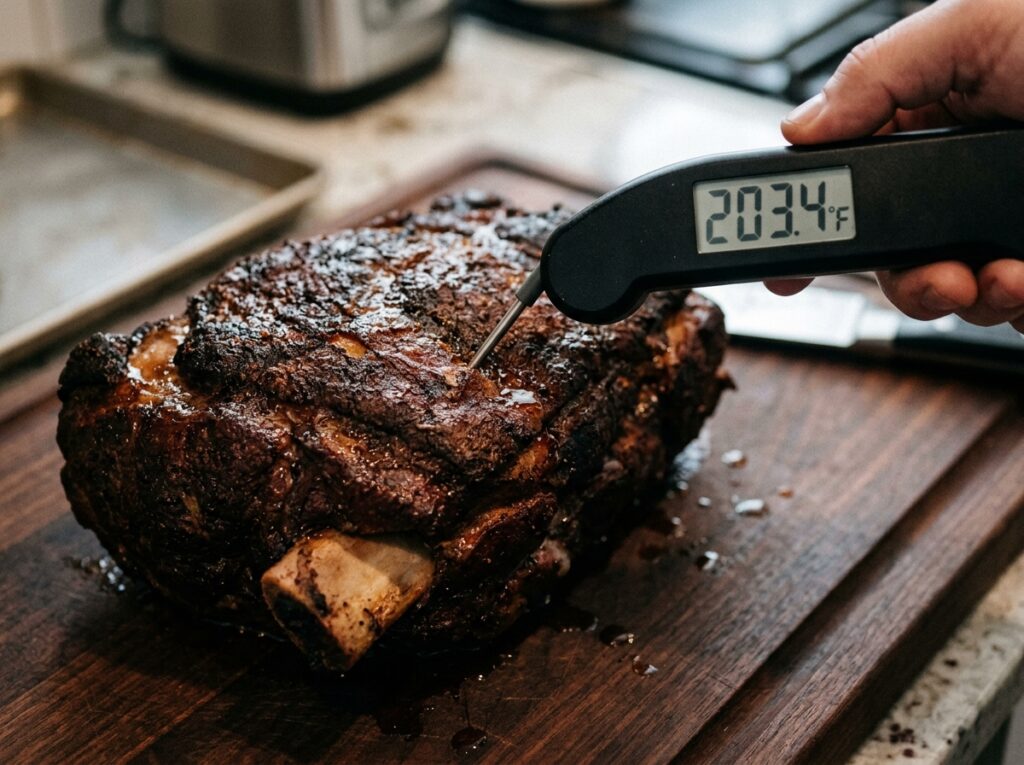
Pork Butt Done Temp — What Pitmasters Actually Aim For
Most people pull their pork butt off the smoker way too early. They see the thermometer hit 165°F, remember that’s the “safe” number for most meats, and assume they’re done. Then they try to shred it — and end up with tough, chewy chunks instead of that melt-in-your-mouth pulled pork they were craving.
Here’s the truth: pork butt plays by different rules. The internal pork butt temperature that makes it safe to eat and the temperature that makes it actually good to eat are two very different numbers. And that gap is where all the magic — or all the disappointment — happens.
Whether you’re smoking your first pork butt this weekend or you’ve done it a dozen times and still aren’t getting the results you want, this guide breaks down the exact temperatures, the science behind them, and the practical tips that’ll help you nail it every single time.
Why Pork Butt Needs a Higher Internal Temperature
You probably already know that the USDA says pork is safe to eat at 145°F with a three-minute rest. That’s perfectly fine for pork chops and pork tenderloin. But if you pull your pork butt at 145°F, you’ll end up with something that’s technically safe but practically inedible — at least for pulled pork.
So what’s different about pork butt?
It comes down to collagen. Pork butt (which actually comes from the shoulder, not the rear — confusing, right?) is loaded with connective tissue, fat, and collagen. These are the things that make cheap, tough cuts feel impossible to chew when they’re undercooked. But here’s the beautiful part: when you cook collagen low and slow past a certain temperature, it breaks down into gelatin. That gelatin is what gives pulled pork its silky, juicy, fall-apart texture.
Collagen doesn’t even start breaking down meaningfully until you’re past 160°F. The real transformation happens between 195°F and 205°F. That’s why pitmasters keep cooking long after the “safe” temperature has been reached. They’re not worried about safety at that point — they’re chasing texture.
Think of it like this: 145°F is when pork butt becomes safe. 200°F is when it becomes spectacular.
The Ideal Internal Pork Butt Temperature
Let’s get specific. The target you should aim for depends on how you plan to serve your pork butt.
For pulled pork: You want an internal temperature between 200°F and 205°F. This is the sweet spot where the collagen has fully rendered, the fat has melted throughout the meat, and the muscle fibers separate with almost no effort. You should be able to push a thermometer probe into the thickest part of the meat and feel it slide in like butter.
For sliced pork butt: If you prefer slices over shreds, pull it a little earlier — around 195°F. The meat will hold together enough to cut clean slices but still be tender and juicy.
For chopped pork: Anywhere between 197°F and 203°F works well. You’ll get a texture that’s easy to chop with a cleaver and still has plenty of moisture.
⚠️ Quick Warning: Don’t go past 210°F. At that point, you risk drying out the meat. Even a pork butt with all its fat and collagen has limits. Overcooking turns that beautiful gelatin into a mushy, dry mess.
The number that most experienced pitmasters land on? 202°F. It’s not a rigid rule, but if you want a single number to remember, that’s the one.
The Stall — And Why Your Pork Butt Temperature Stops Climbing
If you’ve ever smoked a pork butt, you’ve probably experienced the stall. Everything’s going great — the temperature climbs steadily for the first few hours, you’re feeling confident, and then… it just stops.
The thermometer reads 155°F. You check again 30 minutes later. Still 155°F. An hour passes. Maybe it’s gone up one degree. You start wondering if your thermometer is broken, your smoker is malfunctioning, or the meat is somehow defying physics.
Relax. The stall is completely normal. It happens because moisture on the surface of the meat evaporates, cooling it down — the same way sweat cools your body. This evaporative cooling effect perfectly counterbalances the heat from your smoker, and the internal temperature plateaus. The stall typically happens somewhere between 150°F and 170°F and can last anywhere from two to six hours.
You have three options when the stall hits:
Ride it out. Just be patient. The stall will eventually break as the surface dries out and evaporative cooling slows down. This is the purist approach, and it gives you the best bark (that dark, flavorful crust on the outside). But it adds hours to your cook time.
Wrap it. This is the Texas Crutch method. Wrapping your pork butt in aluminum foil or butcher paper traps moisture and heat, pushing through the stall much faster. Foil is more aggressive — it’ll blast through the stall quickly but can soften your bark. Butcher paper is a great middle ground because it’s breathable enough to preserve some bark while still speeding things up.
Increase your smoker temperature. Bumping from 225°F to 275°F can help push past the stall. Just keep a close eye on your temperature readings so you don’t overshoot.
Most backyard smokers use the wrapping method because time is precious on a weekend cook. There’s no shame in it — plenty of competition pitmasters wrap too.
How to Accurately Check Pork Butt Temperature
Getting an accurate temperature reading on a pork butt isn’t as simple as sticking a thermometer in any random spot. The shape of a pork butt is irregular, and there are thick spots, thin spots, fat pockets, and even a bone (in bone-in cuts) that can all throw off your reading.
Here’s how to do it right:
Always probe the thickest part of the meat. That’s where the temperature will be lowest and where you need to be sure the collagen has broken down completely. If the thickest part is done, the rest of the meat is definitely done.
Avoid the bone. If you’re cooking a bone-in pork butt, don’t let your thermometer touch the bone. Bone conducts heat differently than meat, so a reading near the bone will be misleadingly high. Aim for the center of the thickest muscle mass, at least an inch away from any bone.
Check multiple spots. Don’t rely on a single reading. Probe the pork butt in three or four different areas to make sure you’re getting consistent temperatures throughout. If one spot reads 202°F but another reads 188°F, you need more time.
Use a reliable instant-read thermometer. Cheap thermometers can be off by 10–15 degrees, which is the difference between perfect pulled pork and a tough disappointment. A quality instant-read thermometer like a ThermoWorks Thermapen or even a well-reviewed $20 digital model will give you accurate readings in seconds. If you’re unsure about how to read a meat thermometer properly, it’s worth spending a few minutes learning — it’ll improve every piece of meat you cook, not just pork butt.
Use a leave-in probe for monitoring. An instant-read thermometer is great for spot-checking, but a leave-in probe thermometer lets you monitor the internal temperature without opening your smoker. Every time you open the lid, you lose heat and extend your cook time.
🔑 Pro Tip: The “probe tender” test is just as important as the temperature reading. When your pork butt reaches the 195°F–205°F range, stick your thermometer probe into the meat. If it slides in with zero resistance — like poking a hot knife into softened butter — your pork butt is done, regardless of what the exact number says. If there’s still some resistance, give it more time even if the temperature looks right.
Temperature Guide by Cooking Method
The target internal temperature for pork butt stays the same no matter how you cook it — that 200°F to 205°F range for pulled pork doesn’t change. But the cooking method affects how long it takes to get there and what adjustments you might need to make along the way.
Smoking (225°F–250°F)
This is the classic method. At a smoker temperature of 225°F, plan for roughly 1.5 to 2 hours per pound. A 10-pound pork butt could take 15–20 hours. That’s why a lot of people start their cook the night before and let it run overnight.
At 250°F, you’ll shave off a few hours — closer to 1.25 to 1.5 hours per pound. The flavor difference between 225°F and 250°F is minimal, so don’t feel like you’re sacrificing quality for speed.
Wood choice matters here too. Hickory, apple, cherry, and oak are all popular. Hickory gives you a strong, traditional barbecue flavor. Fruitwoods like apple and cherry are milder and slightly sweet. Mix them if you want complexity.
Oven Roasting (300°F–325°F)
No smoker? No problem. You can make excellent pulled pork in your oven. At 300°F–325°F, you’re looking at roughly 40 to 60 minutes per pound. A standard 8-pound pork butt will take about 6–8 hours.
Use a roasting pan with a rack, cover it with foil for the first two-thirds of the cook, then uncover for the final stretch to develop some crust. You won’t get smoke flavor (unless you add liquid smoke or smoked paprika to your rub), but the texture can be every bit as good as smoked pork butt.
If you enjoy oven cooking, this method is similar in patience to cooking a pork tenderloin in the oven at 400°F — you just need to trust the process and let the heat do its work.
Slow Cooker / Crockpot
A slow cooker works for pork butt, but managing it is different. You can’t easily check the internal temperature without lifting the lid (which releases heat), so a leave-in probe thermometer that connects to your phone is especially helpful here.
On the low setting, a 4–5 pound pork butt takes about 10–12 hours. On high, about 6–8 hours. The meat will get tender, but you won’t get any bark or crust — it’ll be braised rather than roasted. Still delicious, just a different experience.
The Resting Period — Don’t Skip This
You’ve spent 12, 15, maybe 18 hours getting that pork butt to the perfect internal temperature. The temptation to tear into it immediately is enormous. Don’t.
Resting is not optional. When you rest a pork butt, the juices inside the meat redistribute. If you shred it immediately off the smoker, those juices pour out onto the cutting board instead of staying inside the meat. You end up with drier pulled pork and a puddle of wasted flavor.
Rest your pork butt for at least 30 minutes, but ideally 1–2 hours. Here’s the best way to do it:
Pull the pork butt off the smoker when it hits your target temperature. If it’s wrapped in butcher paper or foil, leave the wrapping on. Place it in a dry cooler (no ice, obviously) and close the lid. The insulation of the cooler will keep the meat hot for hours — it’ll still be above 160°F even after 3–4 hours in a good cooler.
This “faux Cambro” technique is borrowed from competition barbecue, and it’s genuinely one of the easiest ways to upgrade your pulled pork. The longer rest gives collagen even more time to convert to gelatin, making the meat even more tender.
⚠️ Food Safety Note: Don’t let your pork butt rest so long that it drops below 140°F. Below that temperature, you’re entering the danger zone where bacteria can start growing. For most home cooks, a 1–2 hour rest in a cooler is the perfect balance.
What If Your Pork Butt Temperature Is Off?
Things don’t always go according to plan. Here’s how to handle the most common temperature issues.
It’s Done Too Early
Your pork butt hit 202°F, but dinner isn’t for five more hours. Good news — this is actually an easy problem to solve. Wrap the pork butt tightly in foil, then in old towels, and place it in a cooler. It’ll hold safely above 140°F for up to 4–5 hours. Some people even consider this extended rest a benefit rather than a problem, because the extra resting time makes the meat even more tender.
It’s Not Done and Guests Are Arriving
This one’s stressful, but you have options. You can crank your smoker temperature up to 275°F–300°F to speed things up. You can wrap tightly in foil with a splash of apple juice, which creates a braising effect and accelerates the breakdown of connective tissue. Or, as a last resort, you can finish it in a 300°F oven — transferring from a smoker to an oven mid-cook is perfectly fine and won’t ruin the flavor you’ve already built.
The Temperature Won’t Go Past 170°F
You’ve hit the stall. Refer back to the stall section above. Wrap it, bump the heat, or wait it out. It will eventually push through.
Different Parts Read Different Temperatures
This is normal, especially with larger pork butts. The thin end might read 205°F while the thick end is still at 190°F. Keep cooking. The thick end is your reference point. The thinner sections might get a little more well-done, but with a cut this fatty and collagen-rich, that rarely causes problems.
Bone-In vs. Boneless: Does It Affect Temperature?
People ask this a lot, and the short answer is: the target temperature stays the same regardless of whether your pork butt has a bone or not.
But there are practical differences worth knowing about.
A bone-in pork butt takes slightly longer to cook because the bone acts as an insulator. The meat directly around the bone will be the last to reach temperature. That’s actually fine — the bone also contributes flavor and helps the meat retain moisture during long cooks. And here’s a great doneness indicator: when the bone wiggles freely and you can pull it out cleanly with almost no meat attached, your pork butt is done. This “wiggle test” is a reliable backup to your thermometer.
A boneless pork butt cooks a bit faster and more evenly since there’s no bone insulating the center. It’s also easier to probe for temperature because you don’t have to worry about hitting a bone. The trade-off is that boneless cuts can dry out slightly more during very long cooks because they lack the bone’s insulating protection. Wrapping can help offset this.
If you’re curious about the differences between pork shoulder cuts, take a look at shank vs. butt ham — it gives you a good picture of how the shoulder and leg sections differ.
Quick Temperature Reference
Here’s a simple breakdown to keep handy. Feel free to screenshot this or write it on a sticky note for your next cook.
145°F — USDA minimum safe temperature for pork (not suitable for pulled pork)
160°F–170°F — The stall zone; collagen is starting to break down but not done yet
195°F — Good for sliced pork butt; holds together but tender
200°F–205°F — The sweet spot for pulled pork; shreds easily, maximum juiciness
202°F — The number most pitmasters target
210°F+ — Danger of drying out; you’ve gone too far
Pork Butt vs. Other Pork Cuts — Temperature Comparison
It’s easy to get confused when different pork cuts have different ideal temperatures. Here’s how pork butt compares to other cuts you might be cooking.
Pork tenderloin is a lean, tender cut with very little connective tissue. It’s best at an internal temp of 145°F — totally different from pork butt. Cook it past 160°F and it turns dry and chalky. And yes, a slight pink color in pork tenderloin at 145°F is perfectly safe and actually means it’s cooked correctly.
Pork chops also target 145°F with a three-minute rest. Like tenderloin, they’re lean and don’t benefit from extended cooking. You can learn more about getting the perfect internal temp for pork chops without overcooking them.
Pork butt and pork shoulder are the outliers. They need to go all the way up to 195°F–205°F because of their collagen content. If you treat them like a pork chop, you’ll be disappointed. If you treat them with patience and give them the time and temperature they need, you’ll be rewarded with some of the best meat you’ve ever made.
Understanding this difference is one of the most important things in pork cookery. The cut determines the temperature, not the other way around. A cut with lots of cushion meat and connective tissue needs time and heat to become tender. A lean cut needs restraint and precision.
Tips That Actually Make a Difference
I’ve read hundreds of pulled pork guides, and most of them repeat the same generic advice. Here are a few tips that genuinely impact the final result:
Apply your rub the night before. Dry brining with your rub (especially one containing salt) for 12–24 hours in the fridge seasons the meat deeply and improves moisture retention. A quick 30-minute rub before cooking barely penetrates the surface.
Don’t spritz too often. Spritzing with apple juice or apple cider vinegar is popular, but every time you open your smoker to spritz, you lose heat and extend the cook. If you’re going to spritz, do it every 45–60 minutes after the first three hours — not every 20 minutes.
Fat cap up vs. down depends on your smoker. The old “fat cap up so the fat bastes the meat” advice isn’t universally true. If your heat source is below the meat (like most offset smokers), put the fat cap down so it acts as a heat shield. If your heat comes from above, fat cap up makes more sense. Know your equipment.
Let the internal temperature guide you, not the clock. Recipes that say “cook for 12 hours” are estimates. Every pork butt is different — size, shape, fat content, bone structure, even the individual animal’s genetics affect cooking time. Your thermometer is the only reliable judge of doneness.
Save the drippings. The liquid that collects in your foil or butcher paper wrapping during the rest is liquid gold. Strain it, let it cool slightly, and pour it back over the meat after you shred it. It adds moisture and an incredible concentration of flavor.
FAQ
What internal temperature should pork butt reach for pulled pork?
For pulled pork that shreds easily with a fork, you want an internal temperature between 200°F and 205°F. Most pitmasters aim for 202°F. At this temperature, the collagen in the meat has fully broken down into gelatin, giving you that tender, juicy texture that makes pulled pork special.
Is pork butt done at 190°F?
Technically it’s safe to eat at 145°F, and at 190°F the collagen breakdown is well underway. But 190°F is usually not quite enough for easy shredding. You’ll likely find some sections that are tough or resistant. Push it another 10–15 degrees to the 200°F–205°F range for the best results. If you probe the meat at 190°F and it feels like it’s sliding through butter, you might be okay — but that’s rare at this temperature.
How long does it take to smoke a pork butt to 200°F?
At a smoker temperature of 225°F, expect about 1.5–2 hours per pound. An 8-pound pork butt might take 12–16 hours, including the stall. At 250°F, it’s closer to 1.25–1.5 hours per pound. These are estimates — always cook to temperature, not time.
Should I wrap my pork butt in foil or butcher paper?
Both work. Foil pushes through the stall faster but can make the bark soft and almost mushy. Butcher paper is breathable, so it speeds up the cook while preserving more bark texture. If bark is important to you (and it should be — it’s delicious), go with butcher paper.
Can I let pork butt rest for 4 hours?
Yes, and many experienced cooks intentionally plan for a long rest. Wrap the finished pork butt in foil and towels, place it in a dry cooler, and it’ll stay safely above 140°F for 4–5 hours. The extended rest often makes the meat even more tender. Just check the temperature before serving to make sure it hasn’t dropped below the safe zone.
Your Next Cook Starts Here
Getting the internal pork butt temperature right isn’t complicated once you understand the “why” behind the numbers. Stop pulling it at 165°F and wondering why it won’t shred. Give it the time to hit that 200°F–205°F window, let it rest properly, and you’ll produce pulled pork that genuinely rivals what you’d get at a top barbecue restaurant.
The real secret isn’t a special rub or a fancy smoker. It’s patience. Pork butt rewards those who let it cook until it’s truly ready — not just safe, but done. Trust your thermometer, pay attention to probe tenderness, and respect the rest. Everything else is just details.
Fire up that smoker this weekend and put these temperatures to work. Your taste buds — and everyone you feed — will thank you.