How to Tell When Bacon Is Done and Safe to Eat
Bacon can go from pale and floppy to too dark in what feels like one distracted minute. That’s why so many people second-guess it at the stove. Knowing how to tell when bacon is done matters more than following one fixed time, because thin-cut, thick-cut, skillet bacon, and oven bacon all finish a little differently. Once you know the visual signs, you can stop guessing and cook it exactly how you like it.
How to tell when bacon is done: the quick answer
The easiest answer is this: done bacon looks browned, not raw-looking, and the fat looks rendered instead of thick and rubbery.
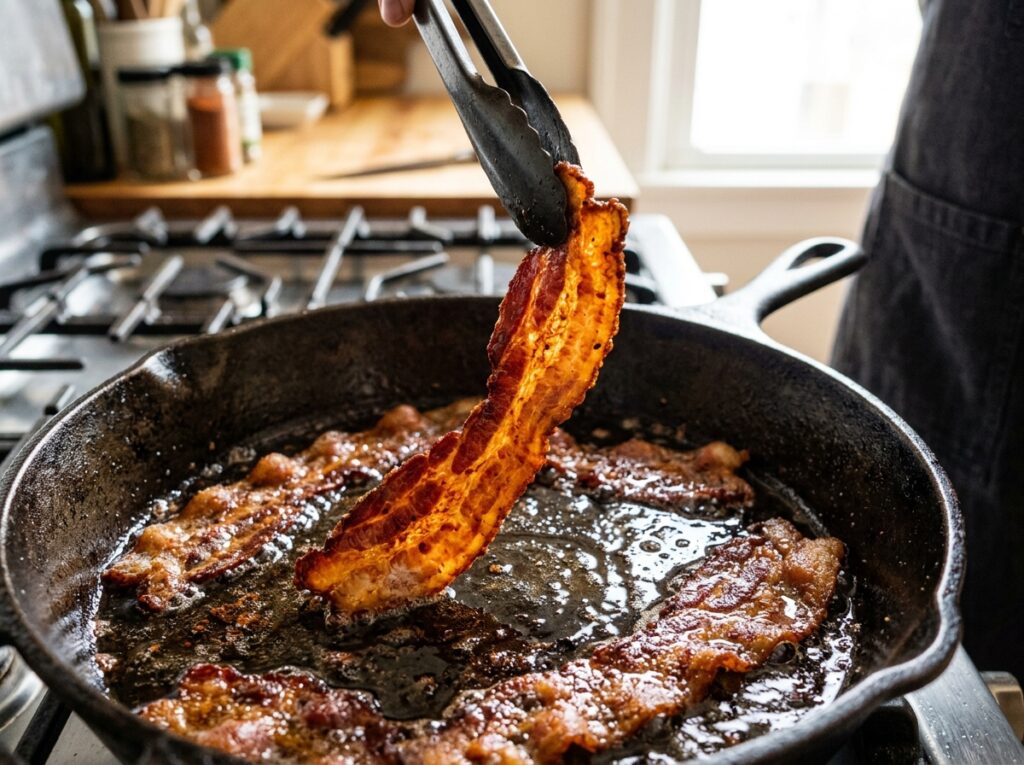
If you lift a strip with tongs, it shouldn’t hang there like a wet ribbon. For chewy bacon, it should bend but still hold its shape. For crisp bacon, it should feel firm and get even crisper after 30 to 60 seconds out of the pan.
Here’s a simple way to think about it:
| Stage | What it looks like | What to do |
|---|---|---|
| Not done | Bright pink meat, shiny surface, thick white fat, very limp | Keep cooking |
| Fully cooked but chewy | Darker red-brown meat, curled edges, most fat rendered, flexible but not wet | Good to eat |
| Crisp-done | Deep brown in spots, very little soft fat left, firms up fast off heat | Great if you like crispy bacon |
| Overdone | Very dark brown or black edges, dry look, bitter smell | Pull it sooner next time |
Pro tip: Pull bacon a little before it looks perfect. It keeps cooking from its own heat, especially if it’s on a hot sheet pan.
Warning: If bacon still looks shiny and raw in the center, or the fat is thick and rubbery, it needs more time.
What finished bacon should look, feel, and sound like
A lot of people focus only on color. Color helps, but it’s not the whole story. Bacon tells you it’s done through a few signals at once.
The color should change, but not all pink is bad
Raw bacon usually looks bright pink or red with thick white bands of fat. As it cooks, the meat darkens. You’ll start to see brown edges and deeper red-brown color through the strip.
That said, bacon is cured meat. Because of the curing process and often smoking too, it can stay a little rosy even after it’s fully cooked. So if you’re staring at bacon and thinking, “Why is it still pink?” don’t panic yet.
A better question is this: Does it still look raw, shiny, and soft? If yes, keep going. If it looks browned and cooked through, that light pink tone may be normal.
Did you know? Bacon often keeps some pink color because curing salts and smoke change the meat’s natural color. That’s one reason bacon doesn’t behave exactly like a plain pork chop.
The fat should look melted, not chalky or thick
Watch the fat as closely as the meat. That’s where a lot of people get tripped up.
At the start, the fat looks thick, solid, and pale. As bacon cooks, that fat melts out. The white bands get thinner, clearer, and less bulky. You’ll also see grease collecting in the pan.
If the strip still has wide sections of fat that look dense and rubbery, it probably isn’t done the way most people want it. This shows up a lot with thick-cut bacon, where the meat can brown before the fat fully renders.
Think of it like this: browned meat plus unrendered fat means “almost there,” not “finished.”
The bend test works better than the clock
If you only remember one trick, remember this one.
Lift a strip of bacon with tongs.
If it droops heavily, looks wet, and flops around with no structure, it likely needs more time. If it bends with a little body and doesn’t look slick, it’s usually fully cooked and chewy. If it holds straighter and feels firm, it’s moving into crisp territory.
This matters because “done” doesn’t always mean “cracker crisp.” Some people want soft, bendy bacon for breakfast. Some want crisp bacon for crumbling over salads or baked potatoes. Both can be fully cooked.
A good real-life example: for a BLT, slightly chewy bacon often works better because it doesn’t shatter when you bite it. For bacon bits, you want it crisp enough to snap.
The sound gets a little calmer near the end
Sound won’t tell the whole story, but it helps.
Early in cooking, bacon spits loudly because water is cooking off fast. As it gets closer to done, the bubbling gets smaller and steadier. The smell changes too. It starts smelling less like raw pork and more rich, smoky, and roasted.
Still, don’t rely on sound alone. A sugary bacon can sound active right up to the point where it burns.
Why timing alone doesn’t work
People love to ask, “How long should bacon cook?” Fair question. The trouble is that timing changes a lot.
Thickness changes everything
Thin supermarket bacon cooks fast. Thick-cut bacon can take quite a bit longer. Slab bacon, which is more like a thick slice of pork belly, is a different job altogether.
Regular sliced bacon in a pan may take around 8 to 12 minutes over medium heat. Thick-cut bacon often needs 12 to 18 minutes. In the oven, regular bacon is often done in about 15 to 20 minutes at 400°F, while thick-cut can stretch to 18 to 25 minutes.
That’s a helpful range. It’s not a promise.
A one-minute difference can matter, especially near the end.
Sugar and smoke can make bacon look done early
Maple bacon, brown sugar bacon, and some smoked bacons darken faster than plain bacon. That darker color can fool you.
The outside may look done while the fat still needs more time. If you cook these styles over high heat, the sugar can burn before the strip renders properly.
So if your bacon looks dark fast, don’t assume it’s ready. Check the fat and texture too.
Not all bacon in the package starts the same way
Some bacon is raw and needs full cooking. Some is labeled fully cooked and only needs reheating. Some says uncured, which confuses a lot of people.
“Uncured” bacon still usually isn’t ready to eat straight from the pack. It often means it was cured with natural sources like celery powder instead of synthetic nitrite. Unless the label says fully cooked or ready to eat, treat bacon as raw.
If you want a clearer breakdown, this article on can you eat bacon raw helps explain what package labels really mean.
The cooking method changes the cues a little
Skillet bacon browns unevenly but gives you fast control. Oven bacon cooks more evenly and stays flatter. Air fryer bacon gets crisp quickly because hot air hits both the strip and the rendered fat. Microwave bacon can go from underdone to hard in a hurry.
That’s why one article saying “cook bacon for 10 minutes” isn’t enough. You need the signs, not just the timer.
How to tell when bacon is done by cooking method
The core cues stay the same across methods, but each one has its own rhythm.
In a skillet
A skillet gives you the clearest look at bacon while it cooks, which is why so many home cooks prefer it.
Start the bacon in a cold pan, then turn the heat to medium or medium-low. That gives the fat time to render before the meat gets too dark. If you blast it on high heat, the edges may burn while the middle still feels rubbery.
As it cooks, look for the strip to shrink a little, curl at the edges, and darken from pink to red-brown. The fat should melt down, and the bacon should stop looking slick in the center.
For regular sliced bacon, you’ll often land somewhere around 8 to 12 minutes. Thick-cut may need 12 to 18 minutes. Turn the strips as needed so they brown evenly.
Want chewy bacon? Pull it when the strip bends with some structure and the fat is mostly rendered.
Want crisp bacon? Leave it a bit longer until the edges are well browned, then let it rest on paper towels for a minute. It’ll crisp more as it cools.
In the oven
Oven bacon is easier if you’re making a big batch. It cooks flatter, cleaner, and more evenly than pan bacon.
Set the oven to 400°F. Lay the strips in a single layer on a sheet pan. Parchment paper makes cleanup much easier, and it helps prevent sticking. If you’re not sure which liner to use, this quick guide on butcher paper vs parchment paper clears that up.
Regular bacon often finishes in 15 to 20 minutes. Thick-cut bacon may need 18 to 25 minutes. If you use a rack, air can move around the strips and speed up crisping a bit.
What should you look for?
The top should be browned in spots. The fat should bubble in smaller, tighter pools rather than looking thick and still. When you lift a piece, it should feel set, not floppy and wet.
The oven has one sneaky habit: bacon can look slightly softer on the tray than it will feel after resting. Give it 30 seconds on paper towels before you judge it.
In an air fryer or microwave
Air fryer bacon cooks fast because the hot air hits the strip hard and helps move rendered fat away from the meat.
At around 350°F to 375°F, regular bacon often cooks in 7 to 10 minutes. Thick-cut usually takes closer to 10 to 14 minutes. Check early, especially if your air fryer runs hot.
The signs are simple. The bacon should darken, the fat should shrink, and the strip should feel firmer at the edges. Since air fryers can brown the tips fast, don’t wait for every inch to match perfectly. Judge the thickest center part.
Microwave bacon works too, but it needs close watching. Put the strips between paper towels and cook in short bursts. Depending on your microwave and bacon thickness, it may take around 4 to 6 minutes total.
Microwave bacon often seems soft right away. Give it a short rest. If it firms up and no longer looks raw in the middle, it’s done. If it still looks shiny and wet, give it another short burst.
Can bacon be pink, chewy, or still soft?
These are the questions people ask most, and honestly, they’re the reason bacon feels confusing.
Pink bacon can still be fully cooked
Here’s the common misconception: if bacon is pink, it must be undercooked.
Not always.
Because bacon is cured, and often smoked, it can keep a pink or rosy tone even when fully cooked. Fresh pork and cured bacon don’t look the same at the finish line.
If you’re curious about how pink works in other pork cuts, our article on can pork tenderloin be pink explains why color alone can be misleading there too.
For bacon, don’t ask only, “Is there pink?” Ask these instead:
Is the meat browned at least in places?
Does the strip look cooked through rather than shiny?
Has the fat rendered down?
Does it feel firm enough for the texture you want?
If the answer is yes, that slight pink color may be completely normal.
Chewy bacon isn’t automatically undercooked
A lot of people think bacon must snap to be safe. That’s not true.
Bacon can be fully cooked and still chewy. In fact, many people prefer it that way. The key difference is between chewy and raw-feeling.
Chewy bacon bends easily, but it doesn’t feel slippery. The fat has mostly rendered, and the meat looks cooked. Raw or undercooked bacon feels limp, wet, and unevenly colored.
If you’re making breakfast sandwiches, burgers, or wraps, chewy bacon is often the better texture. It stays in the sandwich instead of breaking into shards.
Soft or rubbery fat usually means it needs more time
This is the better warning sign.
If the fat is still thick, pale, and rubbery, especially in the middle of the strip, the bacon probably needs more cooking. This happens a lot when the heat is too high. The meat browns fast, but the fat doesn’t get enough time to melt.
Lower the heat a bit and give it another minute or two.
That slower finish makes a big difference.
Warning: If you’re cooking for someone who is pregnant, older, or immunocompromised, lean toward well-cooked bacon and follow package directions closely. General food safety advice helps, but labels and personal medical guidance matter too.
Should you use a thermometer for bacon?
People ask this a lot because thermometers are great for chicken, pork chops, and roasts. Bacon is different.
Thin bacon is too narrow for a great temp reading
With thin slices, a thermometer usually isn’t the best tool. The strip is so narrow that the probe can catch the hot pan, the hot air, or the rendered grease instead of the center of the bacon itself.
That means you can get a reading that looks precise but doesn’t really answer the question.
For most sliced bacon, your eyes and tongs are better than a number.
If you want help using a probe the right way for thicker meats, this guide on how to read a meat thermometer is worth bookmarking.
A thermometer can help with slab bacon or very thick-cut pieces
If you’re cooking slab bacon or very thick pieces, a thermometer can be useful as a backup.
As of 2026, USDA guidance for fresh whole-muscle pork still uses 145°F with a 3-minute rest as the safe benchmark. If you’re checking a thick, bacon-like cut, that number is a reasonable safety floor unless the package gives different instructions.
If you’re wondering why 145°F keeps showing up in pork cooking advice, this article on internal temp for pork chop explains the benchmark in simple terms.
Still, here’s the catch: bacon texture matters just as much as temperature. A thick slice may technically hit a safe temp before the fat renders enough to feel pleasant. So use the thermometer as backup, not as the whole answer.
For regular sliced bacon, visual cues are still the better call.
Tips to get bacon exactly how you like it
Once you know what “done” looks like, the next step is cooking it to your favorite texture on purpose.
For chewy bacon
Use medium-low or medium heat and don’t rush it.
Pull the bacon when the meat has darkened, the edges have curled, and most of the fat has rendered, but the strip still bends easily. It should look cooked, not wet, and it shouldn’t have big rubbery bands of fat left.
This style is great for breakfast plates, sandwiches, and burgers.
For crisp bacon
Cook it a little longer than the chewy stage, but don’t wait until it looks dry as paper in the pan.
The sweet spot is usually right before you think, “Maybe one more minute.” The strip should be well browned, the bubbling should slow, and the fat should be mostly rendered. Then move it to paper towels or a rack and let it rest.
That last rest is where a lot of the crispness happens.
If you leave bacon in the pan until it looks perfect, it can cross into overdone by the time you eat it.
The two mistakes that cause most bacon problems
The first mistake is too much heat.
High heat cooks the outside too fast. The edges get dark, the sugars burn, and the middle fat stays rubbery. Lower heat gives the bacon time to render properly.
The second mistake is crowding the pan.
If the strips overlap or sit too close, they steam instead of fry. Steamed bacon stays pale and floppy longer, then suddenly browns unevenly. Give the strips space.
A simple fix? Cook in batches, or use the oven when you’re feeding a crowd.
Quick fact: Center-cut bacon often cooks faster because it has a bit less fat. Thick-cut bacon needs more patience because there’s more fat to render.
Another good habit: Try a single test strip first. Once you see how that batch behaves, the rest gets much easier.
FAQ Section
How can you tell if bacon is fully cooked?
Fully cooked bacon looks browned and no longer raw in the center. The fat should be mostly rendered, not thick and rubbery. If you lift it with tongs, it should have some structure instead of hanging limp and wet.
For chewy bacon, the strip can still bend. For crispy bacon, it should firm up and nearly snap after a short rest.
Is bacon done if it’s still pink?
Yes, sometimes. Bacon is cured meat, so it can stay pink or rosy even after it’s fully cooked. Don’t judge it by color alone.
Look at the full picture: browned meat, rendered fat, and a texture that feels cooked rather than slick or raw.
What temperature is bacon done?
For regular sliced bacon, temperature isn’t the most useful test because the strips are so thin. Visual cues work better.
For slab bacon or very thick pieces, 145°F can serve as a safety floor based on current USDA guidance for fresh pork, unless the package says otherwise. After that, cook longer if you want more crispness.
How long does bacon take to cook?
It depends on the cut and method.
In a skillet, regular bacon often takes about 8 to 12 minutes. Thick-cut may take 12 to 18 minutes. In a 400°F oven, regular bacon is often done in 15 to 20 minutes, while thick-cut may need 18 to 25 minutes.
Use those as starting points, not guarantees.
Why is my bacon still rubbery in the middle?
The usual reason is that the fat hasn’t rendered enough yet. That can happen if the bacon is thick-cut or if the heat is too high.
Turn the heat down a little and give it more time. Once the fat melts down and the strip loses that wet, limp look, the texture improves fast.
Does bacon get crispier after you take it off the heat?
Yes. Bacon keeps firming up for a short time after cooking, especially if you transfer it to paper towels or a wire rack.
That’s why it’s smart to pull it just before it looks exactly how you want it.
Bacon gets much easier once you stop chasing one magic cook time. Watch for browned meat, rendered fat, and the texture you actually want on the plate. Next time, cook one test strip first, then use that batch as your guide. After a round or two, you’ll know the difference between not done, chewy-done, and crisp-done without guessing.