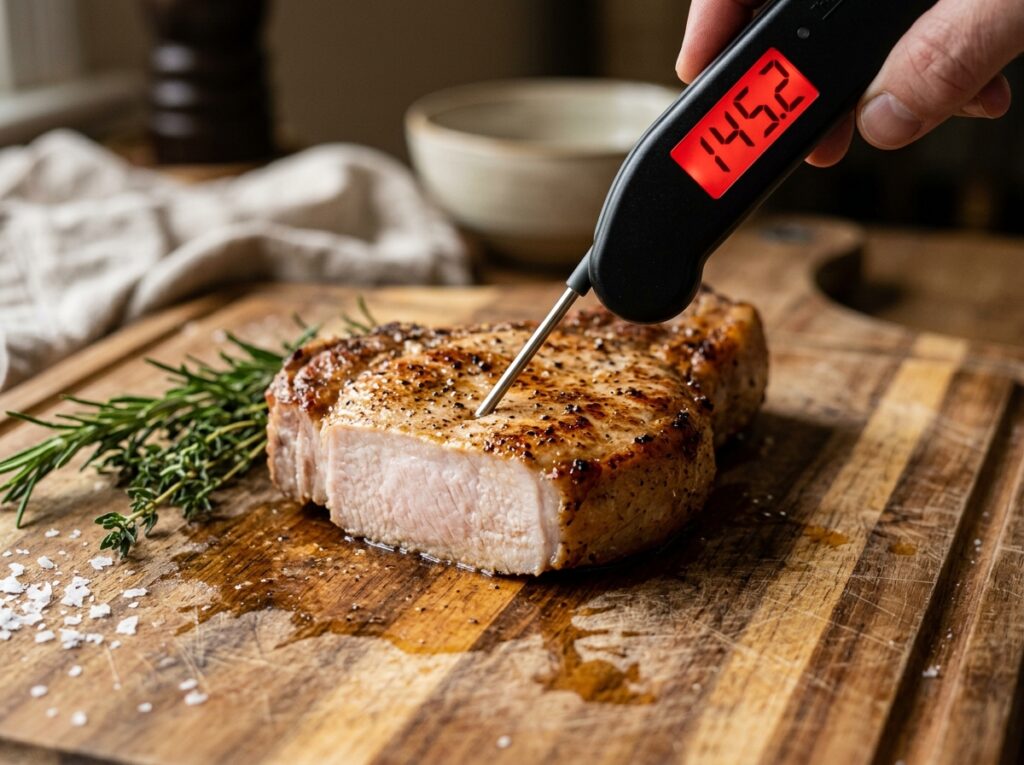
Internal Temp of a Pork Chop — Your Guide to Juicy, Safe Results
The USDA changed its recommended internal temperature for pork back in 2011 — from 160°F all the way down to 145°F. That’s a 15-degree difference. And yet, more than a decade later, millions of home cooks still overcook their pork chops into dry, tough discs because they never got the memo. If you’ve ever bitten into a pork chop that felt like chewing on cardboard, the problem wasn’t your recipe or your pan. It was your target temperature.
Getting the internal temperature of a pork chop right is honestly the single biggest factor between a disappointing dinner and one that makes people ask for your recipe. It’s not about fancy marinades or expensive cuts. It’s about knowing your numbers, using a thermometer, and trusting the science behind food safety.
This article is going to walk you through exactly what temperature you should cook your pork chops to, why that number matters, how the cooking method changes your approach, and a few practical tricks that make all the difference. Whether you’re grilling, pan-searing, baking, or using an air fryer — you’ll know exactly what to do by the time you’re done reading.
Why Internal Temperature Matters More Than Cooking Time
Here’s the thing most recipes get wrong — they give you a time. “Cook for 6 minutes per side.” “Bake for 25 minutes.” That sounds helpful, but it’s actually pretty unreliable.
Why? Because every pork chop is different. A thin, boneless chop from the grocery store is nothing like a thick, bone-in chop from your local butcher. A chop straight from the fridge cooks differently than one that’s been sitting at room temperature for 20 minutes. Your oven might run 15 degrees hotter than your neighbor’s. Your grill has hot spots.
Time is a rough estimate. Temperature is the truth.
When you measure the internal temperature of your pork chop with a meat thermometer, you’re not guessing. You’re getting a real-time snapshot of exactly what’s happening inside the meat. You know whether it’s safe to eat. You know whether it’ll be juicy or dry. You know whether to pull it off the heat or give it another minute.
That’s why professional chefs and pitmasters don’t rely on timers. They rely on thermometers. And if you want consistently great pork chops, you should too.
Quick fact: According to USDA data, pork is the third most consumed meat in the United States, behind chicken and beef. That’s a lot of pork chops being cooked every single day — and a lot of them being overcooked because people skip the thermometer.
The Right Internal Temperature for Pork Chops
Let’s get straight to the number you came here for.
The USDA-recommended internal temperature for pork chops is 145°F (63°C), followed by a 3-minute rest period. That’s it. That’s the gold standard for safety and quality.
At 145°F, the pork will look slightly pink in the center. And that’s completely fine. It’s safe. The pink color doesn’t mean the meat is raw or undercooked — it simply means you haven’t dried it out.
Now, if you prefer your pork chops a bit more done, you can aim for 150°F to 155°F. You’ll lose a little moisture, but the meat will be white all the way through. Some people genuinely prefer that, and that’s okay. It’s your dinner, your call.
But here’s the line you don’t want to cross: 160°F and above. Once your pork chop hits 160°F internally, the muscle fibers have squeezed out most of their moisture. The result is a dry, tough chop. This was actually the old USDA recommendation before 2011, and it’s the reason an entire generation grew up thinking pork chops were supposed to be chewy and bland.
They aren’t. You just have to stop overcooking them.
Pro Tip: If you’re curious whether a slightly pink pork chop is truly safe, check out this detailed piece on whether pork tenderloin can be pink. The same food science applies to pork chops.
What About Bone-In vs. Boneless Pork Chops?
The target internal temperature doesn’t change based on whether your chop has a bone or not. It’s still 145°F. But the way you get there? That does change, and it’s worth understanding why.
Bone-In Pork Chops
Bone conducts heat differently than meat. It actually acts as a bit of an insulator, which means the meat closest to the bone cooks slower than the rest of the chop. This is why you should always insert your thermometer near the bone — not in the thickest part away from it — to get the most accurate reading.
Bone-in chops are also generally thicker (usually 1 to 1.5 inches), so they take longer to reach 145°F. But here’s the upside: that extra thickness gives you a wider margin of error. You’re less likely to accidentally blast past your target temp the way you might with a thin cut.
Many cooks actually prefer bone-in chops because the bone adds flavor during cooking and helps the meat stay juicier. It’s the same principle behind why a bone-in steak or a chicken drumstick often tastes richer than its boneless counterpart.
Boneless Pork Chops
Boneless chops cook faster and more evenly. They’re convenient, easy to portion, and work great for quick weeknight dinners. But that speed is a double-edged sword. Because they’re thinner (often just ¾ inch), they can go from perfectly done to overcooked in about 60 seconds.
With boneless chops, you really need to be checking temperature early and often. Pull them at 140°F and let carryover cooking bring them up to 145°F during the rest. If you wait until the thermometer reads 145°F while they’re still on heat, they’ll likely end up closer to 155°F by the time you eat them.
Understanding Carryover Cooking (This Changes Everything)
Carryover cooking is one of the most important concepts in all of meat cookery, and yet most home cooks have never heard of it.
Here’s how it works: when you pull a pork chop off the heat, it doesn’t stop cooking immediately. The exterior of the meat is hotter than the interior, and that residual heat continues migrating inward. The internal temperature of your pork chop will rise by 3 to 7 degrees after you remove it from the heat source.
The exact amount of carryover depends on a few things — how thick the chop is, how high the cooking temperature was, and whether it has a bone. A thick, bone-in chop cooked on a screaming hot grill might climb 7 degrees during rest. A thin boneless chop from a medium pan might only climb 3 degrees.
So what does this mean practically?
Pull your pork chops off the heat at 140°F to 142°F. Then let them rest for 3 to 5 minutes. By the time you cut into them, they’ll be right at 145°F — perfectly safe and incredibly juicy.
If you pull them at 145°F, they’ll carry over to 150°F or higher. Still edible, but noticeably drier than they could’ve been. And if you pull them at 155°F (which many people do because they’re nervous about pink pork), you’re looking at a final temp of 160°F+. That’s overcooked territory.
The rest period isn’t just about temperature, either. Resting allows the muscle fibers to relax and reabsorb some of the juices that got pushed toward the center during cooking. If you cut into a pork chop straight off the grill, those juices flood out onto the cutting board. If you wait 3 to 5 minutes, they redistribute evenly throughout the meat.
Internal Temperature by Cooking Method
The target temperature stays the same regardless of how you cook your pork chops — 145°F, every time. But each method has its own quirks, and knowing those quirks helps you hit that number more consistently.
Grilling
Grilling is probably the most popular way to cook a pork chop, especially in summer. The high, direct heat creates a beautiful sear and some nice char marks. But it also makes it easy to overcook the exterior while the inside is still catching up.
The best approach for grilling pork chops is a two-zone setup. Sear the chops over direct high heat for about 2 to 3 minutes per side to get color and crust. Then move them to the cooler indirect side and let them finish gently until the internal temp hits 140°F. Close the lid to create an oven-like environment.
For thick bone-in chops (1.25 inches or more), this two-zone method is almost essential. You simply can’t cook them through with direct heat alone without burning the outside.
Pan-Searing (Stovetop)
Pan-searing gives you fantastic control. You can see and hear what’s happening in real time. Start with a heavy skillet — cast iron is ideal — over medium-high heat with a tablespoon of oil. Sear for 3 to 4 minutes per side, then reduce the heat and let the chops finish cooking gently.
One trick that works beautifully: after searing, add a tablespoon of butter, a crushed garlic clove, and a sprig of fresh thyme to the pan. Baste the pork chops with that flavored butter as they finish. This doesn’t just add flavor — the liquid butter also helps transfer heat more evenly across the surface.
Start checking your internal temperature once the chops have been cooking for about 6 to 8 minutes total. Remember, pull at 140°F.
Oven Baking
Baking pork chops at 400°F works really well, especially for thicker cuts. The even, surrounding heat of the oven means fewer hot spots and more predictable results.
For even better results, try a sear-then-bake approach. Get a hard sear on both sides in a hot skillet (about 2 minutes per side), then transfer the whole skillet into a preheated 400°F oven. This gives you the best of both worlds — a crusty, golden exterior and a gently cooked interior.
Boneless chops at 400°F usually take about 12 to 15 minutes in the oven. Bone-in chops can take 15 to 20 minutes. But again — use your thermometer, not the clock.
If you enjoy oven-cooking pork, you might also want to check out this guide on cooking pork tenderloin in the oven at 400°F. Lots of overlapping techniques there.
Air Fryer
Air fryers have become incredibly popular, and they actually do a great job with pork chops. The circulating hot air crisps the exterior while cooking the interior evenly.
Set your air fryer to 400°F and cook boneless chops for about 10 to 12 minutes, flipping halfway through. Bone-in chops might need 14 to 16 minutes. The key here is not to overcrowd the basket — give each chop enough space so the air can circulate around it.
Start checking internal temperature at the 8-minute mark. Air fryers are efficient, and things can go from perfect to overdone quickly.
Sous Vide
If you really want precision, sous vide is hard to beat. You set the water bath to your exact target temperature — say, 140°F — and the pork chop literally can’t overcook. It reaches that temperature and stays there.
Cook for 1 to 2 hours (depending on thickness), then finish with a quick 60-second sear on each side in a blazing hot skillet for color and crust. The result is edge-to-edge perfect doneness with zero guesswork.
Sous vide is a bit more hands-off and requires some equipment, but if you struggle with overcooking pork chops, it’s the most foolproof method available.
How to Use a Meat Thermometer Properly
Owning a meat thermometer is half the battle. Using it correctly is the other half. And honestly, a surprising number of people don’t know how to get an accurate reading.
Here’s what you need to know. Insert the probe into the thickest part of the pork chop, going in from the side rather than the top. You want the tip of the probe to be in the dead center of the meat — not touching bone, not poking through to the pan, and not sitting in a pocket of fat.
For thin chops (under ¾ inch), this can be tricky. You might need to insert the probe horizontally, going in through the side of the chop so the sensor stays in the center of the meat rather than picking up the temperature of the cooking surface.
If you’re using a bone-in chop, take readings in two spots — one near the bone and one in the thickest section of meat away from the bone. The lower reading is the one that matters.
An instant-read digital thermometer is your best friend here. They give you a reading in 2 to 3 seconds and are accurate to within a degree or two. The old dial-type thermometers work, but they’re slower and less precise.
If you haven’t used a meat thermometer before or want to make sure you’re reading it correctly, here’s a helpful walkthrough on how to read a meat thermometer.
Pro Tip: Don’t just check temperature once. Check it 2 to 3 times during cooking, especially as you get close to your target. The last 5 degrees happen fast.
Pork Chop Doneness Levels — A Visual and Temperature Guide
Not everyone wants their pork chop cooked to exactly the same level. Here’s a practical breakdown of what different internal temperatures look like and taste like:
140°F–145°F (Medium): Slightly pink center, very juicy, tender texture. This is what the USDA recommends (with a 3-minute rest from 145°F). Most chefs and food professionals prefer this range. The meat has a subtle blush and practically melts.
150°F–155°F (Medium-Well): Mostly white throughout with just a hint of pink. Still reasonably moist but noticeably firmer than 145°F. A solid choice if the idea of pink pork makes you uneasy but you still want decent texture.
160°F+ (Well Done): White all the way through, firm texture, significantly less juice. This was the old standard. Some people prefer it, and that’s their right — but from a culinary perspective, you’re sacrificing tenderness and moisture.
Below 140°F (Undercooked): Not recommended. While some restaurants serve pork at 135°F for premium heritage breeds, this isn’t safe for home cooking with standard supermarket pork.
Thickness Matters: Adjusting Your Approach
The thickness of your pork chop has a massive impact on how you should cook it. A ½-inch boneless chop and a 1.5-inch bone-in chop are basically two different ingredients that happen to come from the same animal.
Thin Chops (½ to ¾ inch)
These cook incredibly fast — often in just 3 to 4 minutes per side on a hot skillet. The margin for error is tiny. By the time you think to check the temperature, they might already be past 145°F.
Your best strategy with thin chops is high heat for a short time. Get a hard sear, flip once, and get them off the heat. Don’t walk away, don’t check your phone, don’t stir your side dish. Thin chops require your full attention.
Because they’re thin, carryover cooking is minimal — maybe 2 to 3 degrees at most. So you can pull them closer to 143°F and still end up right where you want to be.
Medium Chops (¾ to 1¼ inches)
This is the sweet spot for most home cooks. Thick enough that you have time to react, thin enough that they don’t take forever. The sear-and-finish method works perfectly here — high heat for color, then lower heat to gently bring the center up to temperature.
Thick Chops (1¼ inches and above)
These are where the two-zone approach really shines. Whether you’re on a grill, in a skillet, or using the oven, you need both high heat (for the crust) and moderate heat (for the interior).
With thick chops, carryover cooking is more significant. Pull them at 138°F to 140°F and let them rest for a full 5 minutes. They’ll coast up to 145°F beautifully.
Thick chops also benefit enormously from brining — either a wet brine (water + salt + sugar, soaked for 1 to 4 hours) or a dry brine (salt rubbed directly on the surface, refrigerated uncovered for 2 to 12 hours). Brining changes the protein structure and helps the meat retain moisture during cooking. It’s the single biggest trick for preventing dry pork chops, especially thick ones that spend more time on heat.
The Role of Cut Type in Temperature Management
Not all pork chops come from the same part of the pig, and the cut affects how they cook and how forgiving they are at different temperatures.
Rib chops come from the rib section and tend to have a nice fat cap and a section of loin meat. They’re flavorful and relatively forgiving because the fat keeps things moist even if you slightly overshoot your target temp.
Loin chops (sometimes called center-cut) look like a mini T-bone — they have a section of loin on one side of the bone and a smaller section of tenderloin on the other. The challenge here is that the tenderloin portion is thinner and cooks faster, so it can dry out while the loin side is still catching up. Position these with the loin side toward the hottest part of your heat source.
Shoulder chops (or blade chops) come from the shoulder area and have more connective tissue and fat running through them. They’re more forgiving and harder to overcook because that intramuscular fat keeps them moist. They’re also usually cheaper. Great choice if you’re still building your confidence with pork chop temperatures.
If you’re interested in how the shoulder area of the pig is used for other cuts, this article on pork cushion meat is a great read.
Sirloin chops come from the hip area and have a mix of muscles and a bit of bone. They can be a little uneven in texture, which makes hitting the right internal temperature across the whole chop a bit trickier. Not the best choice for beginners.
Common Mistakes That Lead to Overcooked (or Unsafe) Pork Chops
Let’s talk about the things that go wrong most often. If you can avoid these mistakes, you’ll be ahead of 90% of home cooks.
Cooking straight from the fridge. A cold pork chop hits the pan and the outside cooks way faster than the center. By the time the center reaches 145°F, the outer layers are at 180°F+. Let your chops sit at room temperature for 15 to 20 minutes before cooking. This helps them cook more evenly from edge to center.
Skipping the thermometer. “It looks done” isn’t a strategy. Neither is “it feels firm.” Use a thermometer. Always. Even experienced cooks use them.
Not accounting for carryover cooking. We covered this above, but it bears repeating. If you wait until your thermometer says 145°F while the chop is still on heat, you’re going to end up at 150°F+ after resting. Pull early.
Cutting into the chop to check doneness. Every time you cut into meat while it’s cooking, you create a channel for juices to escape. You’re literally draining your pork chop to see if it’s done. Use a thermometer instead and keep those juices where they belong.
Using the wrong heat level. Screaming high heat the entire time works for a thin chop but destroys a thick one. Match your heat to your chop’s thickness.
Safe Temperature for Stuffed Pork Chops
Stuffed pork chops are a slightly different animal (pun intended). Because the stuffing is inside the meat, it needs to reach a safe temperature too — and stuffing with any bread, vegetable, or especially any meat-based filling needs to hit 165°F at its center.
This means you can’t just check the pork itself. You need to insert your thermometer into the center of the stuffing. The pork around it will be well past 145°F by the time the stuffing is safe, which is why stuffed pork chops tend to be a bit less juicy than their unstuffed counterparts. That’s the tradeoff.
To compensate, use thick-cut chops (at least 1.5 inches), brine them beforehand, and cook at a moderate oven temperature (350°F to 375°F) so the heat has time to penetrate the stuffing without scorching the exterior.
Reheating Leftover Pork Chops Without Drying Them Out
Leftover pork chops are tricky. If you just microwave them, you’ll end up with something resembling a hockey puck. The microwave heats unevenly and drives out moisture fast.
A better method: wrap the pork chop loosely in foil with a splash of chicken broth or water, and warm it in a 275°F oven for about 10 to 15 minutes. The low, gentle heat brings the chop back up to eating temperature without pushing it further past its original doneness.
Alternatively, you can slice the leftover chop thin and quickly warm the slices in a skillet with a bit of butter over medium-low heat. Takes about 2 minutes and keeps things moist.
If you enjoy reheating tips, you’ll find similar techniques in this guide on how to reheat steak — the same principles of low heat and added moisture apply.
What the Experts and Food Scientists Say
The 145°F guideline isn’t just a number someone picked randomly. Food scientists at the USDA determined that pork held at 145°F for 3 minutes achieves the same pathogen kill rate as pork cooked to 160°F instantaneously. The key word there is time. The 3-minute rest isn’t optional — it’s part of the safety equation.
The primary concern with pork used to be Trichinella spiralis (the parasite that causes trichinosis). But modern farming practices have virtually eliminated this risk. USDA reports show that cases of trichinosis in the U.S. have dropped to fewer than 10 per year, and most of those are from wild game, not commercial pork.
The real concern now is Salmonella and other bacteria that live on the surface of the meat. Since pork chops are whole-muscle cuts (unlike ground pork, where bacteria can get mixed throughout), the bacteria are on the outside — and a proper sear kills them effectively even before the center hits 145°F.
This is also why the safety standards are different for ground meat versus whole cuts, and why ground pork should be cooked to 160°F while whole pork chops are safe at 145°F.
How Pork Chop Temperature Compares to Other Meats
Understanding where pork chops sit on the temperature spectrum helps put things in perspective. Here’s a quick comparison:
Pork chops (whole muscle) are safe at 145°F. Beef steaks are also safe at 145°F. Chicken and poultry need to reach 165°F because of how Salmonella behaves differently in poultry meat. Ground meats of any kind should reach 160°F (for beef and pork) or 165°F (for poultry) because grinding distributes bacteria throughout the meat.
Notice that pork chops and beef steaks have the same safety threshold? That surprises a lot of people. We’ve culturally accepted medium-rare steak for decades, but many people still think pork needs to be cooked to shoe-leather consistency. The science says otherwise.
For related pork cuts and their temperatures, check out this guide on internal pork butt temp and this one on internal temp for pork tenderloin. Different cuts, same principles.
FAQ
Is a pork chop safe to eat at 145°F?
Yes, absolutely. The USDA updated its guidelines in 2011 to reflect that pork cooked to 145°F with a 3-minute rest is safe to eat. At this temperature, harmful bacteria are effectively destroyed. The meat may appear slightly pink in the center, but pink doesn’t mean unsafe — it means you’ve cooked it properly.
How do I know when my pork chop is done without a thermometer?
Honestly? You don’t — not with any real accuracy. The touch test (pressing the meat and comparing its firmness to parts of your hand) gives you a rough idea, but it’s unreliable for pork because the difference between 140°F and 160°F is subtle to the touch. A basic instant-read thermometer costs less than $15 and eliminates all the guesswork. It’s one of the best investments you can make for your kitchen.
Should I cook pork chops to a different temperature for kids or elderly family members?
The USDA’s 145°F guideline applies to the general population, including healthy children and older adults. That said, individuals with severely compromised immune systems may be advised by their doctors to eat meat cooked to higher temperatures. If someone in your household has a specific health condition, check with their physician. For most families, 145°F with a proper rest period is perfectly safe.
Why are my pork chops always dry even though I follow the recipe?
The most common culprit is overcooking — either not using a thermometer, not accounting for carryover cooking, or both. Other factors include skipping the brine (especially for lean boneless chops), cooking cold meat straight from the fridge, and using too-thin cuts on high heat. Try brining your chops for an hour before cooking, letting them come to room temp, and pulling them at 140°F to rest.
What internal temperature should ground pork reach?
Ground pork should be cooked to 160°F — that’s 15 degrees higher than whole pork chops. Because grinding mixes any surface bacteria throughout the meat, you need a higher temperature to make sure everything is safe. No pink should remain in ground pork.
Your Pork Chops Deserve Better
If there’s one thing to take away from all of this, it’s simple: get a thermometer and trust 145°F. That one change will transform your pork chops from dry and disappointing to juicy and flavorful. It’s not about fancy technique or expensive equipment. It’s about knowing the right number and having the confidence to pull your meat off the heat when it hits that number — even if it looks a little pink.
Next time you cook pork chops, try it. Pull them at 140°F, rest for 5 minutes, and cut in. You’ll see the difference. You’ll taste the difference. And you’ll probably wonder why you ever cooked them any other way.