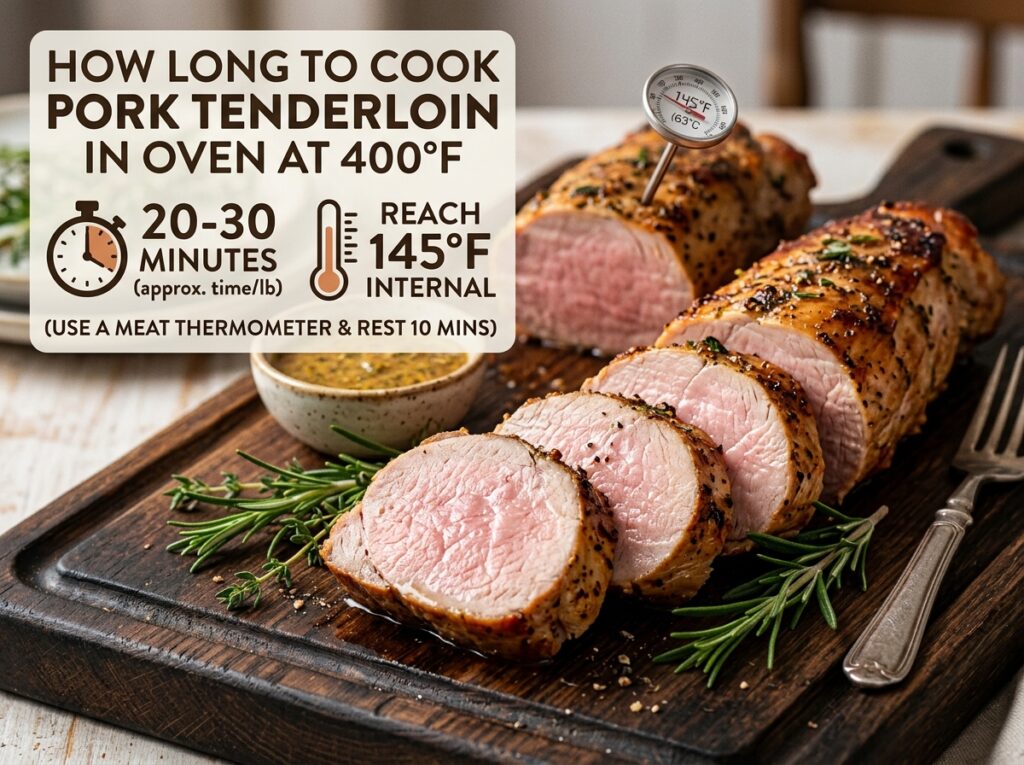
Pork Tenderloin in Oven at 400: Exact Time
A lot of home cooks still overcook pork, and that’s exactly why tenderloin ends up dry. If you’re trying to figure out how long to cook pork tenderloin in oven at 400, the short answer is about 20 to 27 minutes for most 1 to 1.5 pound tenderloins. But the clock alone won’t save dinner. The real target is 145°F in the thickest part, then a short rest before slicing.
How Long to Cook Pork Tenderloin in Oven at 400
Here’s the answer most people want right away: pork tenderloin at 400°F usually takes 20 to 27 minutes in a regular oven.
That range works for the average store-bought tenderloin, which is often around 1 to 1.5 pounds. Smaller ones cook faster. Thick ones need more time. If you’re cooking two at once, you’ll likely land near the upper end.
A simple timing guide helps, but don’t treat it like a law. Think of it as your GPS, not your final destination.
| Tenderloin size | Oven time at 400°F | Start checking temp |
|---|---|---|
| 3/4 to 1 pound | 18–22 minutes | 17 minutes |
| 1 to 1.5 pounds | 20–27 minutes | 18–20 minutes |
| 1.5 to 2 pounds | 25–30 minutes | 22–24 minutes |
| 2 small tenderloins | 23–30 minutes | 20–22 minutes |
Quick fact: most pork tenderloins sold in U.S. grocery stores fall into that 1 to 1.5 pound range.
If you want the safest, most reliable finish, pull it from the oven when the thickest part reaches 145°F. After that, let it rest for 5 to 10 minutes. The temperature will usually climb a little more as it sits.
A lot of ranking articles stop at “25 minutes.” That sounds helpful, but it misses the part that matters most: your tenderloin might be perfect at 21 minutes or dry at 29. A few minutes makes a big difference here.
Pork Tenderloin vs Pork Loin: Don’t Mix Them Up
This mix-up ruins a lot of dinners.
Pork tenderloin is a small, long, lean cut. It’s narrow, soft, and cooks fast. Pork loin is much larger, wider, and heavier. It takes a lot longer in the oven.
Warning: if you use pork loin timing for pork tenderloin, you’ll almost always overcook it.
Picture the difference like this: pork tenderloin is the weeknight cut. Pork loin is the Sunday roast.
A tenderloin is usually about 2 inches thick at its widest point. A pork loin can be several inches thick and weigh 3 to 5 pounds or more. Same animal, very different cooking job.
That confusion also shows up with chops. Pork chops come from the loin, and while the safe finish is similar, the cook time is not. If you make chops often too, this guide on internal temp for pork chops can help you keep those juicy as well.
Did you know? Many packages include two pork tenderloins, not one big roast. If you open the pack and see two skinny pieces, that’s normal.
So before you even preheat the oven, check the label. If it says pork loin, stop and don’t use the timing in this article.
What Changes the Cook Time?
Why do two tenderloins with almost the same weight sometimes finish minutes apart? A few things change the timing.
Thickness matters more than weight
A thick 1.25-pound tenderloin can take longer than a thinner 1.5-pound one.
That surprises people, but it makes sense. Heat has to travel to the center. A thick middle slows that down. A long, thin piece cooks faster even if it weighs a little more.
That’s why “minutes per pound” isn’t the best rule for pork tenderloin. It’s too skinny and uneven for that shortcut to work well every time.
Starting temperature changes the clock
A tenderloin straight from the fridge cooks slower than one that sat out for 15 to 20 minutes while you seasoned it.
You don’t need to leave meat out for an hour. That’s not the goal. Just know that fridge-cold meat can add a few minutes.
If the meat is still partly frozen in the center, timing gets messy fast. The outside can dry out before the middle is done. For even cooking, thaw it fully in the fridge first.
Your oven may not tell the whole truth
Some ovens run hot. Some run cool. Some have one corner that browns like crazy while the other side barely gets color.
If your pork always seems done earlier or later than recipes say, your oven may be the reason. An oven thermometer can clear that up fast.
Convection ovens also cook a little quicker. If you’re using convection, start checking 2 to 4 minutes earlier than the usual range.
Searing changes the timing a bit
A quick sear on the stove adds flavor and color. It also gives the meat a small head start.
If you sear for 1 to 2 minutes per side before roasting, the oven time may drop a little. Not by a huge amount, but enough that you should check early.
The pan matters too
A heavy skillet holds heat better than a thin sheet pan. That can speed up browning and help the meat cook more evenly.
Dark pans often brown the outside faster. Shiny pans tend to reflect more heat.
None of these factors changes the safe finish. They just change how soon you get there.
Best Way to Cook Pork Tenderloin in Oven at 400
If you want juicy pork tenderloin at 400, keep it simple. You don’t need a fancy method. You need dry surface, good seasoning, high enough heat, and a thermometer.
A simple step-by-step method
- Heat your oven to 400°F.
Give it time to fully preheat. A rushed oven adds guesswork. - Trim the silver skin if it’s still attached.
That thin shiny strip doesn’t soften well in the oven. It stays chewy. - Pat the tenderloin dry and season it.
Use a little oil, salt, pepper, garlic powder, and paprika if you like. Dry surface = better browning. - Roast it uncovered.
Set it on a sheet pan, baking dish, or oven-safe skillet. If you like easy cleanup, line the pan first. If you’re not sure what liner makes sense, this quick guide on butcher paper vs parchment paper clears that up. - Start checking the temperature early.
Use an instant-read thermometer in the thickest part. Don’t touch the pan and guess by color. If you need help with placement, here’s a simple guide on how to read a meat thermometer. - Pull it at 145°F and rest it.
Let it sit for 5 to 10 minutes before slicing. That rest keeps more juice in the meat instead of on the cutting board.
That’s the whole game.
If you want extra color, you can sear it in a hot skillet before it goes into the oven. If you want a sweet glaze, brush it on in the last 5 minutes so the sugar doesn’t burn.
A real timing example
Let’s say your pork tenderloin weighs 1.25 pounds.
You trim it, season it, and put it in a fully preheated 400°F oven. No sear. No stuffing. Just plain roasted tenderloin on a sheet pan.
In that case, start checking around 18 to 20 minutes. It will often finish around 22 to 25 minutes.
Now change one detail. Say you sear it for 4 minutes total before roasting. You may find it hits 145°F closer to 20 to 23 minutes in the oven.
That’s why recipes can feel a little slippery. The cut is small enough that tiny changes really matter.
Covered or uncovered?
Roast it uncovered.
Covering it from the start traps steam. Steam is great if you want soft braised meat. It’s not great if you want a nicely browned tenderloin.
If the top starts getting darker than you want near the end, lay a loose piece of foil over it. Don’t wrap it tight.
After it comes out, a loose foil tent during the rest is fine. Tight wrapping can soften the outside.
What Internal Temp Should Pork Tenderloin Reach?
The number to remember is 145°F.
As of 2026, USDA guidance for whole-muscle pork still says it’s safe to eat at 145°F with a 3-minute rest. Many home cooks rest it a little longer, around 5 to 10 minutes, because the texture is better and slicing is easier.
If you want a deeper breakdown, check this guide on the safe internal temperature for pork tenderloin.
A little pink can be totally fine
A lot of people still think pork has to be white all the way through. That’s old-school thinking.
Common misconception: if pork is slightly pink, it must be undercooked.
Not true.
Pork tenderloin can be light pink in the center and still be fully safe if it reached 145°F. Color depends on temperature, yes, but also on pH, lighting, how the meat was handled, and even your seasoning.
If that still feels strange, this article on can pork tenderloin be pink explains it in plain English.
Where to place the thermometer
Stick the thermometer into the thickest middle section of the tenderloin.
Don’t check the skinny tapered end. That part cooks faster and will mislead you. Don’t push the probe so far that it touches the pan, either. Metal skews the reading.
If the tenderloin has a curved shape, go in from the side if that gives you a better shot at the center.
Why resting matters
Fresh from the oven, the juices are moving around fast. Slice right away and they spill out.
Let the meat rest, and those juices settle back in. You get cleaner slices and better texture.
A short rest also lets the temperature finish evening out. Think of it like letting tea steep for one more minute off the heat. You’ve already done the main work, but that little pause improves the result.
If you’re cooking for kids, older adults, pregnant people, or anyone with a weaker immune system, don’t guess. Use the thermometer every time.
Mistakes That Dry Out Pork Tenderloin
Pork tenderloin is lean, which is great for quick cooking but not very forgiving. A few small mistakes can push it from juicy to chalky fast.
Cooking by time only
The timer helps, but it can’t see your meat.
One tenderloin may be done at 21 minutes. Another might need 27. If you only trust the clock, you’re gambling with dinner.
Use time as a guide. Use temperature as the final call.
Waiting for it to turn white all the way through
That old visual test leads to overcooked pork more often than not.
By the time tenderloin looks fully white and firm edge to edge, you’ve usually gone too far. The center should be just cooked through, not dried out.
Skipping the rest
This one seems harmless, but it matters.
If you cut into the tenderloin the second it leaves the oven, you lose moisture. The slices look wet on the board but feel drier in your mouth.
Give it at least 5 minutes. Ten is even better for a thicker piece.
Keeping it covered for the whole cook
People often cover lean meat because they’re afraid it will dry out.
That sounds logical, but with pork tenderloin it often does the opposite. Covered meat steams. The outside stays pale. Then people keep cooking longer to get color, and the center dries out before the surface looks right.
Roast uncovered. Tent loosely only if needed.
Leaving the silver skin on
If you’ve ever eaten tenderloin and found one chewy strip that doesn’t break down, that was probably silver skin.
It won’t melt away in a short roast. Remove it before cooking for better texture.
Starting with partially frozen pork
A frozen middle and warm outside is a bad combo here.
The thin ends overcook while the center struggles to catch up. If you forgot to thaw it, change the dinner plan or give yourself more time. Pork tenderloin really does best when thawed first.
Easy Sides and Leftovers
One reason people love pork tenderloin is that it fits weeknight dinner better than bigger roasts. You can build a full meal around it without spending all evening in the kitchen.
Easy sides that work well
Roasted green beans, broccoli, Brussels sprouts, apples, or carrots all pair well with pork tenderloin.
Potatoes work too, but they usually need more time than the pork. You can roast small potatoes first, or parboil them so they finish faster. If you want exact timing, this guide on how long to boil potatoes makes that part easy.
A simple dinner plan looks like this:
- Start your potatoes or root vegetables first
- Season the pork while the oven heats
- Add the tenderloin once the sides are already moving
- Let the pork rest while you finish the vegetables
That’s the kind of rhythm that makes a weeknight meal feel easy instead of rushed.
How to store leftovers
Leftover pork tenderloin keeps well in the fridge for 3 to 4 days if you cool it and store it properly in a sealed container.
Try to keep the slices a little thick. Thin slices dry out faster.
How to reheat without wrecking it
The best move is gentle heat.
Put slices in a skillet with a splash of broth, water, or even apple juice. Cover for a minute or two and warm them just until heated through.
The microwave works too, but use short bursts and cover the plate. Too much heat turns tenderloin tough in a hurry.
Cold leftovers aren’t a bad option either. Thin slices work great in sandwiches, wraps, salads, or grain bowls.
4. FAQ Section
How long do you cook a 1-pound pork tenderloin at 400?
A 1-pound pork tenderloin usually takes 18 to 22 minutes at 400°F. Start checking the internal temperature around the 17-minute mark so you don’t overshoot.
Is 400 too hot for pork tenderloin?
No, 400°F is a very good oven temperature for pork tenderloin. It cooks the meat fast enough to keep it juicy while still giving the outside some color.
Should pork tenderloin be pink in the middle?
Yes, it can be slightly pink and still be safe. What matters is that the thickest part reaches 145°F, not that the center turns completely white.
Do you cook pork tenderloin covered or uncovered?
Cook it uncovered for the best texture and browning. If needed, you can loosely tent it with foil after baking while it rests.
Can I cook two pork tenderloins at 400 at the same time?
Yes, you can. In most cases, two tenderloins will take about 23 to 30 minutes, depending on their size and how much space you leave between them on the pan. Always check the thicker one first.
Do I need to sear pork tenderloin before baking it?
No, you don’t have to. Searing adds flavor and color, but the tenderloin can still come out juicy and tasty without it if you roast it properly and pull it at 145°F.
5. Conclusion
If you remember just one thing, make it this: pork tenderloin at 400°F usually needs 20 to 27 minutes, but 145°F is the real finish line. Start checking early, roast it uncovered, and give it a few minutes to rest before slicing.
Next time you make it, trust your thermometer more than the timer. That one habit is what turns pork tenderloin from dry and forgettable into something you’ll actually want to cook again.