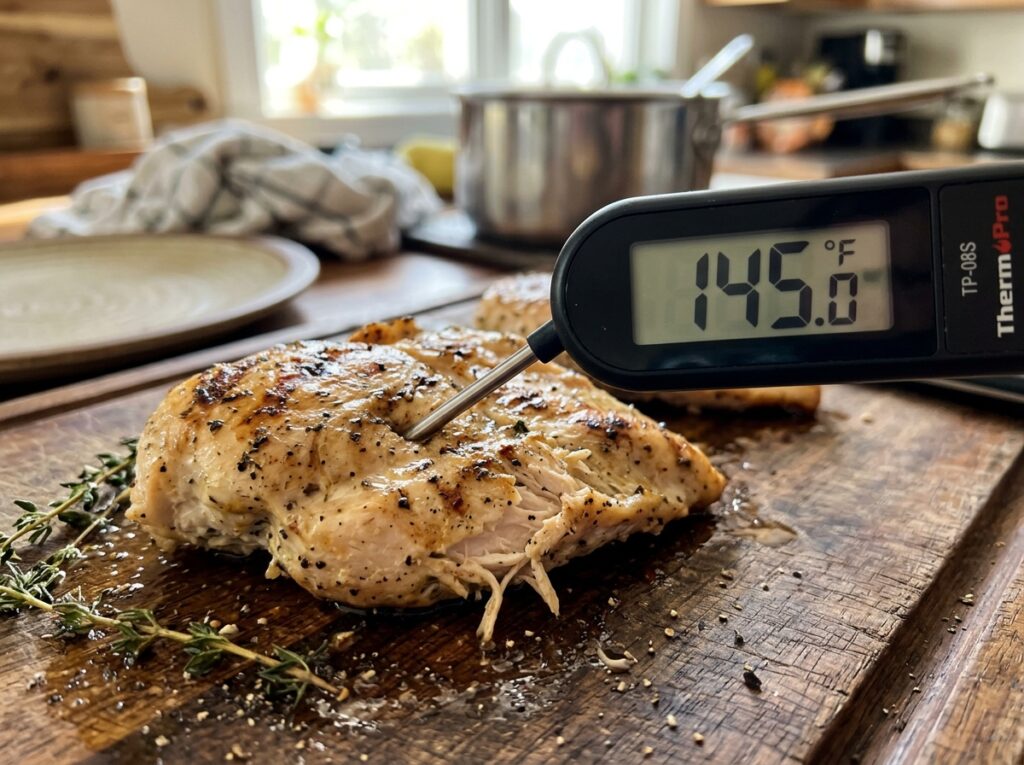
Is 145 Safe for Chicken? Not for Most Cooks
165°F isn’t the only number that can make chicken safe. That’s the part many people miss. If you’re asking is 145 safe for chicken, the honest answer is: not in most everyday cooking, but yes in one very specific setup. The trick is understanding that chicken safety is about temperature plus time, not just one quick thermometer reading.
Is 145 Safe for Chicken? What You Need to Know
Is 145 safe for chicken? The short answer
For normal home cooking, 145°F is too low for chicken if you plan to pull it off the heat and eat it right away.
That means if your chicken breast, thigh, drumstick, or whole bird reads 145°F in the thickest part, keep cooking. As of 2026, USDA and FDA consumer guidance still says poultry should reach 165°F (74°C).
So why do some cooks say 145°F can be safe? Because they’re talking about time-and-temperature pasteurization, usually in a sous vide setup where the temperature stays very steady.
Quick fact:
165°F is the simple home-cook rule for chicken.
145°F only works if the center of the chicken stays at that temperature long enough.
For most home cooking, the answer is no
Think about how most people cook chicken. You bake it, pan-sear it, grill it, smoke it, or air fry it. In those methods, the inside temperature keeps moving. It rises, stalls, and sometimes drops fast once the meat comes off the heat.
So if your thermometer flashes 145°F for a moment, that does not mean the chicken is ready.
A lot of people want a simple yes-or-no answer. Here it is:
- 145°F and served right away: not safe enough for standard chicken cooking
- 165°F in the thickest part: safe for home cooks
- 145°F held long enough with precision: can be safe
That middle line is still the easiest rule to trust on a busy weeknight.
The one case where 145°F can work
If you cook chicken in a carefully controlled water bath, like sous vide, the meat can become safe at a lower temperature if it stays there long enough.
That’s because harmful bacteria like Salmonella and Campylobacter don’t all die only at one magic number. They die faster at higher heat and slower at lower heat.
So yes, 145°F can be safe for chicken, but only if the coldest part of the meat stays at 145°F for the required hold time.
If you’re cooking for young kids, older adults, pregnant people, or anyone with a weaker immune system, it makes sense to stick with the simple USDA rule and aim for 165°F.
Why 165°F is the standard for chicken
Chicken safety is about bacteria, not color
The big food-safety worry with chicken is bacteria, especially Salmonella and Campylobacter. You can’t see them. You can’t smell them. And you definitely can’t judge them by the color of the juices.
That’s where a lot of people go wrong.
Some chicken still looks slightly pink even after it’s fully cooked. That can happen near the bone, after smoking, or with certain marinades. On the flip side, chicken can look white on the outside while the center is still undercooked.
So if you’ve been using the old “clear juices” trick, it’s time to retire it.
Did you know?
Smoked chicken can keep a pink ring even when it’s fully safe. Color alone doesn’t tell the full story.
165°F is the simple rule because it works fast
Here’s the kitchen version of the science: higher heat kills bacteria faster.
At 165°F, the kill step is basically instant for home-cooking purposes. That’s why the USDA uses it. It’s clear. It’s easy to remember. And it leaves less room for mistakes with thermometer placement, carryover cooking, and uneven heat.
You can think of it like this:
- 165°F is the shortcut
- 145°F is the slow route
Both roads can reach the same place, but one is far easier to trust.
There’s another reason this topic confuses people. A lot of readers mix chicken up with pork. Pork often gets the 145°F + rest time treatment, which is why that number shows up all over Google.
If that’s where your confusion started, you’re not alone. The rules for pork are different from poultry. If you’ve ever wondered whether pork tenderloin can be pink, that’s a separate food-safety question with a different answer.
A quick word on carryover cooking
Carryover cooking is real. Meat often keeps rising a few degrees after you remove it from the oven or grill.
But carryover is not something you should blindly assume.
A thick chicken breast might rise a few degrees while resting. A thin cutlet might barely rise at all. So if you pull chicken at 145°F and hope resting will somehow make it safe, you’re guessing.
And food safety isn’t a great place to guess.
Can 145°F ever be safe for chicken? Yes, if time is controlled
How time and temperature work together
This is the part most short answers leave out.
Chicken doesn’t become safe only at one exact number. It becomes safe once heat has destroyed enough harmful bacteria. That can happen at different temperatures, as long as the meat stays there long enough.
That process is called pasteurization.
Don’t let the word scare you. In plain English, it just means the chicken has spent enough time at a hot enough temperature to make it safe to eat.
A rough way to picture it: high heat is like cleaning a stain with strong pressure. Lower heat can still do the job, but it takes more time.
Here’s the rough idea for chicken pasteurization once the coldest part reaches the target temp:
- 165°F: almost instant
- 160°F: about 15 seconds
- 155°F: about 50 seconds
- 150°F: about 3 minutes
- 145°F: about 9 to 10 minutes
Those numbers can vary a little depending on the table being used, but the big point stays the same: 145°F only works if the center holds there long enough.
How long does chicken need at 145°F?
For practical home cooking, think about 9 to 10 minutes at 145°F after the center of the chicken reaches that temperature.
That last part matters a lot.
If a thick chicken breast takes 50 minutes to heat through and the center only reaches 145°F at minute 50, your timer starts then, not at the beginning of the cook.
People often miss that.
A quick thermometer check that says 145°F for two seconds isn’t the same as holding the chicken at 145°F.
Let’s make it real.
Say you’re roasting a thick chicken breast in the oven. You check the middle and it reads 145°F. If you pull it out right there, the center probably has not stayed at 145°F long enough to count as pasteurized.
Now picture sous vide chicken. The whole point of sous vide is stable temperature. Once the center reaches 145°F, it can stay there long enough to become safe without overshooting.
That’s why chefs and serious home cooks can use lower temperatures with confidence in that setup.
Why sous vide changes the answer
Sous vide is what makes the 145°F conversation make sense.
A water bath set to 145°F holds food at a very steady temperature. That gives you control over both parts of the safety equation:
- the temperature
- the time
In a skillet or on a grill, the outside gets much hotter than the center. In sous vide, the chicken warms more evenly. That makes it easier to keep the coldest part of the meat at the target temperature long enough.
Still, even in sous vide, 145°F isn’t always the best choice for texture.
Chicken breast at 145°F can be very juicy, but some people find it a little soft. Many cooks prefer 150°F to 155°F for a firmer bite while still keeping the meat moist.
Dark meat is a different story.
What about thighs and drumsticks at 145°F?
Even if you held dark meat long enough to make it safe, 145°F usually won’t give you good texture.
Thighs and drumsticks have more connective tissue and fat than breast meat. They tend to taste better around 175°F to 185°F, where that tougher tissue has time to soften.
So if you’re cooking thighs and aiming for 145°F, you may solve the safety math in theory but still end up with meat that feels rubbery or underdone.
If texture has been giving you trouble, temperature may be only part of the issue. These tips on chewy chicken causes and fixes can help you sort out what’s happening.
What to do if your chicken only reached 145°F
If it’s in the oven, pan, air fryer, grill, or smoker
Keep cooking it.
That’s the best answer in most cases.
If you’re making regular baked or grilled chicken, don’t try to do mental math around hold times unless you’re using precise low-temp cooking. Bring the thickest part to 165°F, especially with bone-in pieces or uneven cuts.
For chicken breast, many cooks pull it around 160°F to 162°F and let carryover cooking finish the job. That can work well, but check again before serving. Don’t assume the temperature rose enough.
If you want a better sense of oven timing, this guide for baking chicken breast at 350 can help you avoid undercooking or drying it out.
If you’re using sous vide
Then the question changes from “Did it hit 145?” to “Did the center stay at 145 long enough?”
That means you need to account for:
- the time it takes the chicken to heat through
- the hold time after the center reaches 145°F
If you’re not sure, the safest move is simple: leave it in longer. In sous vide cooking, extra time within a reasonable range is usually less risky than pulling it too soon.
If you already sliced into it and found 145°F
No need to panic. You can still fix dinner.
Put the chicken back on the heat and finish cooking it. Use a lower, gentler heat if you’ve already cut into it, since sliced meat can dry out faster.
Try not to rely on appearance after cutting. The inside may look more done than it really is, or less done than it really is. Trust the thermometer.
If someone already ate it
One undercooked bite doesn’t guarantee you’ll get sick. Still, it does raise the risk.
Most healthy adults may be fine, but it’s smart to watch for symptoms like nausea, stomach cramps, vomiting, diarrhea, or fever. If the person who ate it is in a high-risk group or starts feeling ill, contact a medical professional.
Food safety note: This article is general cooking guidance, not personal medical advice. For high-risk households, stick closely to USDA and FDA recommendations.
Cooking temperature can’t fix bad storage
This part gets overlooked all the time.
If the chicken was handled badly before cooking, reaching 165°F doesn’t erase every mistake. Safe cooking matters, but safe storage matters too.
So if your chicken sat out for hours, that’s a different problem. Read this on chicken left out overnight before you decide to cook it anyway.
And if you’re not sure how long raw poultry lasts after thawing, here’s a helpful guide to thawed chicken in the fridge.
Best safe temperatures for different chicken cuts
Chicken breast
Chicken breast is the cut most people worry about because it dries out fast.
For standard home cooking, the safe target is still 165°F. If you want it juicier, don’t just stop at 145°F and hope for the best. Use a good thermometer, pull it a bit before the final temp if carryover will help, and rest it briefly.
If you want to use low temperatures on purpose, sous vide makes more sense. In that case, many cooks like breast meat in the 145°F to 155°F range, depending on the texture they want.
Here’s the simple version:
- Regular baking, grilling, pan cooking: aim for 165°F
- Sous vide with proper hold time: 145°F can be safe
- Best texture for many people in sous vide: often closer to 150°F to 155°F
Thighs and drumsticks
Safety starts at 165°F, but tenderness usually improves above that.
A thigh cooked to only 145°F may be technically workable in a strict time-and-temp setting, but it probably won’t eat well. The meat can feel tight, slippery, or underdone in a way that turns people off.
That’s why plenty of cooks take thighs and drumsticks to 175°F or more. You’re not ruining them. You’re usually improving them.
Whole chicken
A whole bird can fool you because different parts cook at different speeds.
The breast might be ready before the thighs. One side might cook faster than the other. So don’t take one quick reading and call it done.
Check the thickest part of the breast and the inner thigh, without touching bone. If you see 145°F, keep going.
Ground chicken
Ground chicken is the easiest call of all: cook it to 165°F.
That includes chicken burgers, meatballs, sausage, and any dish where the meat has been ground up. Grinding spreads bacteria throughout the meat, so you don’t want to play around with borderline temps unless you’re working with professional-level controls and validated methods.
For everyday home cooking, 145°F is not the target for ground chicken.
How to check chicken the right way
Put the thermometer in the coldest likely spot
Most people don’t actually have a temperature problem. They have a measurement problem.
Insert your thermometer into the thickest part of the meat. Stay away from bone, because bone can throw off the reading. With chicken breast, sliding the probe in from the side often gives a more accurate center reading than poking straight down from the top.
If your thermometer skills could use a refresh, this guide on how to read a meat thermometer makes it much easier.
Pro tip:
For thin breasts or cutlets, go in from the side so the probe tip lands in the center, not straight through it.
Common mistakes that lead to bad readings
A few easy mistakes cause a lot of food-safety confusion.
Touching the pan, tray, or bone can make the reading seem hotter than the meat really is. Checking only one spot can miss a cooler center. Pulling the chicken early because the outer layer is hot is another classic mistake.
And then there’s the color trap.
You might cut into the chicken, see white meat, and assume it’s done. Or you might see a little pink and assume it isn’t. Both guesses can be wrong.
The thermometer is your best friend here.
A better routine for home cooks
If you want a low-stress method, use this approach:
Check the chicken a little before you think it’s done. Probe the thickest part in more than one place. If the lowest reading is under 165°F, give it more time. Rest it briefly, then check again if needed.
That simple habit beats cutting into the meat, losing juices, and still not knowing whether it’s safe.
4. FAQ Section
FAQ
Is chicken safe at 145°F if it rests for 3 minutes?
Usually, no. That 145°F plus a short rest rule is commonly linked with pork, not standard chicken guidance. For chicken, 145°F only works if the center stays there for about 9 to 10 minutes. A quick 3-minute rest doesn’t reliably do that.
Can chicken be pink and still be safe?
Yes. Chicken can still look pink near the bone, after smoking, or because of certain marinades, even when it’s fully cooked. The only reliable check is the internal temperature and, if using lower-temp cooking, the correct hold time.
Is 150°F safe for chicken?
It can be, yes. At 150°F, chicken can become safe if it stays there for roughly 3 minutes after the center reaches that temperature. For most home cooks, though, 165°F is still the easier and safer target to follow without doing time-and-temp calculations.
What if my chicken reads 145°F after I take it out of the oven?
If you cooked it in a normal oven, skillet, grill, or smoker, treat that as not done yet unless you know it held at that temperature long enough. Put it back on the heat and keep cooking until the thickest part reaches 165°F, or verify a proper time-and-temp method.
Is 145°F safe for sous vide chicken?
Yes, it can be. Sous vide is the main situation where 145°F chicken makes sense because the temperature stays stable. The center of the chicken still needs to reach 145°F and stay there long enough to pasteurize. Don’t count the full cooking time as hold time.
5. Conclusion
If you’re cooking chicken the usual way tonight, keep it simple: 145°F is not the finish line. Use a thermometer and take the thickest part to 165°F, especially for baked, grilled, pan-cooked, or smoked chicken.
Save 145°F for precise cooking methods like sous vide, where you can control both time and temperature. One careful thermometer check can spare you dry chicken, bad guesses, and a rough next day.