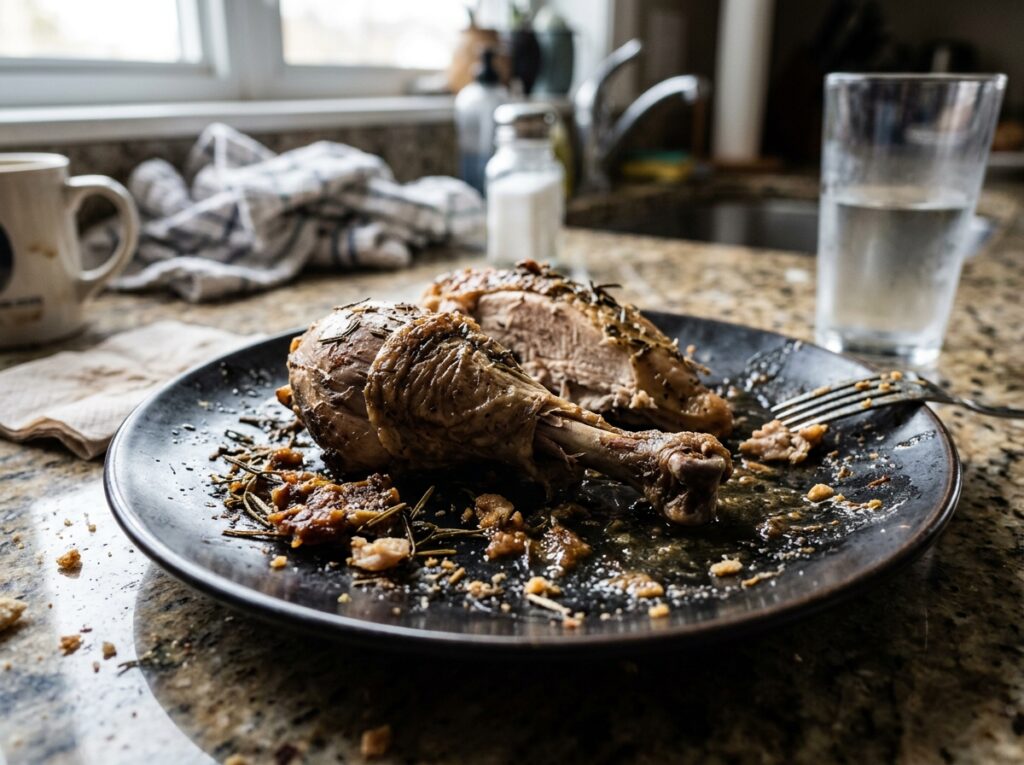
Chicken Left Out Overnight — Is It Safe to Eat?
You cooked a beautiful dinner, had a great time, maybe watched a movie afterward — and then you see it. The chicken. Sitting right there on the counter. All night. Your stomach drops a little, and one question immediately pops into your head: Can I still eat this?
You’re definitely not the only one asking. This is actually one of the most searched food safety questions on the internet, and for good reason. Chicken is one of the most commonly consumed proteins in the world, and it’s also one of the most common causes of foodborne illness. So that plate of chicken sitting on your counter all night? It deserves a serious, honest answer.
Let’s talk about what really happens to chicken when it sits out overnight, what science says about it, and exactly what you should do next.
What Happens to Chicken When It Sits at Room Temperature
Here’s the part most people don’t think about — bacteria don’t take a break just because you forgot. The moment cooked or raw chicken hits what food safety experts call the “Danger Zone” (between 40°F and 140°F, or 4°C to 60°C), bacteria start multiplying. And they do it fast.
According to the USDA (United States Department of Agriculture), bacteria like Salmonella, Staphylococcus aureus, E. coli, and Clostridium perfringens can double in number every 20 minutes at room temperature. That means a small, harmless population of bacteria on your chicken can grow into millions within just a few hours.
By the time your chicken has been sitting on the counter for an entire night — let’s say 7 to 10 hours — the bacterial count can be astronomical. And here’s the kicker: you can’t see, smell, or taste most of these bacteria. The chicken might look perfectly fine. It might smell totally normal. But it can still make you very sick.
Think of it like this: if one bacterium becomes two every 20 minutes, after just 6 hours you could be looking at over 250,000 bacteria from a single cell. After 8 hours? Millions. That’s not a risk worth taking.
The Two-Hour Rule — And Why It Exists
The USDA and the FDA (Food and Drug Administration) both follow what’s called the Two-Hour Rule. It’s simple: perishable food — including all types of chicken — shouldn’t sit out at room temperature for more than two hours. If the room is warmer than 90°F (32°C), that window shrinks to just one hour.
After that, the food enters unsafe territory and should be thrown away. No exceptions.
This rule applies to both raw chicken and cooked chicken. It also applies to chicken that’s been marinated, seasoned, breaded, or prepared in any way. Whether it’s a grilled chicken breast, a rotisserie chicken from the store, fried chicken, or raw chicken thighs you were planning to cook tomorrow — the two-hour rule is your line in the sand.
So if your chicken sat out overnight — which is well beyond two hours — the answer is pretty clear. But let’s go deeper because I know you probably still have questions.
Can You Cook Bacteria Away?
This is the question that trips most people up. And honestly, the logic seems to make sense on the surface. If cooking kills bacteria, why can’t you just reheat chicken that sat out all night and make it safe again?
Here’s the problem: cooking kills bacteria, but it doesn’t destroy bacterial toxins.
Some bacteria, especially Staphylococcus aureus, produce toxins as they multiply. These toxins are heat-stable, meaning they can survive even at boiling temperatures. So even if you cook that chicken to 165°F internally — which is the safe cooking temperature recommended by the USDA — those toxins remain. And those toxins are what actually make you sick.
Clostridium perfringens is another one to watch out for. It’s one of the most common causes of food poisoning in the United States, responsible for roughly one million cases per year according to the CDC (Centers for Disease Control and Prevention). It thrives in food that’s been left at room temperature too long, especially in large portions of cooked meat that cool slowly.
So no, reheating or re-cooking the chicken doesn’t make it safe. The damage is already done at a microscopic level.
Raw Chicken vs. Cooked Chicken Left Out — Is There a Difference?
Both are unsafe after sitting out overnight, but the risks are slightly different.
Raw chicken is already a high-risk food. It commonly carries Salmonella and Campylobacter even when properly refrigerated. Leaving it at room temperature overnight gives these bacteria a perfect breeding ground. On top of the safety issue, raw chicken left out overnight will also start to deteriorate in texture and quality. You might notice a slimy film, a slightly off color, or a sour smell — but again, absence of these signs doesn’t mean the chicken is safe.
Cooked chicken might seem less risky because it was already heated to a safe temperature. But once it cools down and sits in the danger zone, new bacteria can colonize it, and existing spore-forming bacteria (like Clostridium perfringens) that survived cooking can start growing. Cooked chicken is actually a very common culprit in food poisoning outbreaks, precisely because people assume it’s “already safe.”
The bottom line? Whether raw or cooked, chicken left out overnight should go in the trash. No smell test. No taste test. No “just reheat it really well” workarounds. If you’re looking for the right way to store cooked chicken, knowing how long fried chicken lasts in the fridge can help you plan better next time.
What About Marinated or Brined Chicken?
Some people wonder if marinades — especially acidic ones with vinegar, citrus, or wine — offer some protection. After all, acid kills bacteria, right?
Not enough. While acidic marinades can slow bacterial growth slightly, they don’t stop it. A lemon juice marinade isn’t going to prevent Salmonella from multiplying over an 8-hour stretch at room temperature. The acid concentration in typical kitchen marinades isn’t high enough to act as a preservative.
The same goes for salt brines. Yes, salt inhibits certain bacteria, but a typical brine for flavor purposes isn’t salty enough to preserve meat the way commercial curing does. Unless you’re literally salt-curing chicken like a preserved meat product (which nobody does at home for dinner prep), a brine won’t protect your chicken overnight on the counter.
The Real Risks — What Foodborne Illness Looks Like
Let’s talk about what actually happens if you eat chicken that’s been left out too long. Food poisoning from contaminated chicken can range from mildly unpleasant to genuinely dangerous, depending on the type of bacteria involved and your overall health.
Salmonella infection typically shows up 6 to 72 hours after eating contaminated food. Symptoms include diarrhea, stomach cramps, fever, nausea, and vomiting. Most healthy adults recover within 4 to 7 days, but it can lead to hospitalization — especially in young children, elderly adults, pregnant women, and people with weakened immune systems.
Staphylococcal food poisoning hits faster, often within 1 to 6 hours. You’ll likely experience severe nausea, vomiting, stomach cramps, and diarrhea. The good news is it usually passes within 24 hours. The bad news? Those hours are pretty miserable.
Clostridium perfringens poisoning usually causes intense stomach cramps and diarrhea within 6 to 24 hours. It generally resolves on its own, but can be dangerous for older adults and people with compromised health.
Campylobacter infections can cause bloody diarrhea, fever, and cramping that lasts up to a week. In rare cases, it can trigger Guillain-Barré syndrome, a serious neurological condition.
Is a piece of leftover chicken worth all that? Definitely not.
“But My Grandma Always Left Chicken Out and Nobody Got Sick”
You’ve probably heard this one before. Maybe you’ve even said it yourself. And look, it’s true that many people have eaten food that sat out too long and been totally fine. But that’s survivorship bias, not proof of safety.
Just because someone didn’t get sick doesn’t mean the food was safe. It means they got lucky. The bacteria might not have reached dangerous levels yet, or their immune system fought it off without obvious symptoms. But every time you eat food that’s been in the danger zone too long, you’re rolling the dice.
Food safety guidelines exist because they’re based on controlled research, not anecdotal stories. The USDA, FDA, and CDC didn’t set these rules arbitrarily. They’re based on decades of microbiology research and outbreak data.
And honestly, our grandparents’ generation also had a lot more stomach bugs and “24-hour flus” that were probably food poisoning. They just didn’t always know it.
What Should You Actually Do With Chicken Left Out Overnight
Let’s keep this practical. If you wake up and find chicken on the counter from last night, here’s what to do.
Throw it away. Don’t smell it. Don’t taste a small piece to check. Don’t convince yourself it’s fine because the room was cold. Unless you can verify the chicken was in an environment consistently below 40°F (like an unheated garage in winter that stayed cold all night), the safe move is to discard it.
Wrap it up, toss it in the garbage, and wash your hands. If it was on a plate or cutting board, clean that surface thoroughly with hot soapy water and sanitize it.
Yes, it feels wasteful. Nobody likes throwing away food, especially good food. But a trip to the emergency room — or even just 24 hours of vomiting — is a much bigger waste of your time, money, and wellbeing.
How to Prevent This From Happening Again
The best food safety strategy is prevention. Here are some practical habits that’ll help you avoid the dreaded morning-after chicken discovery.
Set a phone alarm. If you’re serving chicken at a party or dinner, set a reminder for two hours out. When that alarm goes off, pack up the leftovers immediately.
Use the “clean as you go” approach. Instead of leaving everything out until after the movie or dessert, put the chicken away right after everyone has served themselves. It takes 30 seconds to put a container in the fridge.
Portion before you store. Large quantities of hot chicken take a long time to cool down in the fridge, which can keep the center in the danger zone longer. Divide it into smaller, shallow containers so it cools faster. The USDA recommends using containers that are two inches deep or less for quick cooling.
Don’t wait for food to cool completely before refrigerating. This is one of the biggest misconceptions. Modern refrigerators are designed to handle warm food. You don’t need to wait until the chicken reaches room temperature. In fact, waiting is exactly what creates the problem. Put it in the fridge while it’s still warm — just don’t put a giant, steaming pot directly in, as that can temporarily raise the fridge’s internal temperature and affect other food. Using shallow containers solves this perfectly.
If you frequently cook chicken in batches, it helps to understand how long thawed chicken lasts in the fridge so you can plan your cooking schedule more safely.
How to Store Chicken the Right Way
Proper storage isn’t complicated, but it does require a little attention. Here’s how to handle chicken safely, whether it’s raw or cooked.
For raw chicken, keep it in its original packaging or a sealed container on the lowest shelf of your fridge. This prevents any juices from dripping onto other food. Raw chicken should be stored at or below 40°F and used within 1 to 2 days of purchase, according to the USDA. If you’re not going to cook it within that window, freeze it.
For cooked chicken, let it cool slightly (no more than 30 minutes on the counter), then transfer it to an airtight container and refrigerate. Cooked chicken stays safe in the fridge for 3 to 4 days. After that, the quality and safety both decline.
If you’re freezing cooked chicken, it’ll stay safe indefinitely, but quality is best within 2 to 6 months. Label your containers with the date so you don’t lose track.
And here’s a pro tip: always use a meat thermometer when cooking chicken. The safe internal temperature is 165°F (74°C), and that’s non-negotiable. Guessing by color or “firmness” isn’t reliable. If you’re not sure how to use one, check out this guide on how to read a meat thermometer — it’s simpler than you think and saves you a lot of guesswork.
Special Situations — What About Overnight in a Car, Lunchbox, or Oven?
People don’t always leave chicken on the kitchen counter. Sometimes it’s in a lunchbox that got left in a backpack. Sometimes it’s in the car after grocery shopping. Sometimes it’s in the oven that was turned off hours ago. Let’s address these.
Chicken left in a car overnight: This is actually worse than the counter in most cases. Cars can get extremely warm, even at night in warmer climates. If the temperature inside the car was above 40°F at any point for more than two hours — toss it.
Chicken in a lunchbox: Unless the lunchbox had a proper ice pack that kept the chicken cold the entire time, it’s not safe after sitting out all day. Insulated lunch bags help, but they don’t keep food cold indefinitely. Most ice packs lose their chill within 4 to 5 hours.
Chicken left in a turned-off oven: The oven might feel like a sealed, “clean” environment, but it’s not a refrigerator. A turned-off oven is essentially just an insulated box at room temperature. The chicken is still in the danger zone and still growing bacteria. Same rules apply — if it’s been more than two hours, throw it out.
What About Other Foods Left Out — Is Chicken Really That Risky?
Chicken is one of the higher-risk foods, but it’s not the only one. All perishable foods follow the same two-hour rule. That includes other meats, dairy, cooked rice, eggs, cut fruits, and prepared salads.
That said, chicken is particularly risky because of its strong association with Salmonella and Campylobacter. According to CDC data, chicken is the most common source of Salmonella outbreaks linked to a single food. About 1 in 25 packages of chicken at the grocery store is contaminated with Salmonella.
So while you should treat all perishable food with the same caution, chicken deserves a little extra respect. If you’re curious about safe storage for other kitchen staples, you might find it helpful to learn how long cooked rice lasts in the fridge or how long salsa stays good — similar principles apply across the board.
Safe Internal Temperatures — A Quick Reference
Since we’re talking about chicken safety, it’s worth mentioning that proper cooking temperature is your first line of defense. You want to make sure your chicken hits the right internal temp before you even think about storing it.
The USDA recommends 165°F (74°C) as the minimum safe internal temperature for all chicken — breasts, thighs, drumsticks, wings, ground chicken, and stuffing that contains chicken. This temperature kills the major bacteria of concern, including Salmonella and Campylobacter.
Some people have started debating lower temperatures held for longer times (like pasteurization curves used in sous vide cooking), and while there’s science behind that approach, it requires precise equipment and timing. For standard home cooking — oven, grill, stovetop — stick with 165°F and use a good meat thermometer to confirm.
If you’ve ever wondered whether 145°F is safe enough for chicken, that’s a topic worth reading about separately. The short answer: it’s complicated, and for most home cooks, 165°F is the safest target.
Want to get your chicken perfectly cooked every time? Here’s a helpful resource on how long to bake chicken breast at 350°F that gives you reliable timing and temperatures.
Who’s Most at Risk From Eating Spoiled Chicken?
While anyone can get food poisoning, certain groups face a much higher risk of serious complications. The CDC identifies four high-risk groups:
Young children (under 5): Their immune systems are still developing, so their bodies can’t fight off foodborne bacteria as effectively. Salmonella infection in young children can lead to severe dehydration and even hospitalization.
Adults over 65: Aging weakens the immune system and reduces stomach acid production, which is one of the body’s first defenses against ingested bacteria.
Pregnant women: Pregnancy changes the immune system in ways that make certain infections more likely and more dangerous. Listeria, which can also grow on improperly stored chicken, poses a particular risk to pregnant women.
People with weakened immune systems: This includes anyone undergoing chemotherapy, living with HIV/AIDS, taking immunosuppressive medications, or managing chronic conditions like diabetes or kidney disease.
If anyone in your household falls into these categories, food safety becomes even more critical. The two-hour rule isn’t just a suggestion — it’s essential protection.
A Note on Food Waste and Guilt
I want to acknowledge something real. Throwing away food feels terrible, especially if you’re on a tight budget or you put effort into preparing a meal. The guilt is understandable.
But here’s the thing — the cost of food poisoning is almost always higher than the cost of the chicken you’re throwing away. A single ER visit in the United States averages over $2,000. Even a milder case means missed work, lost productivity, and genuine physical misery.
The smarter approach is to focus on preventing waste in the first place. Cook smaller portions. Set reminders. Store leftovers promptly. Plan your meals around what’s already in the fridge. These habits save food and keep you safe.
If you’re cooking chicken regularly and want to buy smart, understanding how many chicken breasts are in a pound can help you portion your purchases better so less goes to waste.
FAQs
Can I eat cooked chicken left out for 4 hours?
No. The USDA’s two-hour rule is the maximum safe window for perishable food at room temperature. After four hours, bacterial growth is well into unsafe territory. Even if the chicken looks and smells fine, harmful bacteria and their toxins may already be present. It’s not worth the risk.
Does reheating chicken that sat out overnight kill the bacteria?
Reheating can kill active bacteria, but it won’t destroy heat-resistant toxins produced by bacteria like Staphylococcus aureus during those hours on the counter. These toxins cause food poisoning symptoms regardless of how thoroughly you reheat the food. Once chicken has been in the danger zone for more than two hours, reheating doesn’t make it safe.
How can I tell if chicken has gone bad?
Spoiled chicken often shows signs like a slimy or sticky surface, a grayish or greenish color change, and a sour or sulfur-like smell. But here’s the critical point — bacteria that cause food poisoning don’t always produce visible or detectable changes. Chicken can look, smell, and taste perfectly normal and still be contaminated. When in doubt, throw it out.
Is it safe to eat chicken left out overnight if my house was very cold?
Unless your house was consistently at or below 40°F (4°C) all night — which is basically refrigerator temperature — the answer is no. Most homes, even in winter, stay between 60°F and 72°F indoors, which is well within the bacterial danger zone. Don’t rely on “it felt cold in here” as a food safety measure.
Can I feed chicken left out overnight to my pets?
This isn’t recommended either. Dogs and cats can also get foodborne illness from Salmonella and other bacteria, even though they may be slightly more tolerant than humans. The AVMA (American Veterinary Medical Association) advises against feeding pets food that wouldn’t be considered safe for human consumption.
Your Chicken, Your Call — But the Science Is Clear
Look, nobody’s going to stand in your kitchen and stop you from eating that chicken. You’re an adult. But the science on this topic is really straightforward, and every major food safety authority in the world agrees: chicken left out at room temperature for more than two hours — let alone an entire night — isn’t safe to eat.
The bacteria are invisible. The toxins are tasteless. And the consequences range from an unpleasant 24 hours to a genuinely dangerous medical situation, especially for vulnerable people in your household.
The best thing you can do right now? Toss the chicken, clean the surface it was on, and make a mental note for next time. Set that phone alarm. Put leftovers away before you settle into the couch. It’s a small habit that protects you and your family every single time.
And if you’re already planning your next chicken dinner to replace the one you lost, here’s some inspiration — check out the right way to bake chicken drumsticks at 400°F for a quick, flavorful meal that won’t leave you guessing on time or temperature.
Stay safe, cook smart, and don’t let the counter win.