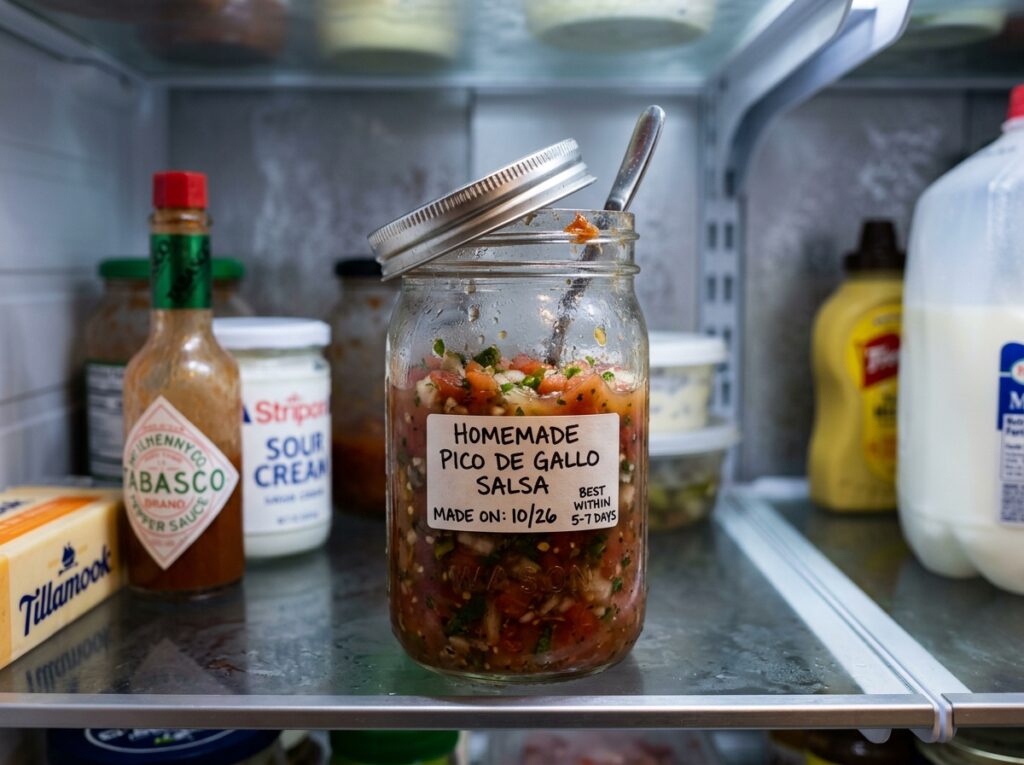
Homemade Salsa in the Fridge: How Long?
A half-used tub of salsa can look totally fine even when it’s past its safe window. That’s why so many people end up standing at the fridge with a chip in hand, doing the smell test and hoping for the best. If you’re asking how long does salsa stay good in the fridge, the short answer is: it depends on the type, and fresh salsa usually lasts a lot less time than people think.
How long does salsa stay good in the fridge after opening?
Here’s the straight answer: fresh salsa usually lasts a few days, while opened jarred salsa can last a few weeks if you store it the right way.
That sounds simple, but salsa isn’t one single food. A homemade pico de gallo, a deli tub of salsa verde, and a shelf-stable jar from the grocery store all behave differently in the fridge.
A quick timeline makes it easier:
| Type of salsa | How long it stays good in the fridge | Best quality |
|---|---|---|
| Homemade fresh salsa or pico de gallo | 3 to 5 days | Best in 1 to 3 days |
| Homemade salsa with avocado or fruit | 1 to 2 days | Best the same day |
| Cooked homemade salsa | 5 to 7 days | Best in 3 to 5 days |
| Refrigerated store-bought fresh salsa | About 5 to 7 days | Follow the use-by date |
| Restaurant or takeout salsa | 3 to 5 days | Sooner if it sat out at dinner |
| Opened shelf-stable jarred salsa | 2 to 4 weeks | Best in 1 to 2 weeks |
Quick fact: Fresh salsa acts more like a chopped salad than a bottled condiment. That’s why it spoils faster.
Homemade salsa
Homemade salsa has the shortest fridge life in most cases. You’re working with fresh tomatoes, onions, cilantro, peppers, and lime juice. Once you chop everything, moisture starts moving around, the vegetables soften, and microbes get more chances to grow.
A basic homemade salsa usually stays good for 3 to 5 days in the fridge if you refrigerate it right away in a clean airtight container.
If your salsa has avocado, mango, pineapple, corn, or black beans, don’t try to stretch it too far. Those extras can change texture fast, and some versions spoil sooner. For avocado-heavy salsa, think 1 to 2 days.
Cooked homemade salsa tends to last a little longer than raw salsa because heat lowers the microbial load. A cooked red or green salsa often keeps for 5 to 7 days in the fridge.
Picture two bowls. One is fresh pico de gallo you made for tacos. The other is a simmered salsa roja. The pico will lose its edge much sooner. That’s normal.
Store-bought jarred salsa
An unopened jar of shelf-stable salsa usually belongs in the pantry, not the fridge. Once you open it, refrigerate it and use it within 2 to 4 weeks, unless the label gives a shorter window.
Why does jarred salsa last longer? It’s often cooked, sealed, acidified, and pasteurized. Many brands also use salt, vinegar, or preservatives that help it stay stable longer after opening.
Still, don’t treat jarred salsa like it lasts forever. Flavor fades. Texture gets softer. And once people start dipping chips into the jar, the clock speeds up.
If you want the bigger picture beyond the fridge, our guide on how long salsa lasts covers pantry, freezer, and opened-jar timelines too.
Refrigerated fresh salsa and restaurant salsa
The tubs you buy from the refrigerated section are different from shelf-stable jars. Those are usually fresher, less processed, and closer to homemade salsa in how they behave.
Most refrigerated store-bought fresh salsa stays good for about 5 to 7 days after opening, but the use-by date on the package matters a lot. If the label gives you a shorter window, go with that.
Restaurant or takeout salsa is even trickier. It may have sat on the table during dinner, and people may have dipped into it more than once. That kind of salsa is best used within 3 to 5 days, sometimes sooner if it spent a long time at room temperature.
A simple rule helps here:
- Fresh and chunky? Think days.
- Jarred and shelf-stable? Think weeks.
That little shortcut saves a lot of guesswork.
What changes salsa’s fridge life?
Not all salsa ages the same way. Two containers can sit side by side in your fridge and spoil on totally different schedules.
The ingredients matter more than most people think
Tomatoes, onions, cilantro, garlic, jalapeños, lime juice, and vinegar all play a role. More acid usually helps salsa last longer. That’s one reason many jarred salsas hold up better than raw homemade ones.
But acid doesn’t make salsa bulletproof.
A lime-heavy salsa may still spoil quickly if it contains a lot of fresh chopped vegetables. On the flip side, a cooked salsa with vinegar may stay solid for several extra days.
Here’s where people often get confused: they assume salsa is like ketchup because both are tomato-based. It isn’t. Fresh salsa is closer to a wet vegetable mix. Once you think of it that way, the shorter fridge life makes a lot more sense.
Fruit also changes the game. Mango salsa and pineapple salsa can turn watery and sour faster than a basic tomato salsa. Avocado salsa is even touchier because avocado browns and softens fast.
The way you handle salsa matters too
Storage isn’t just about the calendar. It’s also about what happened between the store and your fridge.
Did the container sit in a warm car for an hour?
Did it stay on the counter through a movie and snack session?
Did someone dip chips right into it?
All of that shortens its life.
Cross-contamination is a big one. A clean spoon keeps bacteria out. A chip that touched someone’s mouth and then went back into the container does the opposite. It sounds small, but it matters.
Temperature swings also do damage. The FDA says your refrigerator should stay at 40°F (4°C) or below. Salsa stored in the fridge door warms up more often because that spot gets hit with room air every time you open it.
Did you know? The back of the middle shelf is usually colder and steadier than the fridge door. That’s a better home for salsa.
Time at room temperature counts against the total
A lot of people focus only on fridge days. But salsa doesn’t get a fresh start just because you put it back in the fridge later.
If your salsa sat out during a party for two hours, those two hours count. The same food-safety logic shows up in our article on chicken left out overnight: once food spends too long at room temperature, the safest move is to toss it.
That’s especially true for fresh salsa, restaurant salsa, and anything with avocado.
How to tell if salsa has gone bad
This is the part most people really want. Not theory. Not labels. Just: Can I still eat this?
The trouble is, salsa can look mostly okay and still be past its safe window. So don’t rely on one sign alone. Use time, smell, texture, and appearance together.
Normal changes don’t always mean it’s bad
Fresh salsa often gets watery after a day or two. Tomatoes release liquid. Onions soften. Herbs lose some color.
That alone doesn’t mean the salsa is spoiled.
A little separation in jarred salsa is also normal. Give it a stir and check again. Slight darkening on the top can happen from air exposure, especially with fresh salsa.
Think of it like cut apples. A little surface change doesn’t always mean “danger.” It may just mean the food is aging.
Bad salsa usually shows clearer warning signs
Toss the salsa if you notice any of these:
- Mold, even a tiny spot
- A sour, fermented, or yeasty smell
- Bubbling or fizzing when it shouldn’t
- A slimy or extra-thick texture
- A color that looks dull brown, grayish, or strange
- A bulging, leaking, or hissing lid
Warning: If salsa sprays, foams, or smells sharply off when you open it, don’t taste it “just to check.” Throw it out.
A spoilage check is a lot like figuring out how to tell if sweet potato is bad: no single clue tells the whole story. You need the full picture.
When you should toss it without thinking twice
Sometimes you don’t need detective work. The answer is already no.
Throw salsa out right away if:
- It sat out more than 2 hours
- It sat out more than 1 hour in heat above 90°F (32°C)
- You can’t remember when you opened a fresh container
- It smells fine but is already well past the safe fridge window
- The container looks swollen or leaks
That room-temperature rule comes from standard USDA food-safety guidance for perishable foods. And yes, salsa counts more often than people realize, especially fresh salsa.
One more thing: the sniff test has limits. Some harmful bacteria don’t create a strong smell. So if the time window says “probably not,” trust the clock.
How to store salsa so it lasts longer
You can’t make salsa last forever, but you can stop it from spoiling early.
Use the right container and the right fridge spot
An airtight container matters. If the original jar seals well, you can keep it there. If the lid is cracked or loose, transfer the salsa to a clean container with a tight-fitting lid.
Fresh salsa does best in glass or food-safe plastic containers that close firmly. Less air exposure means better flavor and a slower decline.
Keep the container on a shelf inside the fridge, not in the door. That one small choice can buy you better texture and a steadier temperature.
If salsa is part of your weekly meal prep, it also helps to track the rest of the bowl. For example, if you’re pairing it with burrito bowls, make sure you know how long cooked rice in the fridge stays safe too.
A few habits make a real difference
You don’t need a complicated system. A handful of good habits does the job:
- Use a clean spoon every time
- Pour out a serving instead of dipping into the main container
- Put salsa back in the fridge right after eating
- Wipe the rim clean before sealing the jar
- Write the opening date on the lid
- Use a smaller container if the original one is mostly empty
Pro tip: Write the date with a marker or a small piece of tape. You’ll thank yourself three taco nights later.
Here’s a real-life example. Say you bought a large jar for game day. People spooned some onto plates, but a few also dipped chips directly into the jar. Even if that jar still looks okay after two weeks, it’s smarter to toss it earlier than you would a clean, untouched jar.
Don’t let leftovers sit around during the meal
Salsa often gets treated like a table condiment. That’s where trouble starts.
A bowl of salsa set out with chips can warm up fast, especially in summer or in a crowded room. Instead of placing the whole container on the table for hours, serve a smaller portion and refill as needed.
That way, the main batch stays cold and safe in the fridge.
And if taco night left you with wrapped leftovers, these tips on how to reheat a burrito can help you use that salsa while it’s still at its best.
Can you eat salsa left out overnight or freeze it?
These are two of the most common follow-up questions, and both matter because nobody likes wasting food.
Can you eat salsa left out overnight?
No. Salsa left out overnight should be thrown away.
That answer feels annoying, especially if it still smells fine. But once salsa sits out for that long, you can’t make it safe again by chilling it later.
USDA guidance says perishable foods should not sit out longer than 2 hours, or 1 hour if the temperature is above 90°F. Fresh salsa, takeout salsa, and refrigerated salsa all fall into that risk zone pretty fast.
Jarred salsa is a bit sturdier than raw salsa, but once it’s opened and sitting out for hours, it’s still not worth the gamble.
Can you freeze salsa?
Yes, you can freeze many kinds of salsa. The best candidates are cooked salsa, blended salsa, and jarred salsa.
Fresh pico de gallo can also be frozen, but don’t expect the same crunch after thawing. The texture usually turns soft and watery. It still works in cooked dishes, eggs, soups, or casseroles.
For best quality, freeze salsa for about 1 to 2 months. Use a freezer-safe container and leave a little headspace because liquids expand.
Thaw it in the fridge, not on the counter. Then stir it well before using.
If you know you won’t finish a big batch in time, freezing part of it early is smarter than waiting until day five and hoping for the best.
What about the expiration date on salsa?
This part trips people up all the time.
A best-by date mostly speaks to quality. An unopened jar of shelf-stable salsa may still be okay for a while after that date if the seal is intact and the jar looks normal.
A use-by date on refrigerated fresh salsa is more serious. Treat that as a shorter, stricter timeline.
Once the container is opened, the package date matters less than how long it has been open and how it was stored.
Here’s the common mix-up: people see an unopened-style date on the jar and assume their already-open salsa is still fine. But the clock changed the day they broke the seal.
So if your jar says “best by September,” but you opened it three weeks ago and it’s been in and out of the fridge, don’t let the date talk you into keeping it.
4. FAQ Section
FAQ
How long does homemade salsa stay good in the fridge?
Homemade salsa usually stays good in the fridge for 3 to 5 days. If it contains avocado or lots of fruit, use it within 1 to 2 days. Cooked homemade salsa can last 5 to 7 days.
Can I eat salsa after 7 days in the fridge?
It depends on the type. Fresh homemade, deli, or restaurant salsa is usually past its best and often past its safe window after 7 days. Opened jarred salsa may still be okay at 7 days if you stored it properly, used clean utensils, and it shows no spoilage signs.
Does salsa go bad even if it smells fine?
Yes, it can. Smell helps, but it’s not enough on its own. Some harmful bacteria don’t create a strong odor, so you also need to look at how long it’s been open, how it was stored, and whether it sat out.
How long does opened jarred salsa last in the fridge?
Opened jarred salsa usually lasts 2 to 4 weeks in the fridge if you keep it cold, use clean spoons, and close it tightly. Always follow the label if the brand gives a shorter time.
Can you freeze salsa to make it last longer?
Yes. Frozen salsa keeps best for 1 to 2 months. Cooked or blended salsa freezes better than fresh pico de gallo, which often turns watery after thawing.
Is store-bought refrigerated salsa different from jarred salsa?
Yes. Refrigerated salsa is usually fresher and less processed, so it has a shorter shelf life, often about 5 to 7 days after opening. Shelf-stable jarred salsa lasts longer because it’s sealed and processed for storage.
What should I do if I ate old salsa and feel sick?
Most mild cases pass, but food poisoning can get serious. If you have severe vomiting, fever, dehydration, bloody diarrhea, or symptoms that don’t improve, contact a healthcare professional right away.
5. Conclusion
If you remember just one thing, make it this: fresh salsa lasts days, jarred salsa lasts weeks, and room-temperature time counts more than people think.
The easiest next step? Put a date on the lid the moment you open it.
That tiny habit takes the guesswork out of salsa safety. And if you’re still torn between “maybe okay” and “probably not,” trust your gut in the practical sense, not the hungry sense. Salsa is cheap. A rough night after spoiled food isn’t.