How Long to Bake Chicken Breast at 350: Easy Timing
Chicken breast can go from juicy to dry in a pretty small window. If you’re baking at 350°F and just want the straight answer, most boneless skinless chicken breasts take 25 to 30 minutes. But that number changes fast once size, thickness, and bone-in cuts enter the picture.
So if you’ve ever pulled chicken from the oven and thought, “Why is one piece perfect and the other one dry?” you’re not doing anything weird. The timing isn’t one-size-fits-all. A few simple checks make all the difference.
How Long to Bake Chicken Breast at 350
How long to bake chicken breast at 350: the short answer
Here’s the quick version most people came for:
- Boneless skinless chicken breast: 25 to 30 minutes
- Large or very thick boneless breasts: 30 to 35 minutes
- Bone-in chicken breast: 35 to 45 minutes
- Thin-sliced cutlets: 18 to 22 minutes
- Frozen chicken breast: usually 40 to 50 minutes, sometimes more
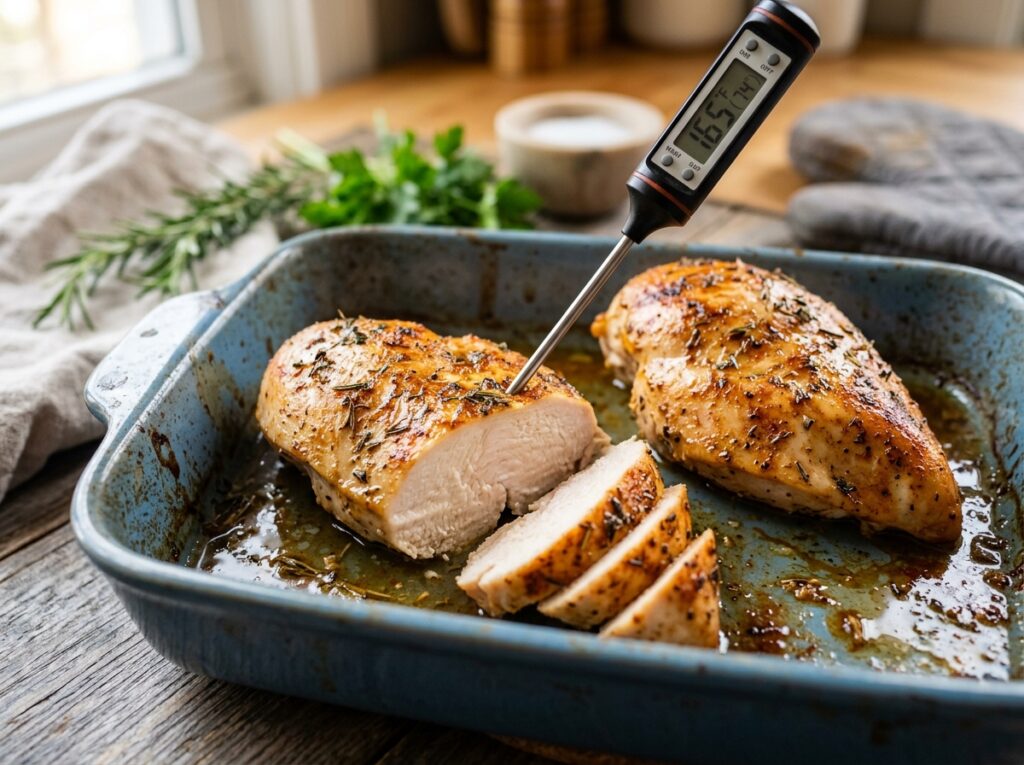
Those times work best in a preheated 350°F oven. Your chicken is done when the thickest part reaches 165°F (74°C).
That last part matters more than the clock.
A timer gives you a starting point. A thermometer gives you the real answer. Two chicken breasts can weigh the same and still cook at different speeds if one is thick and rounded while the other is wide and flat.
Quick fact: the biggest reason baked chicken turns dry isn’t bad seasoning. It’s staying in the oven just a few minutes too long.
So yes, “25 to 30 minutes” is a good baseline. Just don’t treat it like a law.
Why chicken breast bake time at 350 changes so much
Thickness matters more than weight
Most home cooks look at ounces. Your oven cares more about thickness.
Picture two chicken breasts that both weigh 8 ounces. One is broad and flat. The other is tall and thick in the center. The flat one might finish in 24 minutes. The thick one might still need 31 or 32.
That’s why recipe times can feel all over the place online. People aren’t always cooking the same shape of chicken.
If you want more even results, pound the thickest part lightly so the breast is closer to one even thickness. You don’t need to flatten it into a cutlet. Just even it out a bit.
Did you know? A breast that’s about 1 inch thick often lands right in that 25 to 30 minute zone at 350°F.
Boneless and bone-in don’t cook the same way
Boneless skinless breasts cook faster. There’s less mass and no bone slowing things down.
Bone-in breasts, often called split chicken breasts, take longer. The bone affects how heat moves through the meat, and these cuts are usually bigger too. You’ll often need 35 to 45 minutes at 350°F, sometimes a touch more for very large pieces.
Skin also changes things a little. Skin-on chicken can help protect the meat from drying out, but it won’t magically shorten the cook time.
Your pan and oven setup also affect timing
A light metal sheet pan cooks a bit differently than a thick glass baking dish.
Glass dishes tend to heat more slowly. Crowded pans can trap moisture. Dark pans brown faster. And some ovens run hot or cold without you realizing it.
Convection ovens are another twist. If your oven has a fan setting, it usually cooks faster than a conventional oven. You may want to check the chicken 3 to 5 minutes earlier, or lower the oven temperature by 25°F.
Starting with thawed chicken makes life easier
Thawed chicken cooks more evenly than frozen chicken. That’s the easiest path if you want juicy meat and predictable timing.
If your chicken is already defrosted, make sure it’s still safe to use. Here’s a helpful guide on how long thawed chicken in the fridge stays good.
You can cook chicken from frozen, but the timing gets longer and the risk of dry edges goes up.
Bake times at 350 by chicken breast type and size
A simple chart makes this easier, so here’s a practical one.
| Chicken breast type | Typical size/thickness | Bake time at 350°F | Target temp |
|---|---|---|---|
| Boneless, skinless | 4–6 oz, fairly thin | 20–25 min | 165°F |
| Boneless, skinless | 6–8 oz, about 1 inch thick | 25–30 min | 165°F |
| Boneless, skinless | 8–12 oz, thick | 30–35 min | 165°F |
| Thin-sliced cutlets | under 1 inch | 18–22 min | 165°F |
| Bone-in split breast | medium to large | 35–45 min | 165°F |
| Frozen boneless breast | varies | 40–50 min | 165°F |
| Stuffed chicken breast | thick | 35–45 min | 165°F in center |
Use that chart as a guide, not a promise.
Boneless skinless chicken breasts at 350
This is the version most people mean when they search how long to bake chicken breast at 350.
For a standard grocery-store chicken breast, 25 to 30 minutes is the sweet spot. If the pieces are small and thin, start checking around 20 to 22 minutes. If they’re big and thick, check closer to 28 to 30 minutes.
A good rule?
Start checking 5 minutes before you think they’ll be done.
That one habit saves more chicken than any marinade ever will.
Here’s a real-life example. Say you’re baking four boneless breasts for meal prep. Two are around 6 ounces. Two are closer to 9 ounces. Don’t expect all four to come out at the same time. Pull the smaller ones once they hit 165°F, then give the larger pieces a few more minutes.
If you’re cooking tenderloins, don’t follow chicken breast timing. They’re smaller and thinner, so they finish faster. If you’re not sure what you bought, this breakdown of chicken tenderloin vs chicken breast clears it up.
Bone-in chicken breast at 350
Bone-in breasts need more patience.
A medium split chicken breast often takes 35 to 45 minutes at 350°F. Very large ones can creep beyond that. The safest move is still the same: check the thickest part of the meat, not right against the bone.
Color near the bone can fool you a little. Sometimes meat close to the bone keeps a faint pink tint even when it’s fully cooked. That’s why temperature matters more than appearance.
Thin-sliced, stuffed, or frozen chicken breast
Thin cutlets cook much faster. Expect 18 to 22 minutes at 350°F, and watch them closely. There isn’t much room for error there.
Stuffed chicken breasts need longer because the center heats slowly. Plan on 35 to 45 minutes, and make sure both the meat and the filling reach 165°F.
Frozen chicken breast can be baked safely, but it usually takes about 50% longer than thawed chicken. At 350°F, that often means 40 to 50 minutes, sometimes more for thick pieces. It works, but it’s not the best route for texture.
If juicy chicken is your goal, thaw first.
How to bake chicken breast at 350 so it stays juicy
Timing matters, but the method matters too. You don’t need a restaurant trick here. Just a simple routine.
A simple method that works
- Preheat your oven to 350°F.
Don’t put chicken into a cold or half-heated oven. That stretches the cook time and can throw off the texture. - Pat the chicken dry.
Dry surfaces brown better than wet ones. - Rub with a little oil and season well.
Olive oil, salt, pepper, garlic powder, and paprika work great. You can keep it basic. - Even out thick pieces if needed.
A few light taps with a meat mallet or rolling pin help the chicken cook more evenly. - Bake in a single layer.
Leave a little space between pieces on the pan or in the baking dish. - Check early with a thermometer.
Small breasts: start around 20 minutes.
Medium breasts: start around 25 minutes.
Large breasts: start around 28 to 30 minutes. - Rest for 5 to 10 minutes before slicing.
That pause helps the juices settle back into the meat.
That’s it. No fancy move. No complicated sauce needed.
Should you bake chicken breast covered or uncovered at 350?
For most plain chicken breasts, uncovered is the better choice.
Uncovered chicken gets a nicer surface and a less steamed texture. Covered chicken holds in more moisture, but it can turn a bit pale and soft on the outside.
If you’re baking chicken with a sauce, or if you’re worried the top is browning too fast, loosely tenting with foil for part of the time can help. But for everyday seasoned chicken breast, uncovered is usually the cleanest path.
A few small choices make a big difference
Seasoning the chicken 15 to 30 minutes ahead helps. So does using breasts that are close in size.
A little oil keeps the surface from drying out too fast. Resting after baking matters more than people think too. Slice the chicken right away, and the juices run out onto the board instead of staying in your dinner.
Pro tip: If one end of the breast is much thinner than the other, tuck that thin tail under itself before baking. It helps the whole piece cook more evenly.
Meal prep example
Let’s say you’re baking chicken for weekday lunches.
You buy about 2 pounds of boneless breasts, season them simply, and bake them at 350°F. Some pieces may finish at 25 minutes, others at 32. Pull each one as it reaches temp. Don’t wait for the biggest piece if the smaller ones are already done.
If you’re planning portions for a family or for meal prep, this guide on how many chicken breasts are in a pound makes shopping a lot easier.
How to tell when chicken breast baked at 350 is done
Use a meat thermometer, not guesswork
If you only take one tip from this article, take this one.
Use an instant-read meat thermometer.
Insert it into the thickest part of the breast without touching the pan or bone. Once it reads 165°F, the chicken is done.
That one check solves almost every “Is it cooked?” question.
If you need a quick refresher, here’s how to read a meat thermometer the right way.
165°F is the safe target for chicken breast
USDA guidance still says poultry should reach 165°F (74°C).
You may see social posts or random comments claiming lower temperatures work for chicken. Don’t use 145°F for chicken breast if you want the simple, safe answer. This article on whether 145°F is safe for chicken explains why that number causes so much confusion.
For kids, older adults, pregnant people, or anyone with a weaker immune system, sticking closely to the 165°F rule is the smart move.
Don’t rely on color or clear juices alone
Clear juices don’t always mean the chicken is ready. Pink meat doesn’t always mean it’s raw.
That sounds annoying, I know. But it’s true.
Oven temperature, marinade ingredients, bone presence, and even the age of the bird can affect color. A sugar-heavy marinade may make the outside look done before the center is ready. Bone-in pieces may stay a little pink near the bone even after they’re safe.
So if you’ve been cutting into the middle and staring at it like it’s giving you clues, you’re not alone. A thermometer is just better.
Resting helps more than people realize
Fresh-from-the-oven chicken is still moving juices around inside. Give it 5 to 10 minutes on the counter before slicing.
That small wait helps the texture stay moist.
A lot of people think their chicken was “dry from the oven” when the bigger issue was cutting it too soon.
Common mistakes, plus whether 350 is the best oven temperature
Small mistakes that dry out chicken
The most common mistake is simple: overbaking.
Chicken breast is lean. It doesn’t have a lot of fat to hide your timing errors. A few extra minutes can turn a juicy piece into something that needs extra sauce just to get down.
Other common trouble spots:
- baking pieces with very different sizes together
- skipping the thermometer
- slicing right away
- cooking straight from frozen without adjusting time
- using tenderloin timing for breasts, or breast timing for tenderloins
If your chicken often turns out rubbery, stringy, or oddly firm, these chewy chicken causes and fixes can help you figure out what’s going wrong.
Is 350 better than 375 or 400?
For many home cooks, 350°F is the most forgiving temperature.
It cooks chicken gently enough that you have a little breathing room. That’s useful on busy weeknights, especially if your chicken breasts are thick or uneven.
Still, 350 isn’t the only good option.
- 375°F cooks a bit faster and still gives you decent control.
- 400°F cooks faster and can give a little more browning, but the margin between “done” and “dry” gets smaller.
If you tend to forget the timer or you’re baking a batch for meal prep, 350°F is a safe, steady choice. If you want faster cooking and you’re watching the thermometer closely, a hotter oven can work well too.
There isn’t one “best” temperature for every kitchen. There’s just the one that fits your style.
For most readers landing here, 350°F is popular for a reason: it’s simple, reliable, and easier on lean chicken breast.
4. FAQ Section
FAQ
How long do boneless skinless chicken breasts take at 350?
Most boneless skinless chicken breasts take 25 to 30 minutes at 350°F. Small or thin pieces may be done in 20 to 25 minutes, while large thick breasts may need 30 to 35 minutes. Always check for 165°F in the thickest part.
How long do bone-in chicken breasts take at 350?
Bone-in chicken breasts usually take 35 to 45 minutes at 350°F. Large split breasts can take a little longer. Use a meat thermometer and check the thickest part away from the bone.
Should I bake chicken breast covered or uncovered at 350?
Most of the time, bake chicken breast uncovered at 350°F. That gives you a better texture on the outside. Cover it loosely with foil only if you’re baking it with sauce or the top is browning too fast.
Can I bake frozen chicken breast at 350?
Yes, you can bake frozen chicken breast at 350°F, but it takes longer. Expect around 40 to 50 minutes, sometimes more for thick pieces. Thawed chicken usually cooks more evenly and stays juicier.
How do I know when baked chicken breast is done?
Chicken breast is done when the internal temperature reaches 165°F (74°C). The best way to check is with an instant-read thermometer inserted into the thickest part of the meat.
Is 350 or 400 better for chicken breast?
350°F is more forgiving, especially for thicker chicken breasts or meal prep batches. 400°F is faster, but it gives you less room for error and can dry out the meat more easily if you miss the timing.
5. Conclusion
If you want the simple answer, most chicken breasts bake at 350°F in 25 to 30 minutes, with larger or bone-in pieces needing longer. The real secret, though, isn’t memorizing one number. It’s checking the thickest part for 165°F, pulling each piece as soon as it’s done, and letting it rest before slicing.
So the next time chicken breast is on the menu, start checking a little early instead of a little late. That one small shift is usually all it takes to go from dry and disappointing to tender and worth making again.