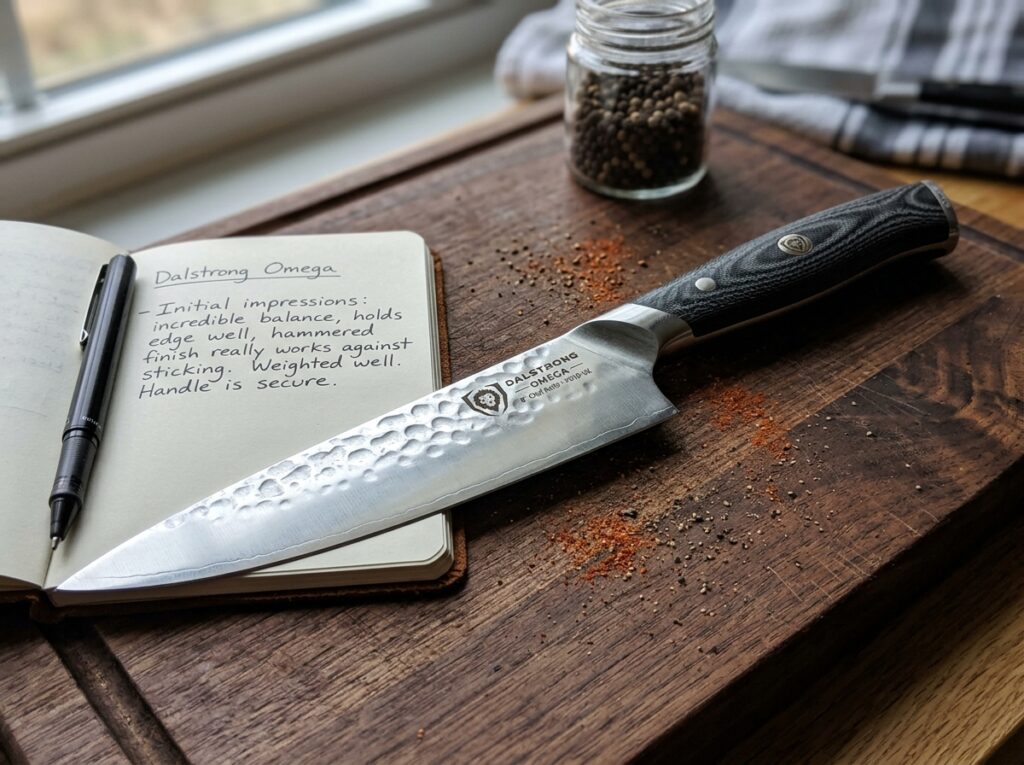
Dalstrong Omega Chef Knife Review: Worth It?
Most home cooks own at least one knife they quietly hate. It’s either too dull after a month, too heavy for daily prep, or it just doesn’t feel right in the hand. And then you start scrolling Amazon, reading dozens of reviews, and you land on the Dalstrong Omega Chef Knife — a blade that promises professional performance without the professional price tag.
But here’s the real question: does it actually deliver? I’ve spent real time with this knife — slicing onions paper-thin, breaking down whole chickens, mincing garlic at speed, and rocking through herbs. This review isn’t based on spec sheets alone. It’s based on what happens when steel meets cutting board, day after day.
If you’re deciding whether the Dalstrong Omega deserves a spot in your kitchen, keep reading. I’ll cover everything from the steel quality and edge retention to how it actually feels in your hand during a 45-minute dinner prep session.
What Exactly Is the Dalstrong Omega Series?
Before we get into the specifics of the chef knife, let’s talk about the Omega series itself. Dalstrong, a brand that’s become something of a cult favorite among home cooks and semi-professional chefs since its founding in 2012, designed the Omega line as a bridge between their entry-level offerings and their premium Shogun or Phantom series.
The Omega series sits in what I’d call the “smart mid-range” — knives that borrow design cues and materials from high-end Japanese cutlery but price themselves where a serious home cook won’t flinch. Think of it like buying a well-equipped mid-trim car. You don’t get every luxury feature, but you get the ones that actually matter for daily driving.
The chef knife, specifically the 8.5-inch version, is the flagship of this series. It’s designed to be your everyday workhorse — the knife you reach for 80% of the time, whether you’re dicing carrots for a stew or slicing through a pork tenderloin fresh from the oven.
The Steel: BD1N-VX Hyper Steel
This is where the Dalstrong Omega gets genuinely interesting. Most knives at this price point use some variation of German stainless steel (like X50CrMoV15) or a standard Japanese VG-10. The Omega goes a different route with BD1N-VX, a nitrogen-enriched, vacuum-heat-treated steel.
What does that actually mean for you? A few things worth caring about.
Edge retention is noticeably above average. Nitrogen in steel does something cool — it forms nitrides within the metal structure that resist wear better than standard carbides. In plain English, your knife stays sharper longer between sharpenings. I went about three weeks of regular daily cooking before I felt it needed a touch-up on a honing rod. That’s solid.
Corrosion resistance is excellent. Nitrogen-enriched steels handle moisture and acidic foods better than many carbon-heavy Japanese steels. You still shouldn’t leave it soaking in the sink (please don’t do that with any good knife), but a quick rinse and dry is all it needs. No rust spots, no discoloration, even after cutting tomatoes and lemons repeatedly.
Hardness sits around 58-60 HRC. That’s right in the sweet spot — hard enough to hold a keen edge, but not so hard that the blade becomes brittle or a nightmare to sharpen at home. For reference, most German knives hover around 56-58 HRC, while ultra-hard Japanese blades can reach 63-67 HRC. The Omega finds a comfortable middle ground.
Pro Tip: If you’re new to maintaining quality kitchen knives, a ceramic honing rod works better for this steel than a traditional grooved steel rod. The finer abrasion suits the harder steel without removing excessive material.
Blade Design and Geometry
Here’s where daily performance really lives — not just in what the blade is made of, but how it’s shaped.
The Dalstrong Omega chef knife features a blade length of 8.5 inches, which gives you slightly more cutting surface than a standard 8-inch chef knife. That extra half inch might sound trivial, but you feel it when you’re slicing through a large cabbage head or making long, smooth cuts through a brisket.
The blade profile leans Japanese. It has a flatter belly compared to a German-style chef knife, with a gentle curve toward the tip. What this means in practice is that push-cutting and draw-cutting feel natural, while the traditional Western rocking motion still works — it just requires a bit of adjustment if that’s all you’ve ever known.
The edge angle is ground to about 15-16 degrees per side. That’s noticeably more acute than the typical 20-degree German grind. A thinner edge means less resistance when cutting, which translates to cleaner cuts and less effort. You really notice the difference when you’re doing precision work — julienning bell peppers, creating fine brunoise from shallots, or slicing delicate herbs without bruising them.
The blade thickness tapers nicely from spine to edge, and the spine itself is thin enough that you won’t get excessive food wedging. Thick carrots and potatoes split cleanly without that annoying cracking-and-sticking thing you get with chunkier blades.
Did You Know? A knife’s cutting performance depends more on blade geometry (thickness, taper, edge angle) than on steel type alone. Two knives made from the same steel can feel completely different based on how they’re ground.
The Handle: Comfort During Long Prep Sessions
Let me be honest — this is one area where opinions split, and personal preference matters more than specs.
The Dalstrong Omega uses a military-grade G10 handle in a dark charcoal color. G10 is a fiberglass laminate material that’s incredibly durable, moisture-resistant, and grippy even with wet hands. It won’t absorb odors like wood, and it doesn’t crack or warp over time. From a practical standpoint, it’s excellent.
The shape is ergonomic with rounded contours that fill your palm without pressure points. During a long cooking session — say you’re prepping a full Thanksgiving spread, including figuring out how much turkey breast you need per person and cutting all those vegetables — your hand doesn’t fatigue the way it does with a poorly balanced knife.
The handle-to-blade transition is smooth with no harsh bolster edge digging into your index finger. If you use a pinch grip (and you should with most chef knives), the choil area gives your fingers a comfortable resting spot.
Where some people push back is on aesthetics. The Omega’s handle isn’t flashy. It doesn’t have the stunning engraved Damascus pattern of the Shogun series or the warm walnut look of a Wüsthof Classic. It’s functional and utilitarian. If you care about how your knife looks hanging on a magnetic strip, this one won’t win beauty contests. But pick it up and use it for 20 minutes? You’ll probably stop caring about looks.
Balance and Weight: How It Feels in Your Hand
The Dalstrong Omega chef knife weighs around 7.5 to 8 ounces, which plants it firmly in lightweight-to-mid territory. It’s lighter than a Wüsthof Classic (which can hit 9+ ounces) but not as feather-light as a Miyabi Birchwood or a MAC Professional.
The balance point sits very close to where the blade meets the handle. That means the knife doesn’t feel blade-heavy or handle-heavy — it pivots easily at the pinch point. For rapid knife work, like mincing herbs or creating a fine dice, this kind of balance is exactly what you want. The knife does the work for you rather than fighting against you.
If you’re someone who likes a heavier knife that “falls through” food with its own weight (think German-style cutting where you let gravity help), the Omega might feel a little light at first. But give yourself a few days. The precision and control you gain from the lighter weight more than makes up for it.
I tested this specifically during a meal prep that involved breaking down chicken breasts and slicing through root vegetables, and the knife transitioned between tasks without any awkwardness. The balance stayed consistent regardless of grip position or cutting angle.
Edge Retention and Sharpening
Okay, let’s address one of the biggest questions people have: how long does the Dalstrong Omega stay sharp?
Out of the box, this knife comes scary sharp. Dalstrong advertises their edge as hand-finished to a mirror polish, and I believe it. Paper cuts cleanly, tomato skins give way with zero pressure, and you can shave arm hair if you’re into that kind of testing (I’m not, but I did check).
After two weeks of daily cooking — roughly 30-45 minutes of active cutting per day — the edge was still performing well. By week three, I noticed a slight decrease in tomato-skin performance (the gold standard for home sharpness testing). A few passes on a ceramic honing rod brought it right back.
After about six weeks of consistent use, I did a proper sharpening on a 1000/3000 grit whetstone. The BD1N-VX steel responded beautifully — it sharpened faster than I expected for its hardness and took a very keen edge with minimal effort.
Warning: Avoid pull-through sharpeners with this knife. Those devices use fixed-angle carbide or ceramic slots that remove too much material and can damage a thinner Japanese-style edge. A whetstone or a quality electric sharpener with adjustable angles (like the Work Sharp Precision Adjust) is a much better choice.
For home cooks who don’t want to learn whetstone sharpening (totally understandable), a good honing rod will keep this knife performing well for months between proper sharpenings.
Real-World Kitchen Performance
Specs and materials only tell part of the story. What really matters is how this knife handles the foods you actually cook every week.
Vegetables and Fruits
This is where the Omega genuinely shines. The thin blade geometry and acute edge angle make it a joy for vegetable prep. Onion slicing produces clean, even cuts with minimal tearing (less crying, which is always a win). Dicing potatoes, carrots, and celery feels effortless. The flatter blade profile means you get consistent contact with the cutting board, which helps with uniform cuts.
Softer items like ripe tomatoes, avocados, and mushrooms get sliced without squishing. If you’ve ever tried cutting baby bella mushrooms with a dull knife and ended up crushing them, you’ll appreciate how cleanly the Omega handles delicate produce.
Proteins
Breaking down raw chicken was smooth. The knife moved through joints with reasonable effort, and the thin tip was precise enough to separate tendons and silverskin without wasting meat. It’s not a butcher’s knife, and I wouldn’t use it to hack through bones, but for trimming, portioning, and slicing boneless cuts, it’s very capable.
Slicing cooked steak — especially when you want those thin, perfectly reheated steak slices — was clean with minimal shredding. Cooked chicken carved neatly too, with smooth strokes producing even pieces.
Herbs and Fine Work
Mincing parsley, cilantro, and basil was a highlight. The sharp edge cuts through herbs rather than bruising them, so you get clean green colors instead of darkened, mushy leaves. The rocking motion works well enough despite the flatter profile — you just use a smaller arc than you would with a German knife.
What the Dalstrong Omega Does Well
Let me give you the straight highlights without any fluff.
The sharpness out of the box is genuinely impressive. You don’t need to sharpen it before first use, which isn’t always the case even with $200+ knives. The BD1N-VX steel punches above its weight class in terms of edge retention and corrosion resistance. It’s a smart steel choice that most competitors in this price range aren’t offering.
The blade geometry favors precision. If you’re someone who actually wants to improve your knife skills and make cleaner cuts, this blade rewards good technique. The G10 handle is practically indestructible and stays grippy through long, sweaty prep sessions.
And the price point deserves mention. At roughly $80-100 depending on where you buy it and what sales are running, you’re getting performance that competes with knives costing $150-200. That’s a genuine value proposition, not marketing hype.
Where It Falls Short
No knife is perfect, and pretending otherwise would waste your time.
The blade length (8.5 inches) might not suit everyone. If you have smaller hands or a compact kitchen, a standard 8-inch or even a 7-inch blade might feel more manageable. That extra half inch changes the overall feel, and not everyone prefers it.
The “Japanese hybrid” design can confuse Western-trained cooks. If you’ve spent years using a heavy German knife with a big belly curve and a full bolster, the Omega will feel… different. Not bad, just different. There’s an adjustment period, especially with rocking cuts.
Dalstrong’s marketing can be a bit much. The packaging is dramatic — a beautiful box, a sheath, polishing cloth, the whole presentation. Some people love that. Others find it a little over-the-top and wonder if they’re paying for packaging theater instead of the knife itself. To be fair, the knife holds up its end of the bargain. But the marketing tone can set expectations unrealistically high.
It’s not ideal for heavy-duty tasks. Don’t use this to break down a whole pork butt through the bone or smash garlic cloves with the flat side (a thinner blade can flex or chip this way). For those tasks, keep a beater knife in the drawer.
Dalstrong Omega vs. the Competition
How does it stack up against other popular options in the same price range?
Against the Victorinox Fibrox Pro 8-Inch
The Victorinox is the default budget recommendation everywhere, and for good reason — it’s around $35-40 and perfectly functional. But the Dalstrong Omega is a clear step up in steel quality, edge geometry, and overall fit-and-finish. If your budget allows the jump from $40 to $90, you’ll feel the difference every time you pick it up.
Against the Tojiro DP Gyuto
The Tojiro is another popular mid-range Japanese-style knife. It uses VG-10 steel, which is a proven performer. Honestly, the two knives are closely matched in cutting performance. The Dalstrong edges ahead slightly in handle comfort and corrosion resistance (thanks to the nitrogen-enriched steel), while the Tojiro might feel a bit more refined in terms of blade thinness. It’s a close call.
Against the Wüsthof Pro
A German-made knife at a similar price point. The Wüsthof Pro is heavier, thicker, and has a more pronounced belly curve. If you prefer Western-style cutting and want something that feels substantial in hand, the Wüsthof wins on tradition. If you want a lighter, sharper, more precise knife, the Dalstrong Omega takes it.
Who Should Buy the Dalstrong Omega Chef Knife?
This knife fits a specific kind of cook really well.
You’re the right buyer if you’ve outgrown your starter knife and want something that genuinely performs better — not just looks nicer. You appreciate sharp, precise cutting and you’re willing to care for your knife properly (hand washing, occasional honing, storing it safely). You cook regularly, at least a few times a week, and you enjoy the process of prepping food rather than viewing it as a chore.
You’re probably NOT the right buyer if you throw all your knives in a drawer together, run them through the dishwasher, and just want something that “works fine.” No judgment — but a $90 knife deserves a little respect, and this one will reward you for giving it some.
If you’re someone who spends serious time in the kitchen — someone who cares about how long to boil potatoes properly, who reads their meat thermometer carefully, and who wants their prep work to be efficient and enjoyable — the Dalstrong Omega is built for you.
Care and Maintenance Tips
Getting a great knife is step one. Keeping it great is step two.
Hand wash only. The dishwasher’s harsh detergents, high heat, and jostling against other items will dull the edge and potentially damage the handle over time. A quick wash with soap and warm water, then dry immediately with a towel. Takes 15 seconds.
Hone before (or after) each use. A ceramic honing rod realigns the edge’s microscopic teeth without removing material. It takes 30 seconds and makes a noticeable difference in cutting feel.
Store it properly. A magnetic knife strip, a blade guard, or a dedicated knife block. Never toss it loose in a drawer where it’ll bang against other utensils.
Sharpen it 2-3 times a year if you cook daily. A 1000/3000 grit whetstone is all you need. There are plenty of great YouTube tutorials for beginners — it’s a skill worth learning.
Use the right cutting surface. Wood or plastic cutting boards only. Glass, ceramic, marble, or granite boards will destroy any knife’s edge faster than you can say “dull.” If you’re doing serious prep work — like organizing a full DIY outdoor kitchen setup — make sure your cutting surfaces are blade-friendly.
FAQ
Is the Dalstrong Omega chef knife worth the money?
Yes, for most home cooks who take their cooking seriously. The BD1N-VX steel, thin blade geometry, and comfortable handle deliver performance that punches above its $80-100 price tag. You’re getting a knife that competes with brands charging $150 or more. That said, if you only cook once a week and don’t care much about knife performance, a $30-40 Victorinox will serve you just fine.
Can I put the Dalstrong Omega in the dishwasher?
You can, but you absolutely shouldn’t. The dishwasher’s combination of abrasive detergents, high-temperature water, and physical contact with other items will degrade the edge quickly and can damage the G10 handle over time. Hand wash with soap and warm water, dry it immediately, and your knife will last for years.
How often should I sharpen the Dalstrong Omega?
With regular honing (a few passes on a ceramic rod before each cooking session), you’ll only need to actually sharpen the blade on a whetstone every 3-4 months with daily use. If you cook less frequently, twice a year might be enough. You’ll know it’s time when the knife struggles to slice through tomato skin cleanly or when honing no longer restores the cutting feel.
Is the Dalstrong Omega a Japanese or German knife?
It’s a hybrid, technically. The blade geometry, edge angle, and steel choice lean Japanese. The overall profile and handle design borrow from Western chef knife traditions. Dalstrong describes it as a fusion, and that’s accurate. You get Japanese precision with Western familiarity.
What size Dalstrong Omega should I get?
The 8.5-inch chef knife is the most versatile option for most cooks. If you have smaller hands or a very small cutting board, their 7-inch version (if available in the Omega line) might be more comfortable. The 8.5-inch blade handles everything from mincing garlic to slicing watermelon, so it’s the safest pick for a single all-purpose knife.
Final Thoughts
The Dalstrong Omega chef knife isn’t a magic wand that’ll turn you into a Michelin-star chef overnight. But it is a smartly designed, well-made knife that makes daily cooking faster, cleaner, and more enjoyable. The BD1N-VX steel is a genuine differentiator at this price point, the blade geometry rewards good technique, and the handle stays comfortable through long prep sessions.
If you’re looking for one good knife to anchor your kitchen — the knife you reach for every single time you cook — the Omega earns that spot honestly. Treat it well, keep it sharp, and it’ll make every meal you prepare feel a little more effortless.
Your next step? Pick one up, run it through a pile of onions, and feel the difference a real knife makes. Your cooking deserves it.