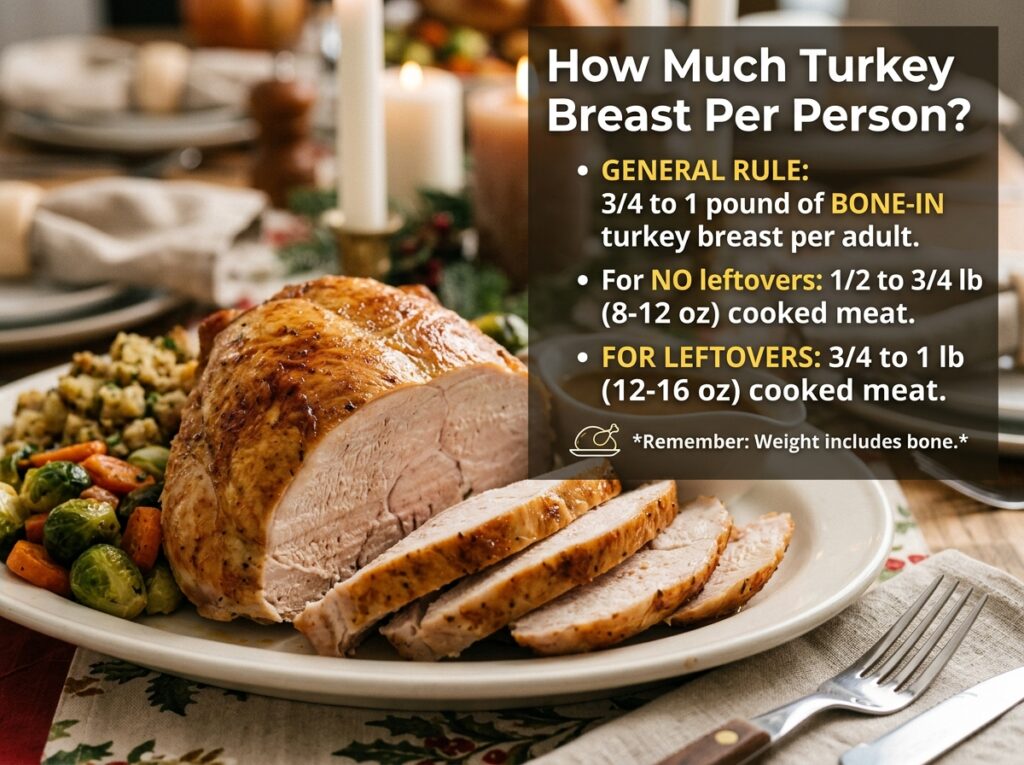
How Much Turkey Breast Per Person? Easy Guide
A 5-pound turkey breast can look huge at the store. Then dinner starts, a few people ask for seconds, and suddenly it doesn’t seem like much at all.
If you want the short answer, here it is: plan about 1/2 pound of boneless turkey breast per adult, or 3/4 pound of bone-in turkey breast per adult. That usually gives each person about 6 to 8 ounces of cooked turkey, which works well for a normal dinner. If you want leftovers, bump it up a little
How much turkey breast per person is enough?
For most meals, 1/2 pound of raw boneless turkey breast per person is a safe, easy rule. If you’re buying bone-in turkey breast, go with 3/4 pound per person.
Why the difference? Bones take up weight, and turkey loses moisture as it cooks. So a raw 4-pound turkey breast won’t give you 4 pounds of sliced meat on the table.
Here’s the simplest way to think about it:
| Type of meal | Boneless turkey breast | Bone-in turkey breast | Cooked turkey per person |
|---|---|---|---|
| Light meal, lots of sides | 1/3 to 1/2 lb | 1/2 to 3/4 lb | 4 to 6 oz |
| Standard dinner | 1/2 lb | 3/4 lb | 6 to 8 oz |
| Big appetites or leftovers | 3/4 lb | 1 lb | 8 to 10 oz |
Quick fact: Turkey breast usually loses about 20% to 25% of its weight during cooking. Bone-in cuts give you even less edible meat because part of the weight is bone.
If you’re serving pre-cooked turkey breast, the math changes a bit. In that case, you’re buying the finished product, so 1/3 to 1/2 pound per person is usually enough.
And if you’re talking about deli-sliced turkey breast for sandwiches, you can go lower. 3 to 4 ounces per person works for most adults.
What changes the amount you need?
A lot of articles throw out one number and call it done. Real dinners don’t work like that. The right amount depends on who’s eating, what else is on the table, and whether you want leftovers tomorrow.
Your side dishes matter more than you think
Turkey disappears faster if it’s the star of the meal.
If you’re serving a full holiday spread with stuffing, mashed potatoes, rolls, green beans, cranberry sauce, and pie, people often take a smaller portion of meat. In that case, 1/2 pound boneless per adult usually works well.
But if dinner is more protein-heavy and lighter on sides, you should plan for more turkey. Think roasted vegetables and salad, not a table loaded with starches. People will fill the gap with extra slices of turkey.
A buffet also changes things. Guests tend to take a little of everything at first, then come back for seconds on the items they love. If your turkey is really juicy and well-seasoned, guess what they’ll come back for?
Adults, kids, and hungry guests don’t eat the same
Not every seat at the table should count the same.
A simple rule that works well:
- 1 adult = full portion
- 1 child under 10 = half portion
- 1 teen or big eater = 1.25 portions
So if you’re feeding 6 adults and 4 small kids, don’t shop like you’re feeding 10 adults. That would leave you with a mountain of leftovers.
Here’s a quick example. Say you’re making a standard dinner:
- 6 adults = 6 full portions
- 4 kids = 2 adult portions
That’s 8 adult portions total.
For 8 adult portions, you’d want about 4 pounds boneless or 6 pounds bone-in.
Raw weight and cooked weight can trip you up
This is where people get confused fast.
The weight on the package is usually raw weight. After cooking, turkey breast shrinks because it loses water. Boneless turkey breast can lose roughly a quarter of its weight. Bone-in turkey breast gives you even less sliced meat because the bone isn’t edible.
So if a recipe says “serve 6 ounces per person,” that’s often talking about the cooked amount on the plate, not the raw package weight.
Did you know? A cooked 6-ounce portion may start as around 8 ounces raw, sometimes a little more depending on the cut and cooking method.
Leftovers change the math in a big way
Some people want one dinner and done. Others are already thinking about turkey sandwiches, turkey soup, and late-night fridge raids.
If leftovers matter, don’t use the bare minimum. Add 25% to 50% more.
For example, for 8 adults:
- Standard meal: 4 pounds boneless
- Leftovers too: 5 to 6 pounds boneless
That extra pound or two goes fast. One sandwich can use 4 to 6 ounces of sliced turkey without even trying.
How many pounds of turkey breast for 4, 6, 8, 10, or 12 people?
Most people don’t want a formula. They want a shopping answer. Fair enough.
Here’s a simple table for a standard dinner.
| Number of people | Boneless turkey breast | Bone-in turkey breast |
|---|---|---|
| 4 people | 2 lb | 3 lb |
| 6 people | 3 lb | 4.5 lb |
| 8 people | 4 lb | 6 lb |
| 10 people | 5 lb | 7.5 lb |
| 12 people | 6 lb | 9 lb |
| 15 people | 7.5 lb | 11 to 12 lb |
| 20 people | 10 lb | 15 lb |
If you want leftovers, use this adjusted range:
| Number of people | Boneless with leftovers | Bone-in with leftovers |
|---|---|---|
| 4 people | 2.5 to 3 lb | 4 lb |
| 6 people | 4 to 4.5 lb | 6 lb |
| 8 people | 5 to 6 lb | 8 lb |
| 10 people | 6.5 to 7.5 lb | 10 lb |
| 12 people | 8 to 9 lb | 12 lb |
These numbers aren’t fancy. They’re practical. And that’s what you need when you’re standing in the meat aisle trying to decide between two packages that are close, but not exact.
Pro tip: If you’re between sizes, round up. An extra pound of turkey is far easier to manage than not having enough food.
A fast formula you can use in the store
If you like quick math, here’s the easiest version:
- Boneless turkey breast: number of adults x 0.5 pound
- Bone-in turkey breast: number of adults x 0.75 pound
- For leftovers: multiply the result by 1.25 to 1.5
So for 9 adults wanting leftovers:
- 9 x 0.5 = 4.5 pounds boneless
- 4.5 x 1.25 = about 5.6 pounds
You’d buy 5.5 to 6 pounds boneless turkey breast.
Bone-in or boneless turkey breast: which should you buy?
Both work. The better choice depends on what matters more to you: easy carving, flavor, presentation, or value.
Bone-in turkey breast gives you less edible meat
Bone-in turkey breast usually tastes great and can stay juicy because the bone helps slow down cooking a bit. But part of that weight is bone, so you’ll need more pounds per person.
That’s why the rule jumps from 1/2 pound boneless to 3/4 pound bone-in per adult.
Some bone-in turkey breasts also come with skin, which many people love. If your guests won’t eat the skin, don’t count it as part of the meal value.
Boneless turkey breast is easier to portion
Boneless turkey breast is simpler if you want clean slices and easier math. It’s also great for smaller dinners because you can buy closer to the exact amount you need.
If you’re feeding 5 or 6 people, a boneless roast often feels less wasteful than a large bone-in piece.
And if you struggle to picture what meat weights actually look like, this quick guide on how many chicken breasts are in a pound can help you judge package sizes a little better. It’s not turkey, of course, but it gives you a handy visual for lean poultry.
Whole turkey uses a different rule
A lot of people mix up turkey breast math with whole turkey math.
For a whole turkey, many cooks use 1 to 1.25 pounds per person, sometimes more if they want lots of leftovers. That number is higher because you’re paying for bones, wings, legs, and the whole body, not just breast meat.
If you end up going with a full bird instead, our guide on how to cook a 20-pound turkey at 350 can help with timing.
How to buy, cook, and carve turkey breast without running short
Getting the right weight is step one. Step two is making sure the turkey you bought actually turns into juicy, sliceable meat.
Buy a little extra if the package size is awkward
Stores rarely stock the exact weight you want.
Let’s say you need 5 pounds boneless turkey breast and the choices are 4.6 pounds or 5.8 pounds. Buy the 5.8. That extra bit gives you breathing room, and turkey reheats well.
The same goes for bone-in cuts. If your target is around 7.5 pounds and the store has a 7-pound piece and an 8.2-pound piece, go bigger.
Cook to temperature, not just time
Turkey breast dries out fast if you guess.
The USDA says poultry should reach 165°F in the thickest part. A good instant-read thermometer is your best friend here. If you need a refresher, this guide on how to read a meat thermometer makes it simple.
Warning: Don’t trust color alone. Turkey can look done before it reaches a safe temperature, and it can also stay pink in spots even after it’s safe.
Let it rest before slicing
This part gets skipped all the time, and it matters.
After cooking, let turkey breast rest for 15 to 20 minutes before carving. That gives the juices time to settle, so you keep more moisture in the meat instead of losing it onto the cutting board.
Think of it like opening a soda the second you shake it. Everything rushes out at once. Resting keeps that from happening.
Slice thinner if you’re close on portions
Carving style changes how far the turkey goes.
Thin slices look generous on a platter, and guests can always take more. Thick steak-like slabs disappear fast. If you’re serving a crowd and your amount feels tight, slice thinner and fan the turkey on the platter. It looks fuller and serves more people.
Roast size and thickness matter
Two turkey breasts can weigh the same and still cook differently. One may be long and thin, the other short and thick.
That’s one reason time charts only help so much. If you want another white-meat roasting reference point, our timing guide for baking chicken breast at 350 can give you a useful feel for how lean poultry behaves in the oven.
Common mistakes that throw off your turkey math
Most portion problems come from a few easy mistakes.
Counting everyone as a full adult portion
A table with grandparents, toddlers, and light eaters won’t eat like a football team. On the flip side, a holiday table with hungry teens might crush more turkey than you expect.
Do a quick reality check before you shop. Who actually loves turkey? Who mostly wants mashed potatoes? That answer matters.
Forgetting whether the weight is raw or cooked
This one causes more underbuying than anything else.
If you read that people eat 6 ounces of turkey and then buy 6 ounces raw per person, you’ll probably come up short after cooking loss.
Buying too little because there are lots of sides
Yes, sides help. But they don’t replace the main dish.
People may take small first portions of turkey, then come back for more. That second round is where the shortage shows up.
Not planning for the next day
Leftover turkey is part of the appeal for many holiday meals. If you know people will make sandwiches or take some home, buy extra on purpose. Don’t hope the meal magically stretches.
Mixing up roasted turkey breast and deli turkey
These are not the same thing.
For a roasted turkey breast dinner, you want 6 to 8 ounces cooked per adult. For deli turkey on sandwiches, 3 to 4 ounces is usually enough, unless you’re building giant deli-style stacks.
- FAQ Section
FAQ
How much boneless turkey breast per person?
For a standard meal, plan 1/2 pound of raw boneless turkey breast per person. That usually gives each adult about 6 to 8 ounces of cooked turkey. If you want leftovers, increase it to 3/4 pound per person.
How many pounds of turkey breast do I need for 10 people?
For 10 adults, buy about 5 pounds of boneless turkey breast or 7.5 pounds of bone-in turkey breast for a normal dinner. If you want leftovers, go up to 6.5 to 7.5 pounds boneless or about 10 pounds bone-in.
How much bone-in turkey breast per person should I buy?
A good rule is 3/4 pound of raw bone-in turkey breast per person. If your group loves turkey or you want extra for sandwiches, use 1 pound per person.
How much cooked turkey breast per person should I serve?
Most adults eat 6 to 8 ounces of cooked turkey breast at dinner. For a lighter meal with lots of sides, 4 to 6 ounces may be enough. For big eaters, plan 8 to 10 ounces.
How much turkey breast per person for sandwiches?
If you’re serving sliced turkey breast for sandwiches, use 3 to 4 ounces per person. If guests are making large deli-style sandwiches, go closer to 5 ounces each.
Is turkey breast per person the same as whole turkey per person?
No. A whole turkey includes more bone and non-breast parts, so the rule is different. For a whole bird, many people use 1 to 1.25 pounds per person. For turkey breast only, you can usually use 1/2 pound boneless or 3/4 pound bone-in per person.
- Conclusion
If you want the safest, simplest rule, stick with 1/2 pound boneless turkey breast per adult or 3/4 pound bone-in. Then adjust for kids, big eaters, and leftovers.
Before you shop, do one quick count: how many full adult portions are really sitting at your table? Once you know that number, turkey math gets a lot less stressful. And if you’re torn between two package sizes, go a little bigger. Nobody complains about extra turkey the next day.