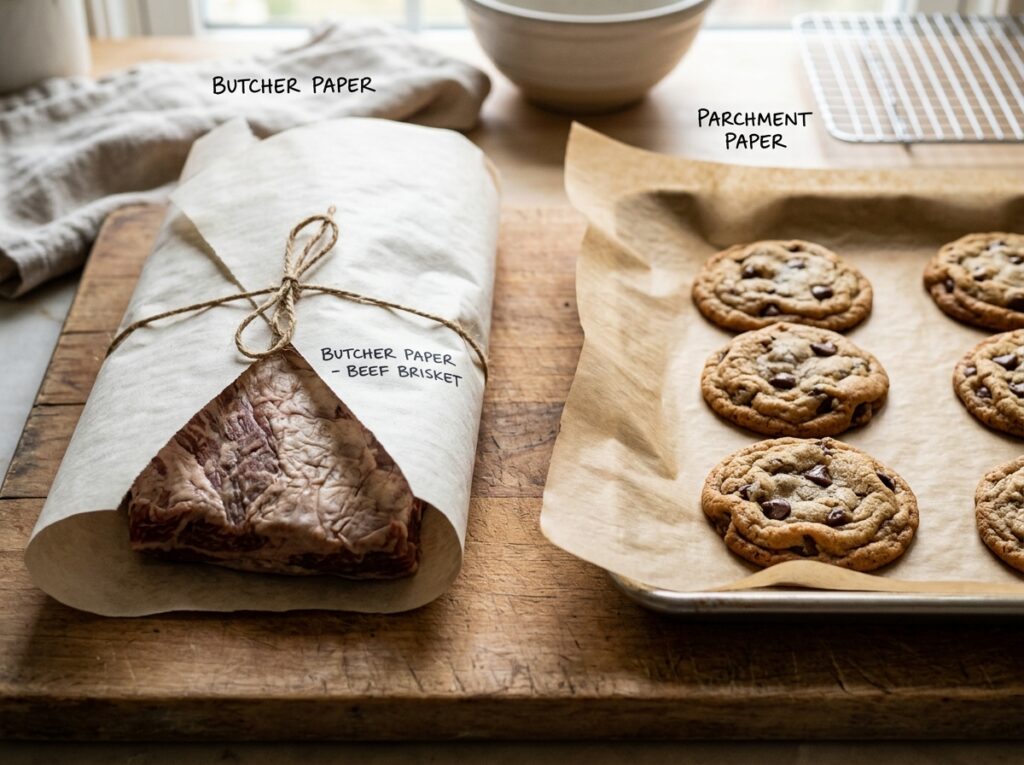
Butcher Paper vs Parchment Paper: Which One Do You Really Need?
You’re standing in the grocery aisle staring at two rolls that look almost identical. One says butcher paper. The other says parchment paper. Both are brown, both come on a roll, and both seem like they belong in the kitchen. So what’s the actual difference — and does it even matter?
It matters a lot, actually. Grab the wrong one for your brisket wrap, and you’ll end up with soggy, steamed meat instead of a beautiful bark. Use the wrong one in your oven, and you might be scraping burned cookies off a sheet of paper that was never designed for heat. These two products were built for completely different jobs, and mixing them up can ruin your food or even cause a safety issue.
Let’s break down everything — what each paper is made of, how they handle heat, when you should pick one over the other, and a few real-world situations where the choice genuinely changes the outcome of your cook.
What Exactly Is Butcher Paper?
Butcher paper is a thick, sturdy paper originally designed for — you guessed it — butchers. Its primary job was wrapping raw meat at the counter. You’ve probably seen it in its classic white or pink form at delis and meat shops for decades.
The most popular type for cooking is pink butcher paper (sometimes called peach paper). It’s FDA-approved for food contact and treated to resist moisture without being fully waterproof. That’s a key detail. It lets just enough moisture escape to keep meat from getting soggy, while still holding in enough steam to keep things tender.
White butcher paper exists too, but it’s typically used for wrapping sandwiches or lining trays at BBQ joints — not for actual cooking. And there’s also a waxed or poly-coated version that’s strictly for wrapping and storing. You absolutely don’t want to throw that one in a smoker or oven because the coating will melt.
Quick Fact: Pink butcher paper became famous in the BBQ world when Aaron Franklin of Franklin Barbecue in Austin, Texas, started using it to wrap brisket during the stall. It quickly became the gold standard for competitive and backyard pitmasters alike.
The paper itself is usually made from virgin wood pulp, meaning it hasn’t been recycled. That matters because recycled paper can contain chemicals or inks you don’t want touching your food. Good quality pink butcher paper is unbleached, unwaxed, and free of any coatings.
What Exactly Is Parchment Paper?
Parchment paper is a completely different product with a completely different purpose. It’s made by running paper through a bath of sulfuric acid (sounds scary, but the process is totally food-safe and has been used for over a century). This acid bath gelatinizes the surface of the paper, making it non-stick, grease-resistant, and heat-tolerant.
Most parchment paper you’ll find at the store is rated safe up to around 420°F to 450°F (215°C to 230°C), depending on the brand. Some premium versions can handle slightly higher temps, but going above the rated temperature can cause the paper to darken, become brittle, and potentially scorch.
You’ll find parchment paper in two forms — flat sheets (pre-cut to fit standard baking pans) and rolls. Both work the same way. The flat sheets are just more convenient if you’re tired of the roll curling up on you.
Parchment paper is the baking world’s best friend. Cookies, roasted vegetables, fish en papillote, cake layers — if it goes in the oven, parchment paper probably makes it easier. Its non-stick surface means you don’t need to grease your pan, and cleanup is as simple as tossing the paper in the trash.
One thing people often confuse: parchment paper is not wax paper. Wax paper has a thin coating of wax that will melt and smoke in the oven. Parchment paper is treated to resist heat. Mixing these two up is one of the most common kitchen mistakes, and it usually ends with a smoke-filled kitchen and a ruined batch of brownies.
The Core Differences Between Butcher Paper and Parchment Paper
Let’s get into the specific ways these two papers differ, because the differences go well beyond just “one’s for meat, one’s for baking.”
Material and Construction
Butcher paper is thick, dense, and feels almost like a lightweight cardboard. It’s built to be strong enough to wrap heavy cuts of meat without tearing. You can fold it, crumple it, and pull it tight around a 15-pound brisket, and it holds up.
Parchment paper is thinner, smoother, and has a slight sheen from the silicone or acid treatment. It’s flexible and easy to cut, but it doesn’t have the structural strength of butcher paper. Try wrapping a brisket in parchment paper and you’ll find it tears, falls apart from the moisture, and generally can’t handle the job.
Heat Tolerance
This is where the practical difference really shows up. Parchment paper has a defined heat limit — usually around 420°F to 450°F. Stay within that range and it performs beautifully. Go above it, and it can burn.
Pink butcher paper doesn’t have a silicone coating, so it doesn’t have the same kind of “heat rating.” But because it’s used in smokers that typically run between 225°F and 275°F, it handles those low-and-slow temperatures just fine. You can also use it in an oven at moderate temperatures. At very high heat (above 450°F), it’ll scorch and potentially catch fire — same as any paper product.
Moisture Behavior
Here’s the real game-changer. Parchment paper traps moisture. It creates a sealed, steamy environment around your food. That’s great for baking, where you want even heat distribution and no sticking. It’s not great for BBQ, where you want smoke to penetrate and bark to form.
Butcher paper is semi-permeable. It lets some moisture escape while retaining enough to keep meat juicy. Think of it as breathable packaging for your brisket. Smoke particles can still pass through the paper and reach the meat surface, so you don’t lose that smoky flavor or the crusty bark you’ve been building for hours.
This is exactly why pitmasters prefer butcher paper over aluminum foil for wrapping brisket — foil traps everything and can make the bark mushy, while butcher paper preserves it.
Non-Stick Properties
Parchment paper wins this category hands down. Its silicone-treated surface means almost nothing sticks to it. Melted cheese, sticky caramel, wet cookie dough — all slide right off.
Butcher paper has zero non-stick properties. If you bake cookies on butcher paper, they’ll stick. If you roast something sugary on it, you’ll be scraping it off. It simply wasn’t designed for that purpose.
When to Use Butcher Paper
Butcher paper really shines in a few specific situations. Let’s talk about each one.
BBQ and Smoking Meat
This is butcher paper’s greatest strength. If you’re smoking brisket, pork butt, or pork ribs, wrapping in pink butcher paper during the stall (that frustrating period when the internal temperature plateaus around 150°F–170°F) helps push through the stall faster while protecting your bark.
The result? A brisket with a dark, flavorful crust on the outside and juicy, tender meat inside. If you’ve been tracking your internal pork butt temp during a long smoke, you know how valuable it is to power through that stall without sacrificing texture.
The same logic applies to pork tenderloin. Whether you’re finishing a pork tenderloin in the oven at 400°F or pulling it off the smoker, wrapping in butcher paper during the resting period helps maintain the right moisture balance.
Wrapping and Storing Raw Meat
Butcher paper’s original purpose still makes sense today. If you buy meat from a local butcher or farmer’s market, wrapping it in butcher paper for short-term fridge storage works well. It lets the surface breathe slightly, which can help prevent the slimy texture that plastic wrap sometimes creates on fresh cuts.
For longer storage, though, you’ll want to switch to vacuum sealing or airtight freezer bags.
Table Covering and Presentation
This one’s more about style than cooking, but it’s worth mentioning. BBQ restaurants across Texas and the South use butcher paper as table covering. It’s cheap, disposable, and adds that rustic, authentic feel. Some places serve your smoked meat directly on a sheet of pink butcher paper — no plate needed.
When to Use Parchment Paper
Parchment paper belongs in the oven, on the baking sheet, and inside cake pans. Here’s where it truly earns its spot in your kitchen.
Baking
Cookies, scones, biscuits, pastries — anything you bake on a sheet pan benefits from a layer of parchment paper underneath. No greasing needed, no sticking, and your pan stays clean. If you’ve ever had to chisel a burned chocolate chip cookie off an unlined baking sheet, you already understand why parchment paper is worth the small cost.
Parchment paper also gives you more even heat on the bottom of your baked goods. Without it, direct contact with the metal pan can cause the bottoms to brown too fast. With parchment as a buffer, you get a more consistent bake.
Roasting Vegetables
Spread your veggies on a parchment-lined sheet pan, toss with oil and salt, and roast. Cleanup takes 30 seconds. Without parchment, you’re soaking that pan for an hour trying to scrub off caramelized bits. If you’re also working on how long to boil potatoes for a side dish while your roasted veggies are in the oven, you’ll appreciate having one less thing to clean.
En Papillote Cooking
This fancy-sounding French technique just means cooking food sealed inside a parchment paper pouch. Fish is the classic choice — place a salmon fillet on parchment, add herbs, lemon, and a splash of white wine, fold the paper into a sealed packet, and bake. The steam inside the packet cooks the fish gently and evenly. It’s one of the healthiest and most delicious ways to bake salmon at 350°F.
Lining Cake Pans
Cut a circle of parchment to fit the bottom of your cake pan, and your cake layers will pop out cleanly every time. No more cake surgery trying to free a stuck layer with a butter knife. This tiny step takes 30 seconds and saves you from a crumbled disaster.
Reheating Food
Parchment paper works surprisingly well when you’re reheating steak or warming up leftovers in the oven. Place the food on a parchment-lined tray, cover loosely with foil if needed, and the parchment keeps the bottom from sticking or getting overly crispy. The same approach works beautifully when you’re looking to reheat french fries in the oven — parchment helps them crisp up without cementing themselves to the pan.
Can You Swap One for the Other?
This is the question everyone really wants answered. And the short answer is: not really, not without trade-offs.
You can’t use butcher paper as a replacement for parchment paper in baking. It doesn’t have non-stick properties, it’s not treated for oven use the same way, and food will stick to it. You could technically line a sheet pan with it in a pinch, but anything sticky, sugary, or cheese-heavy will bond to the paper like glue.
Going the other direction — using parchment paper instead of butcher paper for smoking — is equally problematic. Parchment traps too much moisture, doesn’t let smoke through, and doesn’t have the structural strength to hold a heavy, juicy brisket together. Your bark will get steamed, and you’ll end up with a soft, mushy exterior instead of that beautiful crust.
Pro Tip: If you’re ever in a situation where you don’t have the right paper, aluminum foil is a more versatile substitute for either one — but it comes with its own trade-offs. For baking, foil works but doesn’t offer the same non-stick performance. For BBQ, foil wraps tighter than butcher paper and traps all moisture, which is fine for some cooks (it’s the basis of the “Texas crutch”) but does soften the bark more.
Pink Butcher Paper vs White Butcher Paper — Does the Color Matter?
You’ll see both pink and white butcher paper at the store, and the color difference isn’t just cosmetic.
Pink (peach) butcher paper is unbleached and typically stronger. It’s the preferred choice for BBQ because it hasn’t been treated with bleaching chemicals, and it holds up better when exposed to heat and moisture over long periods. If you’re wrapping meat that’s going to sit in a smoker for hours, pink is the only option worth considering.
White butcher paper is usually bleached and sometimes slightly thinner. It’s fine for wrapping sandwiches, lining serving trays, or craft projects. But for cooking — especially in a smoker — stick with pink. The bleaching process can weaken the paper, and there’s always the question of whether you want bleaching chemicals near your food at high temperatures, even if they’re technically considered safe.
Butcher Paper vs Parchment Paper vs Wax Paper — The Three-Way Confusion
Since we’re here, let’s clear up the three-way confusion that trips people up constantly.
Wax paper is coated with a thin layer of food-grade wax (paraffin or soy). It’s moisture-resistant and non-stick at room temperature. You can use it for wrapping sandwiches, rolling out dough on a counter, or separating layers of frozen cookies. But it absolutely cannot go in the oven. The wax coating melts, smokes, and can even catch fire.
Parchment paper handles heat up to about 420°F–450°F, is non-stick, and is your go-to for anything that goes in the oven.
Butcher paper is thick, breathable, and built for wrapping meat — whether raw for storage or cooked during smoking. Not designed for baking.
Three different products, three different jobs. Don’t mix them up.
What About Food Safety?
Both butcher paper (the food-grade kind) and parchment paper are FDA-approved for direct food contact. But there are a few things to keep in mind.
Make sure your butcher paper is specifically labeled as food-grade or FDA-approved. Craft butcher paper — the kind sold at art supply stores for drawing or covering tables at kids’ parties — might look identical, but it may contain dyes, chemicals, or coatings that aren’t safe for food contact. Always check the packaging.
With parchment paper, stick to the temperature limits printed on the box. If you’re broiling at 500°F or higher, parchment paper can scorch and break down. It won’t release toxic fumes, but it will darken, crumble, and could potentially ignite if it touches a direct flame or heating element.
Also, don’t reuse either paper excessively. Parchment paper can go through one or two rounds of baking if it’s still intact, but once it gets brittle or darkened, toss it. Butcher paper should be single-use — once it’s been saturated with meat juices, it’s done.
If you’re curious about food safety in general, this ties into the broader theme of storing food correctly — something that matters whether you’re keeping cooked rice in the fridge or storing fried chicken in the fridge for tomorrow’s lunch.
Butcher Paper for Resting Meat — Why It Works So Well
Here’s a practical tip that a lot of home cooks don’t think about. After you pull a steak, brisket, or roast off the heat, you need to rest it. Resting lets the juices redistribute through the meat, so they don’t all pour out the moment you cut into it.
Wrapping meat in butcher paper during the rest is a smart move. It provides a light layer of insulation that keeps the meat warm without trapping so much steam that the surface gets soggy. Your tomahawk steak or Delmonico steak will hold its crust beautifully if you rest it loosely wrapped in butcher paper rather than tightly sealed in foil.
For larger cuts — a whole brisket, a pork cushion meat roast, or a bone-in pork shoulder — you can wrap in butcher paper and then place the wrapped meat in a cooler (without ice) to hold it warm for up to 2-4 hours. This is a classic competition BBQ technique, and it works beautifully for timing your meal when guests are arriving at different times.
Cost and Availability
Parchment paper is everywhere. Every grocery store carries it, and a roll costs between $3 and $7 depending on the brand and length. Reynolds, If You Care, and store brands are all reliable options.
Pink butcher paper is a little more niche. You’ll find it at some grocery stores (especially in BBQ-heavy regions like Texas), but it’s more commonly available online. A roll from brands like Bryco Goods or Pink Butcher Paper Co. runs about $15 to $25 for 150-200 feet — which lasts a long time since you only use it for smoking and wrapping.
If you’re serious about BBQ, investing in a roll of quality pink butcher paper is absolutely worth it. Think of it the same way you’d think about a good chef knife — it’s a tool that makes your cooking better when you use the right one.
FAQ
Can I use butcher paper in the oven instead of parchment paper?
You can use food-grade butcher paper in the oven at low to moderate temperatures (under 400°F), but it won’t perform like parchment paper. Food will stick to it because butcher paper doesn’t have a non-stick coating. For baking cookies, cakes, or roasting vegetables, parchment paper is always the better choice.
Is butcher paper the same as kraft paper?
Not exactly. Kraft paper and butcher paper are both made from wood pulp using a similar process, but butcher paper is specifically manufactured to meet food-safety standards. Kraft paper — the kind used for shipping packages or craft projects — may contain adhesives, recycled materials, or chemical treatments that aren’t food-safe. Always use paper explicitly labeled for food contact.
Can parchment paper go in a smoker?
Technically yes, since most smokers run below 300°F and parchment paper is rated to about 420°F. But it’s not a good choice for wrapping meat in a smoker. Parchment paper traps moisture and doesn’t allow smoke to pass through, which defeats the purpose of smoking. You’ll lose bark development and end up with steamed meat. Stick with pink butcher paper for the smoker.
Is parchment paper toxic when heated?
No. Parchment paper is safe to use in the oven within its rated temperature range. The silicone coating used on most parchment paper is food-grade and stable at baking temperatures. If you exceed the maximum temperature (usually 420°F–450°F), the paper may darken and become brittle, but it doesn’t release harmful chemicals. Just don’t let it touch open flames or direct contact with a broiler element.
Can I freeze meat wrapped in butcher paper?
You can, but it’s not ideal for long-term freezing. Butcher paper isn’t airtight, so meat wrapped only in butcher paper is more susceptible to freezer burn over time. For short-term storage (a few days in the fridge or up to a couple weeks in the freezer), it works fine. For longer freezer storage, wrap in plastic wrap or use a vacuum sealer first, then add a layer of butcher paper on the outside if you want.
Final Thoughts
Butcher paper and parchment paper look similar on the shelf, but they do very different things. Parchment paper belongs in your oven — it’s your non-stick, heat-resistant best friend for baking, roasting, and keeping your pans clean. Butcher paper belongs at the smoker and the cutting board — it’s the breathable wrapper that protects your bark, holds your juices, and lets smoke do its job.
The easiest way to remember? Parchment is for the baker. Butcher paper is for the pitmaster. Keep both in your kitchen, grab the right one for the job, and you won’t have to second-guess yourself at the grocery store ever again.