How Long Does Salmon Take at 350?
Salmon can go from soft and juicy to dry and chalky faster than most people expect. That’s why so many home cooks keep opening the oven and wondering if it’s done yet. If you’re asking how long does it take to bake salmon at 350, the short answer is about 12 to 20 minutes for most fillets. The catch? Thickness matters more than anything else. Once you know how to judge that, salmon gets a whole lot easier to cook well.
How Long Does It Take to Bake Salmon at 350?
If you want the quick answer, here it is: baked salmon at 350°F usually takes 12 to 20 minutes for individual fillets. A large side of salmon often needs 20 to 28 minutes. Those numbers work for thawed salmon in a fully preheated oven.
That range may sound a little broad, but salmon isn’t one-size-fits-all. A thin sockeye fillet and a thick Atlantic salmon portion won’t finish at the same time, even if they weigh about the same.
The good news? 350°F is a forgiving oven temperature. It cooks salmon gently, which gives you a little more room before it dries out.
How long does it take to bake salmon at 350?
For most home kitchens, these times are a good starting point:
| Salmon cut or thickness | Bake time at 350°F | What to expect |
|---|---|---|
| Thin fillet, about 1/2 inch | 8–12 minutes | Edges turn opaque fast |
| Average fillet, about 3/4 inch | 10–14 minutes | Center stays moist |
| Thick fillet, about 1 inch | 12–16 minutes | Sweet spot for most recipes |
| Very thick fillet, 1 1/4 to 1 1/2 inches | 16–20 minutes | Needs temp check in center |
| Whole side of salmon, 2 to 3 pounds | 20–28 minutes | Check thickest middle section |
These times assume you’re baking the salmon uncovered or lightly covered on a sheet pan or in a baking dish.
Quick fact: if your fillet is right around 1 inch thick, start checking it at 12 minutes. Many pieces finish between 14 and 16 minutes.
A lot of people search for an exact minute count, but salmon doesn’t work like boxed mac and cheese. Your oven might run hot. The pan material matters. A cold fillet straight from the fridge cooks a bit slower than one that sat out for 10 to 15 minutes.
That’s why time gets you close, but doneness tells you when to stop.
And if you usually cook other proteins at the same oven temp, salmon can feel surprisingly fast. For example, unlike baking chicken breast at 350, salmon often goes from raw to ready in well under 20 minutes.
What changes the baking time at 350?
Thickness matters more than weight
This is the biggest thing people miss.
A thick, tall fillet takes longer than a wide, flat one. Two salmon pieces can both weigh 6 ounces, but the thicker piece may need several more minutes. Think of it like toast. One thick slice and one thin slice don’t brown at the same pace, even if they came from the same loaf.
So when you’re standing in the kitchen trying to guess bake time, don’t focus only on ounces. Look at the thickest part of the fish.
The type of salmon changes texture, not just flavor
Not all salmon behaves the same way in the oven.
Atlantic salmon is usually thicker and fattier. It tends to stay moist a little longer, which makes it beginner-friendly.
Sockeye is often thinner and leaner. It cooks faster and can dry out faster too.
Coho sits somewhere in the middle, while king salmon is rich and forgiving.
That doesn’t mean you need different rules for every type. It just means a thin wild fillet may be done before your timer says it “should” be.
Did you know? Two fillets that look similar in the package can cook very differently if one is wild sockeye and the other is farm-raised Atlantic salmon.
Skin-on or skinless makes a small difference
Skin-on salmon often holds moisture a bit better. The skin acts like a light barrier between the fish and the hot pan. Skinless pieces can still turn out great, but they need a little more attention so they don’t overcook on the bottom.
If your salmon has skin, bake it skin-side down. That’s the easiest way to do it.
Covered or uncovered changes the feel of the fish
Uncovered salmon gets a slightly more roasted top. Covered salmon traps more moisture and steams a bit as it bakes.
Neither way is wrong.
If you want a softer, gentler result, loosely cover the pan with foil for most of the cook time. If you want a little more color on top, leave it uncovered.
Frozen salmon takes longer
You can bake frozen salmon at 350, but it won’t cook as evenly as thawed salmon. The outside may be ready while the middle still needs time.
If you’re working from frozen, expect the bake time to go up quite a bit. Many frozen portions need 20 to 30 minutes, sometimes more, depending on thickness.
For the best texture, thaw it first in the fridge.
Your pan and oven matter too
A dark metal sheet pan can cook a little faster than a glass baking dish. Some ovens run 15 to 25 degrees hot or cold. That’s enough to throw off your timing.
If salmon always seems overdone at your house, your oven may be hotter than the dial says.
How to bake salmon at 350 so it stays moist
You don’t need a fancy method. You just need a simple routine that keeps the fish from drying out.
A simple method that works almost every time
- Heat your oven to 350°F. Let it fully preheat.
- Pat the salmon dry. This helps the surface cook better.
- Place it on a lined pan. Parchment is great for easy cleanup and less sticking. If you’re not sure which paper belongs in the oven, this guide on butcher paper vs parchment paper clears it up fast.
- Brush with oil or melted butter. Add salt, black pepper, and any seasoning you like.
- Bake until just done. Start checking a few minutes early.
- Rest it for 3 to 5 minutes. Carryover heat finishes the center gently.
That’s it. No complicated trick. No special equipment beyond a sheet pan and, ideally, a thermometer.
Use a thermometer if you want real confidence
A timer is helpful. A thermometer is better.
Insert an instant-read thermometer into the thickest part of the fillet. Don’t push it all the way through to the pan. Aim for the center.
If you’re not fully comfortable using one yet, this quick guide on how to read a meat thermometer makes it simple.
Easy seasoning ideas that work at 350
Salmon doesn’t need much to taste good.
A basic mix of olive oil, salt, pepper, garlic, and lemon works almost every time. If you want something sweeter, try honey and Dijon mustard. If you want more depth, use soy sauce, ginger, and a little brown sugar. For a fresh flavor, go with dill, parsley, and butter.
The main thing is not to bury the fish under a heavy coating that burns before the salmon finishes.
Pro tip: If your marinade has sugar, check the salmon a bit earlier. Sugary glazes color quickly.
Don’t crowd the pan
Salmon needs space around it so hot air can move. If you pack several fillets tightly together with a pile of vegetables, the pan steams more than it roasts. That can slow browning and make the texture softer.
A little space fixes a lot.
How to tell when baked salmon is done
This is where most people get nervous. The timer says one thing. The fish looks half-ready. You poke it again. Then suddenly it’s dry.
Here’s the easier way to judge it.
Use temperature for the safest answer
For food safety, the USDA recommends cooking fish to 145°F in the thickest part.
At that point, the flesh should be opaque and separate easily.
Some cooks prefer salmon at a lower internal temperature, often around 125°F to 135°F, because it feels softer and more buttery. That can be a texture choice, but it is not the official food safety standard.
If you’re cooking for kids, older adults, pregnant people, or anyone with a weaker immune system, it’s smart to stick with the official 145°F guidance.
Look for visual signs too
Done salmon usually changes in three clear ways.
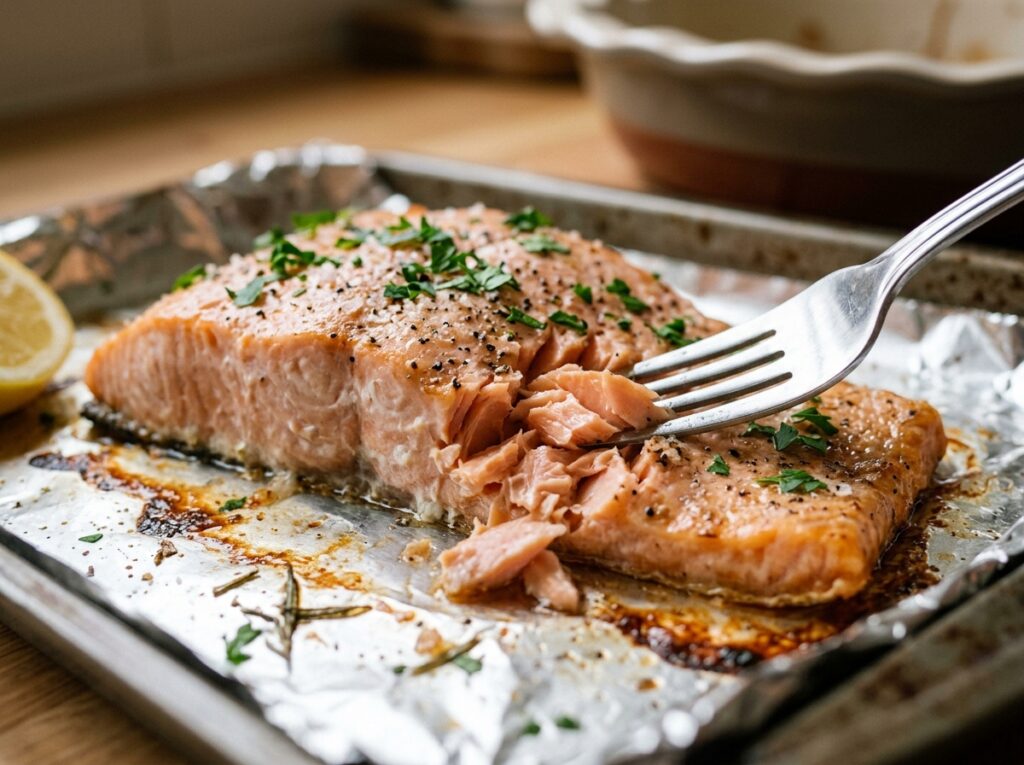
The outside turns from shiny and translucent to more opaque. The layers begin to separate. If you press gently with a fork or finger, the fish gives a little and starts to flake.
You don’t want it to look bone dry. You want it to look set, moist, and tender.
A lot of good salmon still has a slightly deeper color in the center, especially right after it comes out of the oven. Resting finishes the job.
Common misconception: wait until it flakes hard
That’s often too late.
People hear “cook until it flakes” and keep going until the fish falls apart into dry chunks. Good salmon should flake with light pressure, not crumble like canned tuna.
Think of it like brownies. You don’t wait until they look dry to call them done. You pull them when they still have some softness left.
What about the white stuff on top?
That white stuff is called albumin. It’s a protein that comes out of salmon as it cooks.
It looks a little odd, but it’s harmless.
You’ll usually see more of it when salmon cooks too fast or too long. Lower heat, gentler cooking, and pulling the fish earlier can help reduce it.
Warning: Don’t judge doneness by albumin. Some perfectly cooked salmon shows a little. Some overcooked salmon shows a lot.
Real timing examples for baking salmon at 350
Sometimes a plain number feels too abstract. Real kitchen examples make it easier.
Example 1: A normal weeknight fillet
You bought two Atlantic salmon fillets, each about 6 ounces and close to 1 inch thick.
Bake them at 350°F and start checking around 12 minutes. Most likely, they’ll be ready in 14 to 16 minutes.
That’s the classic home-cook scenario.
Example 2: A thin wild sockeye piece
Now picture a thinner sockeye fillet. It’s only about 1/2 inch thick at the narrow end and maybe 3/4 inch in the center.
That piece might be done in 9 to 11 minutes. If you use the 16-minute timing from a thicker Atlantic fillet, it can dry out fast.
This is why thickness beats weight.
Example 3: A big side of salmon for dinner guests
Say you’re baking a 2-pound side of salmon for four or five people.
At 350°F, it often takes about 22 to 26 minutes, depending on the thickest section. Start checking earlier if the tail end is thin.
One trick helps here: if the tail section is very slim, tuck it slightly under itself so the whole piece cooks more evenly.
Example 4: Salmon with a fast side
Want a full dinner without juggling four burners?
Bake salmon with asparagus, green beans, or cherry tomatoes. Those vegetables cook on a similar timeline. Potatoes are different. They need longer, so get those going first.
If potatoes are part of the plan, this guide on how long to boil potatoes can help you time everything without stress.
Common problems and easy fixes
Even simple foods can go sideways. Here’s what usually happens with salmon, and what to do next time.
The salmon turned out dry
That usually means one of three things happened: it baked too long, your oven runs hot, or the fillet was very lean and thin.
Next time, start checking earlier. Add a little oil or butter on top. You can also cover it loosely for part of the bake.
A small timing change makes a big difference with fish.
The middle still looks undercooked
No panic. Put it back in the oven for 2 to 4 minutes and check again.
Salmon is forgiving enough for a quick return trip. Just don’t add another full 10 minutes out of frustration. That’s how it goes from underdone to overdone in one shot.
The skin stuck to the pan
Use parchment paper. It’s the easiest fix.
You can also let the salmon rest a minute before lifting it. Sometimes the skin releases more cleanly once the fish settles.
The thin end cooked before the thick end
That happens a lot with whole sides.
Fold the narrow tail section under slightly before baking. That evens out the shape, so the whole piece finishes closer together.
The fish tasted good but looked messy
That’s usually albumin or torn skin.
Neither one ruins the meal. If presentation matters, use a wide spatula, line the pan, and don’t move the salmon until it’s done resting.
What to serve with baked salmon, plus storage tips
A lot of people don’t stop at “How long does it take to bake salmon at 350?” They also want dinner to make sense as a whole.
Easy sides that fit the timing
Salmon pairs well with simple sides because it already has plenty of flavor.
Roasted asparagus, green beans, rice, couscous, and a crisp salad all work. If you meal prep rice bowls for lunch, make sure your leftover rice is still safe to use. This quick guide on how long cooked rice lasts in the fridge is worth bookmarking.
You don’t need a restaurant plate here. A piece of salmon, some potatoes, and a lemon wedge can feel like a full dinner with very little effort.
How long cooked salmon lasts
Cooked salmon usually keeps in the fridge for 3 to 4 days in an airtight container.
Let it cool slightly, then refrigerate it within 2 hours. If your kitchen is very warm, don’t stretch that time.
Best way to reheat it
Low and slow works better than blasting it in the microwave.
A gentle reheat in the oven, around 275°F, helps keep it from drying out. You only need to warm it through, not cook it again.
Cold leftover salmon also works really well in salads, grain bowls, and wraps.
Pro tip: Leftover baked salmon mixed with rice, cucumber, and a little sauce makes a fast lunch that doesn’t feel like leftovers at all.
4. FAQ Section
FAQ
Is it better to bake salmon at 350 or 400?
Both can work, but they give you different results.
350°F is gentler and gives you a bigger margin before the fish overcooks. It’s a great choice if you want tender, moist salmon and less stress.
400°F cooks faster and can give you a slightly more roasted finish on top. If you already know your timing well, 400 can be great. If you often overcook fish, 350 is usually the safer bet.
Do you bake salmon covered or uncovered at 350?
You can do either one.
Bake it uncovered if you want a lightly roasted top and a firmer surface. Bake it covered loosely with foil if you want softer, moister salmon with more gentle heat.
Most home cooks bake salmon uncovered at 350, then cover it only if they’re worried about drying it out.
Can salmon be a little pink in the middle?
It can look slightly deeper in color in the center and still be fine, especially right after it leaves the oven. Color alone doesn’t tell the full story.
For the safest result, use a thermometer and cook salmon to 145°F in the thickest part, based on USDA guidance. If you prefer a softer center, know that many cooks pull salmon earlier for texture, but that is outside the official food safety standard.
Can you bake frozen salmon at 350?
Yes, you can. It just takes longer.
Frozen salmon at 350°F often needs 20 to 30 minutes, sometimes more, depending on thickness. The texture is usually better if you thaw it first in the fridge.
If you bake it from frozen, season once the surface softens a bit, and use a thermometer so you don’t guess.
Should I bake salmon on foil or parchment paper?
Both work, but parchment is usually easier for everyday baking.
Parchment helps prevent sticking and cleanup is simple. Foil is handy if you want to make a sealed packet with lemon, herbs, and butter.
If you’re choosing between the two, parchment is often the easier pick for basic baked salmon.
5. Conclusion
If you remember just one thing, make it this: most salmon fillets bake at 350°F in 12 to 20 minutes, and thickness matters more than anything else. Start checking early, use a thermometer if you can, and don’t wait for the fish to look dry before pulling it out.
Next time salmon is on your menu, look at the thickest part, set your timer a little early, and trust the signs. That small habit is what turns “pretty good” salmon into the kind you’ll want to make again next week.