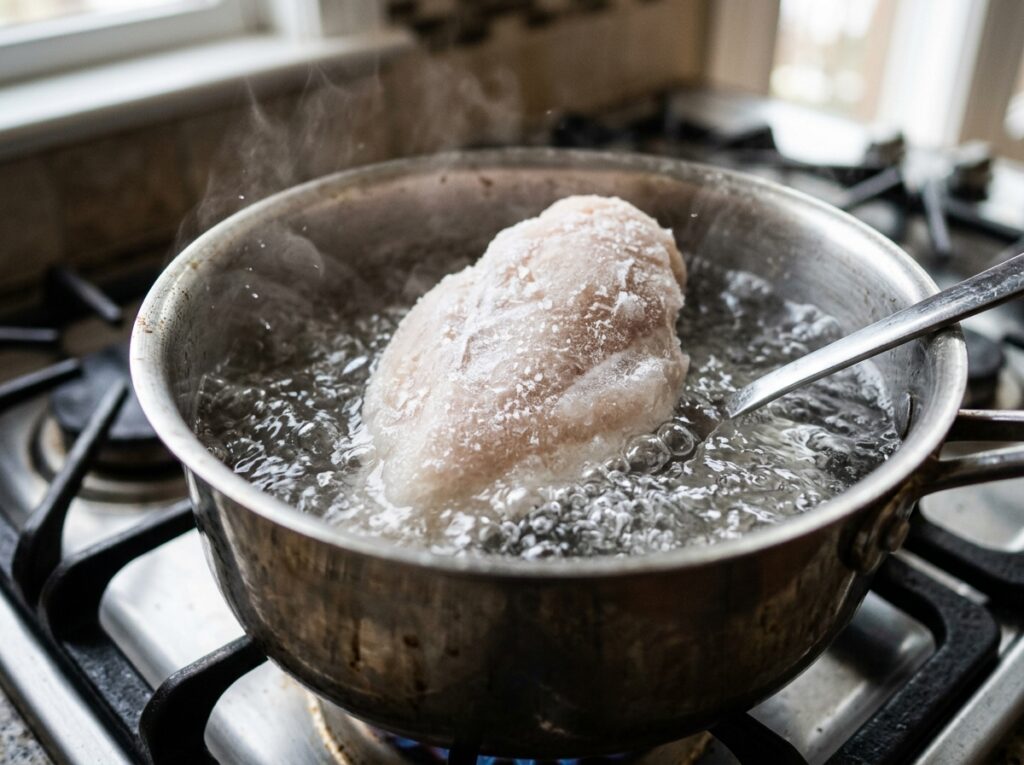
Can You Boil Frozen Chicken Without Thawing?
Dinner panic usually shows up right around the time you’re hungry. You open the freezer, grab the chicken, and realize it’s still rock solid. So now what? Takeout again?
Here’s the good news: yes, you can boil frozen chicken. You don’t need to thaw it first, and it can still be safe to eat. You just need to cook it long enough, use the right heat, and make sure the thickest part reaches 165°F (74°C).
A lot of people search this because they want one clear answer. Is it safe? How long does it take? Will the chicken turn rubbery? Can you use it for shredded chicken or soup? Let’s sort it out in plain English.
The Short Answer: Can You Boil Frozen Chicken?
Yes, you can boil frozen chicken safely if you cook it straight from frozen and bring it to an internal temperature of 165°F. That’s the number that matters.
The USDA has long said frozen poultry can be cooked without thawing first. The catch is simple: it usually takes about 50% longer than thawed chicken.
So if your usual chicken breast takes 15 to 20 minutes to simmer, the frozen version may need 25 to 30 minutes. Bigger pieces can take longer.
That said, not every frozen chicken situation is a great fit for boiling. Boneless breasts, thighs, tenderloins, and smaller bone-in pieces work well. A whole frozen chicken is a different story. It’s awkward, slow, and much harder to cook evenly on the stovetop.
Quick facts:
- Yes, you can boil frozen chicken without thawing
- 165°F is the safe internal temperature
- Frozen chicken usually needs about 50% more time
- A gentle simmer gives better texture than a hard boil
- It works best for soups, shredded chicken, and meal prep
- It’s not a good slow cooker job from frozen
Boil vs simmer: what actually works best?
Most people say “boil,” but a full rolling boil isn’t your best friend here.
If you boil chicken like pasta, the outside can tighten up fast and turn chewy before the center cooks through. A gentle simmer is better. Think of small bubbles, not wild splashing.
A good method is to bring the liquid up to a boil, then lower the heat so the chicken cooks steadily. You’ll still get the job done safely, but the meat stays more tender.
Did you know? Many cooks “boil” chicken for shredding, but what they’re really doing is simmering or poaching it.
Is It Safe to Boil Frozen Chicken?
Yes, it’s safe if you handle the temperature properly.
Frozen chicken isn’t safer just because it’s frozen. Freezing slows bacteria, but it doesn’t kill everything. Raw chicken can still carry bacteria like Salmonella or Campylobacter. Heat is what makes it safe.
That’s why the real safety rule isn’t “was it frozen?” The real rule is: did the chicken reach 165°F all the way through?
What makes it safe
Water transfers heat very well. That’s why boiling or simmering frozen chicken on the stovetop can work fine. The heat moves into the meat, the ice melts, and the chicken cooks through.
The danger comes from guessing.
Color alone won’t tell you enough. Clear juices don’t always tell you enough either. The thickest part can still be undercooked while the outside looks done.
If you’re not used to checking meat, this guide on how to read a meat thermometer makes it simple.
Why 165°F matters
For chicken, 165°F is the safe internal temperature recommended by USDA food safety guidance. You want that reading in the thickest part of the meat, away from bone.
Some people still ask if chicken is okay at 145°F. It isn’t the simple target you want for everyday home cooking. If you want the full breakdown, this post on is 145 safe for chicken clears that up.
Why a slow cooker is different
Here’s where people get tripped up.
You can boil frozen chicken on the stove, but you shouldn’t cook frozen chicken in a slow cooker. A slow cooker can keep the chicken in the food safety “danger zone” for too long, especially in the early part of cooking.
That danger zone sits between 40°F and 140°F. Bacteria grow fastest there.
A pot on the stove heats up much faster. That’s why it’s a safer option than tossing a frozen block of chicken into a slow cooker and hoping for the best.
Warning: If you’re cooking for a pregnant person, an older adult, a child, or someone with a weak immune system, be extra strict with temperature and storage. This is general food safety guidance, not personal medical advice.
How to Boil Frozen Chicken the Right Way
If you do it right, boiled frozen chicken can be easy, juicy, and useful for all kinds of meals.
Best cuts for boiling from frozen
The easiest cuts are the ones that cook fairly evenly:
- boneless chicken breasts
- boneless thighs
- tenderloins
- drumsticks or smaller bone-in pieces
You’ll get the best results if the pieces are similar in size. If one breast is huge and the other is tiny, one will likely overcook before the other finishes.
A whole frozen chicken is possible in theory, but it’s not very practical. The outside can overcook badly before the deepest parts are safe. If you’re working with a full bird, thawing first is the smarter move.
Step-by-step method
Here’s the simple stovetop method that works for most raw frozen chicken pieces.
- Put the frozen chicken in a pot.
Use a pot large enough so the pieces aren’t crammed together. - Cover with water or broth.
Aim for about an inch of liquid over the chicken. - Add basic flavor.
Salt, pepper, garlic, onion, bay leaf, or a little bouillon can help a lot. - Bring the liquid to a boil.
Use medium-high heat. - Lower it to a gentle simmer.
Once the water boils, reduce the heat so it cooks steadily. - Separate pieces if needed.
If the chicken was frozen together, wait a few minutes, then use tongs to pull the pieces apart gently. - Check the internal temperature.
Don’t stop cooking until the thickest part hits 165°F. - Rest it for a few minutes.
Then slice, chop, or shred it.
That’s it. No thawing drama.
A real kitchen example
Say you’ve got two frozen boneless chicken breasts and want shredded chicken for tacos.
You place them in a pot with chicken broth, half an onion, a smashed garlic clove, a pinch of salt, and black pepper. Bring it to a boil, lower to a simmer, and let them cook until the center reaches 165°F.
Once they rest for 5 minutes, you shred them with two forks. The broth in the pot now has extra flavor too, so you can use it for soup, rice, or sauce.
That’s one reason this method is so popular. It solves dinner fast and doesn’t waste effort.
Pro tip: Broth gives you better flavor than plain water. If all you have is water, add salt and aromatics so the chicken doesn’t taste flat.
How Long Does Frozen Chicken Take to Boil?
This is usually the next question, and it makes sense. You want dinner, not a science project.
The short answer: it depends on the cut, thickness, and whether it’s bone-in or boneless.
A good rule is to expect about 50% more time than thawed chicken. Still, use that as a rough guide, not a finish line.
Typical simmer times for frozen chicken
These time ranges are for raw frozen chicken pieces cooked at a gentle simmer after the liquid comes back up to temperature.
| Chicken cut | Typical time from frozen | Best use |
|---|---|---|
| Tenderloins | 15–20 minutes | wraps, salads |
| Small boneless breasts | 20–25 minutes | slicing, bowls |
| Large boneless breasts | 25–30 minutes | shredding |
| Boneless thighs | 25–30 minutes | tacos, meal prep |
| Bone-in thighs or drumsticks | 30–40 minutes | soups, hearty meals |
If your chicken pieces are very large, packed tightly, or frozen into a thick block, add more time and check the temperature in more than one piece.
How to tell it’s done without guessing
The safest answer is still the thermometer.
Check the thickest part. If it reads 165°F, you’re good.
You can also look for signs that support the reading:
- the meat looks opaque all the way through
- the center is no longer glossy or raw-looking
- the fibers pull apart easily after a short rest
Still, don’t rely on clear juices alone. That’s a common kitchen shortcut, but it can fool you.
Common misconception: Chicken that looks white on the outside isn’t always cooked in the center.
Common Problems: Dry, Rubbery, or Uneven Chicken
Boiled chicken gets a bad reputation for one reason: people often overcook it.
If your chicken turns out tough, stringy, or bland, the method usually needs a small fix.
Why boiled chicken gets tough
The biggest texture mistake is using a hard rolling boil the whole time.
That much heat makes the muscle fibers tighten up fast. The result? Dry chicken that feels a little like chewing a sponge. Not ideal.
Another problem is leaving the chicken in the pot long after it’s done. Once it hits 165°F, you don’t gain extra safety by cooking it for another 15 minutes. You just lose moisture.
If you run into texture issues often, this piece on chewy chicken causes and fixes can help you spot the reason fast.
What to do if the pieces are frozen together
This is super common.
You buy a bag of chicken breasts or thighs, and the whole thing freezes into one solid chunk. Don’t try to force it apart with a knife on the counter. That’s how slips and cuts happen.
Instead, place the block in the pot, start heating the liquid, and wait a few minutes. As the outer layer softens, use tongs to gently separate the pieces.
If the block is very large, thawing first may be the easier call. If you go that route, make sure you store it safely. Here’s a practical guide on thawed chicken in the fridge so you know how long you’ve got.
Why the flavor can seem flat
Water cooks chicken, but it doesn’t add much by itself.
If you boil frozen chicken in plain water with no seasoning, you’ll get edible chicken, but not very exciting chicken. Salt helps. So do onion, garlic, peppercorns, herbs, or broth.
Think of it like making tea. Hot water alone does the heating, but the good stuff needs time and flavor around it.
When boiling isn’t the best method
Boiling frozen chicken is great for speed and convenience. But if you want browned edges, roasted flavor, or crisp skin, the stovetop isn’t the winner.
For that kind of result, baking is better. If you want that route for boneless meat, this post on how to bake chicken breast at 350 is a useful next step.
Storing and Using Boiled Frozen Chicken
Once your chicken is cooked, the next part matters too. Safe cooking can still go sideways if the storage is sloppy.
How long it lasts after cooking
Cooked chicken usually keeps for 3 to 4 days in the fridge if you cool it and store it properly. Use a sealed container and refrigerate it within 2 hours of cooking.
If your kitchen is very warm, don’t push that time.
You can also freeze cooked chicken for longer storage. It keeps its best quality for a few months, especially if you shred it and store it with a little broth to protect the texture.
Don’t leave it sitting out
This part gets ignored all the time.
If the chicken sat on the counter too long after cooking, don’t gamble with it. Food poisoning isn’t worth saving a few dollars. If you’re unsure about that situation, read this guide on chicken left out overnight before you decide.
Best ways to use boiled frozen chicken
This cooking method shines when you need simple, ready-to-use chicken.
It works really well for:
- shredded chicken tacos
- chicken salad
- soups and noodle bowls
- sandwiches and wraps
- quick pasta dishes
Did you know? The liquid left in the pot can turn into a light homemade broth. Strain it, taste it, and save it for soup or rice.
4. FAQ Section
Frequently Asked Questions
Can you boil frozen chicken without thawing?
Yes, you can boil frozen chicken without thawing it first. The key is to cook it fully and make sure the thickest part reaches 165°F (74°C). Frozen chicken usually takes about 50% longer than thawed chicken.
How long does it take to boil frozen chicken breast?
Most frozen chicken breasts take 20 to 30 minutes at a gentle simmer, depending on size and thickness. Small breasts cook faster. Large ones can take longer. Always check with a thermometer instead of relying on time alone.
Can you boil frozen chicken for shredding?
Yes, and it’s actually one of the best uses for this method. Simmer the frozen chicken in water or broth until it reaches 165°F, let it rest for a few minutes, then shred it with forks or a mixer.
Is it better to thaw chicken before boiling?
Thawing can give you more even cooking and slightly better texture, especially with large pieces. Still, it’s not required. If you’re short on time, boiling from frozen is a safe and practical option.
Can you put frozen chicken straight into boiling water?
Yes, you can. A lot of people do exactly that. Just make sure the water returns to a boil, then lower it to a simmer and cook until the chicken reaches 165°F internally.
Can you boil a whole frozen chicken?
It’s not the best method. A whole frozen chicken is hard to cook evenly on the stovetop, and the outer meat may overcook before the center is safe. Thawing first or using the oven is usually the better choice.
5. Conclusion
If your chicken is frozen solid, you don’t need to scrap dinner. You can boil frozen chicken safely, and for shredded chicken, soup, or simple meal prep, it’s one of the easiest fixes in the kitchen.
Just remember the three things that matter most: cook it from frozen, keep it at a gentle simmer, and check for 165°F.
So the next time you forget to thaw the chicken, don’t panic. Grab a pot, use a thermometer, and let the stove save the night.