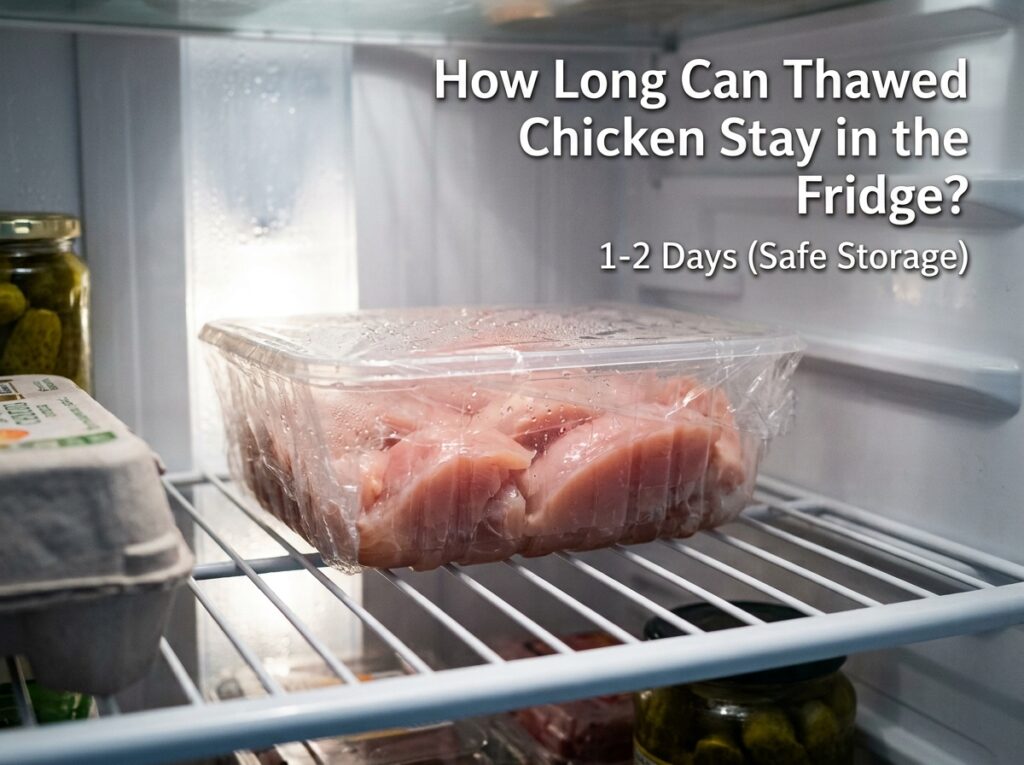
Thawed Chicken in the Fridge: Safe Time Guide
Raw chicken doesn’t give you much wiggle room. If you’re asking how long can thawed chicken stay in the fridge, the safe answer for raw chicken is usually 1 to 2 days. That’s the rule most home cooks need right away. The part that trips people up is simple: the clock changes based on how you thawed it, how cold your fridge is, and whether the chicken is raw or cooked.
The short answer
Here’s the clear version.
Raw thawed chicken can stay in the fridge for 1 to 2 days if you thawed it in the refrigerator and kept it at 40°F (4°C) or below.
That applies to most raw chicken cuts, including breasts, thighs, wings, drumsticks, and even a whole chicken. Ground chicken follows the same basic fridge rule too.
If you thawed the chicken in cold water or in the microwave, don’t put it back in the fridge and wait a day or two. Cook it right away. Faster thawing methods can warm parts of the meat more than you think.
If the chicken is already cooked and you thawed it in the fridge, you usually have 3 to 4 days to eat it. That’s a different clock from raw chicken.
Quick facts:
- Raw chicken thawed in the fridge: 1 to 2 days
- Chicken thawed in cold water: cook immediately
- Chicken thawed in the microwave: cook immediately
- Cooked chicken thawed in the fridge: 3 to 4 days
- Safe fridge temperature: 40°F (4°C) or below
USDA food safety guidance backs those time frames, and they’re worth following. Chicken isn’t a “smell it and hope for the best” food.
Did you know? Freezing doesn’t kill every germ in chicken. It mostly pauses growth. Once the meat thaws, bacteria can start multiplying again.
What changes how long thawed chicken lasts in the fridge?
Was it thawed in the fridge, cold water, or the microwave?
This is the biggest factor.
If you thawed chicken in the fridge, you get that 1 to 2 day window for raw meat. That’s the safest thawing method because the chicken stays cold the whole time.
If you thawed it in a bowl of cold water, the outside of the chicken can warm up faster than the center. The same thing happens in the microwave. That’s why USDA guidance says to cook it immediately after those methods.
A lot of people do this: they thaw chicken in water because dinner is in two hours, then plans change, and they slide it into the fridge for tomorrow. That feels harmless. It’s not the safest move. Parts of the chicken may already be warm enough for bacteria to grow.
If you’re often short on time, it helps to know you can sometimes skip thawing altogether. For example, you can boil frozen chicken safely instead of racing the fridge clock.
Is your fridge actually cold enough?
Plenty of fridges say they’re cold. Not all of them are.
The safe range is 40°F (4°C) or below, but many people don’t check the real temperature. A crowded fridge, a weak seal, or constant door opening can push the inside temp higher than you think.
Try to keep chicken in the coldest part of the fridge, usually near the back on a lower shelf. Don’t leave it in the door. The door warms up every time someone grabs milk, juice, or leftovers.
A fridge that runs closer to 37°F to 38°F gives you a better cushion. You still shouldn’t stretch raw thawed chicken past 2 days, but you’re less likely to drift into risky territory.
Is it raw or already cooked?
This one causes a lot of mix-ups.
Raw thawed chicken has a short fridge life: 1 to 2 days.
Cooked chicken thawed in the fridge usually lasts 3 to 4 days. That’s closer to the storage rule for leftovers. So if you froze grilled chicken, shredded chicken, or cooked soup chicken, you’ve got more room after thawing than you would with raw meat.
If you’re dealing with leftovers instead of raw poultry, the timing works more like other cooked chicken storage guides, such as fried chicken in the fridge.
Does marinated chicken last longer?
Not really.
A marinade might add flavor, tenderness, and color. It doesn’t turn raw chicken into a longer-lasting food. If the chicken is raw and thawed, the safe fridge window is still 1 to 2 days.
Some people think lemon juice, vinegar, or yogurt “preserves” the meat. It doesn’t protect you from the usual bacteria risks in any meaningful way at home fridge temperatures.
What about unopened or vacuum-sealed chicken?
An unopened package can stay fresher in terms of smell and texture, but it doesn’t magically get a free pass on food safety time.
If it’s raw and fully thawed in the fridge, stick to the same 1 to 2 day rule unless the package label gives stricter instructions. The label on your specific product always deserves a quick look.
Can you tell if thawed chicken has gone bad?
Don’t trust smell alone
Your nose can help, but it can’t do the whole job.
Chicken can carry bacteria like Salmonella and Campylobacter without giving off a strong warning smell. That’s why time and temperature matter so much. A package can smell normal and still be unsafe.
Think of smell like a smoke alarm. If it goes off, you know something’s wrong. If it stays quiet, that doesn’t prove the house is safe.
Signs you should toss thawed chicken
A few signs do make the answer easier.
Throw it out if you notice:
- A sour or rotten smell
- A slimy or sticky surface
- Gray, green, or dull yellow patches
- A package that looks puffy, swollen, or leaking badly
- A texture that feels off in a way you can’t ignore
You don’t need every sign on that list. One clear warning is enough.
That said, here’s the part people don’t love hearing: even if it looks fine, raw thawed chicken that has been in the fridge more than 2 days should usually be tossed. Time beats appearance.
Warning: If the chicken sat out too long before you put it in the fridge, the fridge doesn’t “fix” it. Cold storage slows bacterial growth. It doesn’t undo unsafe time at room temperature.
Do sell-by and use-by dates still matter after freezing?
Yes, but not in the way people often think.
A sell-by date mostly helps stores manage stock. It’s not a timer that suddenly flips chicken from safe to unsafe at midnight.
A use-by date is more about quality and the maker’s recommendation. It still matters, but freezing changes the timeline because freezing pauses the spoilage clock.
Here’s the simple rule: if you froze raw chicken before it spoiled, then thawed it later in the fridge, you still want to use it within 1 to 2 days after thawing.
So if the pack had a close date before freezing, don’t assume you bought yourself a week once it thawed. You didn’t.
What if it still has ice crystals?
That usually means it isn’t fully thawed yet.
In practical terms, the “thawed chicken” clock hasn’t fully started if the center is still icy and stiff. But don’t use that as a loophole to drag things out for days. Once it’s thawed enough to cook easily, plan to use it soon.
A little frost is one thing. A fully soft package sitting in the fridge for day after day is a different story.
Real-life thawed chicken scenarios
“I thawed it overnight. Can I cook it tomorrow?”
Most likely, yes.
If you moved raw chicken from the freezer to the fridge last night and it thawed by this morning, tomorrow is usually still okay. That lands inside the 1 to 2 day safe window.
Here’s an easy way to think about it:
If the chicken becomes fully thawed on Monday, then Tuesday is fine and Wednesday is usually your outer edge. By Thursday, you’re pushing past the safe range.
Don’t obsess over the exact hour unless you need to. Just don’t let “I thawed it last night” turn into “I forgot about it until three days later.”
“It’s been in the fridge for 3 days. Is it still okay?”
For raw thawed chicken, 3 full days is usually too long.
Could some people still cook it? Yes. Should you count on that being safe? No.
Food poisoning isn’t always dramatic right away. It can show up later, and chicken is one of the foods that deserves a stricter line. If it’s been fully thawed in the fridge for 3 days, the safer call is to throw it out.
If it’s only been thawing in the fridge for 3 days and is still partly frozen in the middle, that’s a little different. Large birds take longer to thaw. But once it’s fully thawed, start that 1 to 2 day countdown.
“I thawed it on the counter for a bit”
This is where trouble starts.
Raw chicken should not stay in the danger zone between 40°F and 140°F for long. If it sat at room temperature for more than 2 hours, toss it. If the room was very warm, around 90°F (32°C) or higher, that drops to 1 hour.
A lot of people say, “But the center was still cold.” The center isn’t the whole story. Bacteria grow on the surface first, and the outside warms up fast.
If the chicken was left out all night, don’t try to save it. Our guide on chicken left out overnight explains why that’s a hard no.
“I forgot to cook it. Can I refreeze it?”
Sometimes, yes.
You can refreeze raw chicken if you thawed it in the fridge and kept it cold the whole time. USDA guidance allows that. The catch is quality. The texture may get a little worse after another freeze-thaw round.
If you thawed the chicken in cold water or in the microwave, don’t refreeze it raw. Cook it first, then cool it and freeze the cooked chicken if you need more time.
A good middle-ground move is this: if day 2 is almost over and you still won’t cook it tonight, cook it now in a simple way. Bake it, poach it, or pan-cook it. Then you’ve turned a short shelf-life raw food into cooked chicken that usually keeps 3 to 4 more days in the fridge.
“The package smells fine. Can I push one more day?”
I wouldn’t.
That extra day feels small, but with raw poultry it’s a gamble that doesn’t pay off. Chicken is cheaper than a miserable weekend with stomach cramps and diarrhea.
Pro tip: Write the thaw date on the package with tape or a marker. That one tiny habit saves a lot of guessing later.
Best ways to store and cook thawed chicken
Simple storage steps that help you get the full safe window
You can’t make thawed raw chicken last a week. You can make sure you get the safest version of those 1 to 2 days.
Do these simple things:
- Keep it on a plate or tray so juices don’t drip
- Store it on the bottom shelf of the fridge
- Leave it in its original wrap or a sealed container
- Label it with the date it thawed
That’s it. Nothing fancy. Just clean, cold, and contained.
If the pack is leaking, rewrap it or move it to a sealed bowl right away. Cross-contamination causes as many kitchen problems as spoiled meat itself.
Cook it to the right temperature
Safe storage matters, but safe cooking matters too.
Chicken should reach an internal temperature of 165°F (74°C) in the thickest part. Don’t guess by color alone. Pink can be misleading, and clear juices aren’t a perfect test either.
A cheap probe thermometer makes life much easier, especially if you’re still learning how to read a meat thermometer.
And no, 145°F isn’t enough for chicken in normal home cooking. If you’ve seen mixed advice online, check this breakdown on whether 145°F is safe for chicken.
Easy next steps if dinner is tonight
If the chicken is thawed and you’re ready to use it, don’t overthink it.
Cook it the same day if you can. That’s the easiest way to stay on the safe side and avoid waste. If you need a simple plan, you can bake chicken breast at 350 and get dinner sorted without much fuss.
You can also cook thawed chicken in batches for salads, wraps, rice bowls, soups, or sandwiches. Once it’s cooked, your storage window becomes a lot more forgiving.
What people often get wrong about thawed chicken
“If it smells okay, it’s safe”
Not always.
Bad smell is a warning sign. No bad smell is not a safety stamp. Harmful bacteria don’t always announce themselves.
“Freezing resets the date forever”
Freezing buys time. It doesn’t erase the normal rules after thawing.
Once the chicken is thawed, you’re back on a short clock. Think of freezing like pressing pause, not delete.
“One extra day won’t matter”
Sometimes people get away with it. That doesn’t make it smart.
Food safety is one of those areas where being “usually fine” isn’t good enough. Raw chicken deserves a tighter standard than many other foods in your fridge.
Food safety note: General storage advice helps most people, but it isn’t personal medical advice. If a child, older adult, pregnant person, or someone with a weak immune system eats questionable chicken and gets symptoms like vomiting, diarrhea, fever, or strong stomach pain, get medical advice quickly.
- FAQ Section
FAQ Section
How long can thawed raw chicken stay in the fridge?
Thawed raw chicken can stay in the fridge for 1 to 2 days if you thawed it in the refrigerator and kept the fridge at 40°F (4°C) or below. If you thawed it in cold water or the microwave, cook it right away.
Can thawed chicken stay in the fridge for 3 days?
Usually, no. For raw chicken, 3 days is beyond the safe 1 to 2 day window once it’s fully thawed. If it has been fully thawed that long, the safer choice is to throw it out.
Can I refreeze thawed chicken?
Yes, if you thawed it in the fridge and kept it cold the whole time. You can refreeze it raw, though the texture may suffer a bit. If you thawed it in cold water or the microwave, cook it first before freezing again.
Does cooked thawed chicken last longer than raw thawed chicken?
Yes. Cooked chicken thawed in the fridge usually lasts 3 to 4 days, while raw thawed chicken lasts 1 to 2 days. Raw poultry always has the shorter safety window.
What if thawed chicken smells fine after 2 days?
Smell alone isn’t enough to prove safety. If raw chicken has been thawed in the fridge for more than 2 days, don’t trust appearance or smell. Time matters more. Toss it if you’re past the safe window.
Is chicken safe if I thawed it on the counter?
Only for a very short time. If raw chicken sat at room temperature for more than 2 hours, it should be thrown out. If the room was 90°F (32°C) or hotter, the limit is 1 hour.
- Conclusion
Thawed chicken is one of those foods where the simple answer really is the best one: raw chicken gets 1 to 2 days in the fridge, and that’s about it. If you thawed it in water or the microwave, cook it right away. If it sat on the counter too long, don’t try to rescue it.
The easiest next step? Start labeling the day you move chicken from freezer to fridge. That one habit keeps you out of the guessing game, saves dinner, and helps you make the safe call every time.