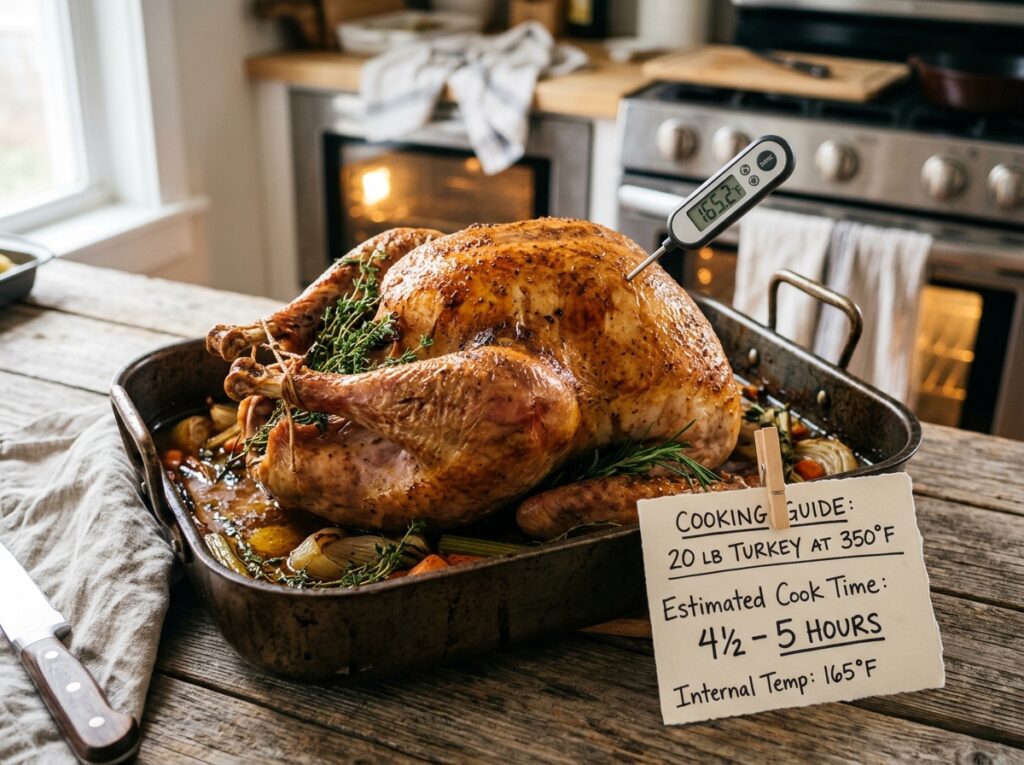
20 Pound Turkey at 350: Easy Cook Time Chart
Five degrees can be the difference between juicy turkey and dry slices nobody wants. Timing matters too. If you’re trying to figure out how long to cook a 20 pound turkey at 350, the short answer is about 4 to 4½ hours for a thawed, unstuffed turkey and about 4½ to 5 hours for a stuffed one.
That’s the number most people want. But the real goal isn’t just “done.” You want the bird safe, browned, and still moist when it hits the table. So let’s make the timing easy, clear up the stuff that changes it, and help you plan dinner without last-minute panic.
How long to cook a 20 pound turkey at 350
A 20-pound whole turkey at 350°F usually needs 4 to 4½ hours if it’s fully thawed and unstuffed. If it’s stuffed, plan on 4½ to 5 hours.
That timing is for a standard whole bird roasted in a regular oven, breast side up, in a roasting pan. It assumes the turkey is thawed all the way through and not spatchcocked or partially frozen.
Here’s a quick chart you can trust:
| Turkey condition | Approx. cook time at 350°F | Start checking temp |
|---|---|---|
| Fully thawed, unstuffed | 4 to 4½ hours | 3¾ hours |
| Fully thawed, stuffed | 4½ to 5 hours | 4¼ hours |
| Convection oven | Usually a bit less | 30 minutes earlier |
| Partially frozen | Unreliable timing | Thaw more first |
Why the range? Because ovens vary, turkey shape varies, and stuffing slows things down. A wide, shorter bird may cook a little faster than a tall, dense one. Your oven might also run hot or cold without telling you.
Quick Fact: A turkey finishing 30 minutes early is much easier to manage than a turkey finishing 30 minutes late. Build in a little cushion.
One more thing: cooking time tells you when to start checking. It does not tell you when to stop cooking. Your thermometer decides that.
What changes the cooking time?
Stuffed or unstuffed makes a real difference
A stuffed turkey takes longer because the center of the stuffing has to heat up too. Think of it like baking a potato plain versus packing the middle with something cold. The heat needs more time to reach the center.
If you stuff the turkey, the stuffing must also reach 165°F. That’s why many cooks prefer to bake stuffing separately. It’s easier, a little safer, and it often gives you better texture too.
If you want the classic look of a stuffed bird, fill the cavity loosely, not tightly. Packed stuffing slows cooking and can leave the center underdone.
A fully thawed turkey cooks more evenly
This one causes a lot of stress every holiday season. A 20-pound turkey needs about 4 to 5 days in the fridge to thaw safely. If the cavity still has ice or the bird feels stiff in the thick parts, your timing can go off fast.
That matters because the outside may cook normally while the inside lags behind. Then you’re stuck with a bird that’s too brown on the outside and still not ready in the center.
If you’re already juggling fridge space and poultry safety, the same cold-storage basics in this post on thawed chicken in the fridge apply here too: keep it cold, don’t stretch the safe window, and cook it before quality drops.
Oven accuracy changes everything
Home ovens aren’t perfect. Some run hot. Some run cool. Some have hot spots near the back wall. So if your recipe promised “exactly 4 hours,” take that with a grain of salt.
A few things can shift the cook time:
- Opening the oven door too often
- Using a very deep roasting pan
- Cooking with a cold stuffing
- Using foil too early and too tightly
- Roasting in a convection oven
A dark roasting pan may brown the skin faster. A rack helps heat move around the bird, which usually gives you more even cooking.
Brined, buttered, or pre-seasoned birds still need a thermometer
Brining can help the meat stay juicy, but it doesn’t remove the need to check temperature. A pre-basted supermarket turkey can also brown faster because of the added fats and seasoning.
So yes, season it how you like. Just don’t let that trick you into trusting the clock alone.
How to roast a 20-pound turkey at 350 without guesswork
You don’t need restaurant training for this. You just need a simple plan.
Step-by-step method
- Thaw the turkey completely.
A 20-pound bird usually needs 4 to 5 days in the fridge. If it’s still icy inside, hold off on roasting. - Preheat your oven to 350°F.
Put the rack in the lower third so the turkey fits well and the top skin doesn’t brown too fast. - Remove the giblets and pat the turkey dry.
Don’t wash the turkey. That can spread raw poultry juices around your sink and counters. Dry skin browns better anyway. - Season the turkey and place it breast side up on a rack.
Rub it with oil or softened butter. Add salt, pepper, and any herbs you like. If you use aromatics in the cavity, keep them loose so air can still move. - Roast until the thickest parts reach a safe temperature.
Start checking at about 3¾ hours for an unstuffed turkey. Check sooner if your oven runs hot. If you need help with probe placement, this article on how to read a meat thermometer makes it simple. - Rest the turkey before carving.
Give it at least 30 to 45 minutes. A large bird can rest close to an hour under loose foil and still serve well.
That’s the process. Clean, simple, no drama.
Do you need to cover the turkey?
Usually, no. Start uncovered so the skin can brown.
If the top gets dark too early, loosely tent the breast area with foil during the last part of cooking. Don’t wrap it tight like a baked potato. You just want to slow the browning, not steam the whole bird.
Do you need to baste?
You can, but you don’t have to.
A lot of people baste because it feels like the “right” thing to do. Truth is, opening the oven every 20 minutes drops the heat and can add to your cooking time. If you want to baste once or twice near the end, that’s fine. Just don’t turn it into a full-time job.
Should you put water in the bottom of the pan?
Not enough to touch the turkey. You’re roasting, not boiling.
A little broth or water in the pan is fine if you want drippings that won’t burn, especially if your pan tends to smoke. But the bird should sit on a rack above the liquid, not in it.
Pro Tip: If you don’t have a roasting rack, make a rough “rack” with thick carrot and onion pieces. It lifts the turkey and helps air circulate.
How to tell when your turkey is done
This is the part that saves Thanksgiving.
Check more than one spot
The best reading comes from the thickest part of the thigh, without touching bone. Check the breast too. If the turkey is stuffed, check the center of the stuffing as well.
A turkey can look done on the outside and still need more time inside. That’s why color alone doesn’t help much.
If one area is ready and another is lagging, that’s normal. The breast and thighs don’t always finish at the same second.
What temperature should turkey reach?
For food safety, USDA guidance still says 165°F in the thickest parts of the turkey and in the stuffing.
That means:
- Breast: 165°F
- Thigh: 165°F or higher
- Stuffing: 165°F
Some experienced cooks pull the bird a bit earlier in the breast because the temperature rises while it rests. If you’re new to roasting turkey, keep it simple: check a few spots and make sure the meat is safely at 165°F.
Color and juices can fool you
A lot of people still check turkey by looking at the juices. If they run clear, the bird must be done, right? Not always.
Juices can look clear before the deepest meat reaches a safe temperature. Pink meat near the bone can also happen even after the bird is fully cooked. That’s why the thermometer matters more than the juices, the skin color, or the little plastic pop-up timer.
Warning: A pop-up timer is a backup, not your best tool.
Resting matters more than people think
The turkey needs time after it leaves the oven. During the rest, the juices settle back into the meat, and the bird becomes easier to carve.
Cut it too soon and those juices end up on the cutting board instead of in your slice.
Did you know? A large turkey often keeps rising a few degrees while it rests. That’s one reason big birds carve better after a patient pause.
A real timeline for serving dinner on time
Most people asking about turkey time aren’t just curious. They’re trying to answer one very real question:
“What time do I put this thing in the oven?”
Let’s say dinner is at 5:00 p.m. and your turkey is 20 pounds, thawed, and unstuffed.
Here’s a solid plan:
| Task | Time |
|---|---|
| Prep and season turkey | 10:45 to 11:15 a.m. |
| Turkey goes into 350°F oven | 11:30 a.m. |
| Start checking temperature | 3:15 p.m. |
| Likely done | 3:45 to 4:15 p.m. |
| Rest under loose foil | 4:15 to 5:00 p.m. |
| Carve and serve | 5:00 p.m. |
If the turkey is stuffed, move the oven time earlier by about 30 to 45 minutes.
That buffer matters. A turkey that’s ready at 4:00 p.m. can rest happily. A turkey that still needs 40 minutes at 5:00 p.m. will turn your kitchen into a stress factory.
Planning portions
A 20-pound turkey usually feeds a good-size group, especially if you’re serving sides and want leftovers. If you’re still trying to judge serving size, this quick breakdown of how much turkey breast per person can help you plan without guessing.
Getting the sides to land at the same time
Turkey timing gets all the attention, but side dishes often cause the real mess. Potatoes, gravy, rolls, and stuffing all compete for space and attention.
If mashed potatoes are on your menu, this post on how long to boil potatoes can help you line them up with the turkey rest time, which is the sweet spot for finishing sides.
Common mistakes that throw off turkey cooking time
Relying on time alone.
The biggest mistake is treating 4 to 4½ hours like a promise. It’s a range, not a contract. Use the clock to know when to start checking, then use the thermometer to decide when it’s done.
Starting with a half-frozen bird.
This is one of the fastest ways to wreck the schedule. The outside cooks, the inside stalls, and you end up chasing temperature for what feels like forever.
Stuffing the cavity too tightly.
A tightly packed turkey cooks slower and more unevenly. Loose stuffing is better. Separate stuffing is easiest.
Opening the oven every few minutes.
You want to peek. Everyone wants to peek. But every open door drops heat and stretches the cook time. Trust the oven more than your curiosity.
Skipping the rest.
Pulling a turkey from the oven and slicing it right away seems efficient. It usually gives you drier meat and a wetter cutting board.
Leaving turkey out too long after cooking.
Once the meal is over, refrigerate leftovers within 2 hours. The same safety rule explained in this article on chicken left out overnight applies to turkey too. Big holiday meals can linger, but bacteria don’t care that guests are still chatting.
Thinking browning means done.
A turkey can turn golden before the inside is ready. If the skin gets dark early, tent with foil and keep cooking until the internal temperature is right.
4. FAQ Section
FAQ Section
How long does it take to cook a 20 lb turkey at 350?
A 20-pound thawed turkey at 350°F takes about 4 to 4½ hours unstuffed and 4½ to 5 hours stuffed. Start checking the temperature before the low end of the range so you don’t overcook it.
Is it better to cook a 20-pound turkey at 325 or 350?
Both temperatures work. 325°F is a classic roasting temperature and shows up in a lot of USDA and package guidance. 350°F cooks a bit faster and often gives better browning. If you choose 350, keep a close eye on the internal temperature and tent with foil if the skin darkens too quickly.
Do you cook a 20-pound turkey covered or uncovered?
Cook it mostly uncovered. That helps the skin brown and crisp. If the breast or top starts getting too dark before the inside is done, loosely tent that area with foil near the end.
How long should a 20-pound turkey rest before carving?
Let it rest for 30 to 45 minutes at minimum. A very large bird can rest up to an hour under loose foil. Resting keeps the meat juicier and makes carving easier.
Can I cook a stuffed 20-pound turkey at 350?
Yes, you can. Expect it to take about 4½ to 5 hours. The key is checking the center of the stuffing as well as the turkey meat. Both need to reach 165°F.
Can I cook a partially frozen 20-pound turkey at 350?
You can technically cook a frozen turkey, but the timing gets much less predictable, and the outside may overcook before the inside catches up. For the best result, fully thaw the bird before roasting.
What if my turkey is done early?
That’s actually a good problem. Let it rest under loose foil. A turkey finishing a little early is easier to manage than one running late. Just don’t leave it out for more than 2 hours total before refrigerating leftovers.
5. Conclusion
If you only remember one thing, remember this: a 20-pound turkey at 350°F usually needs about 4 to 4½ hours unstuffed or 4½ to 5 hours stuffed, but the thermometer is what really calls the game.
So here’s your next move. Decide whether you’re cooking it stuffed or unstuffed, count backward from your serving time, and plan for that rest at the end. Do that, and your turkey won’t just be done on time. It’ll be worth waiting for.