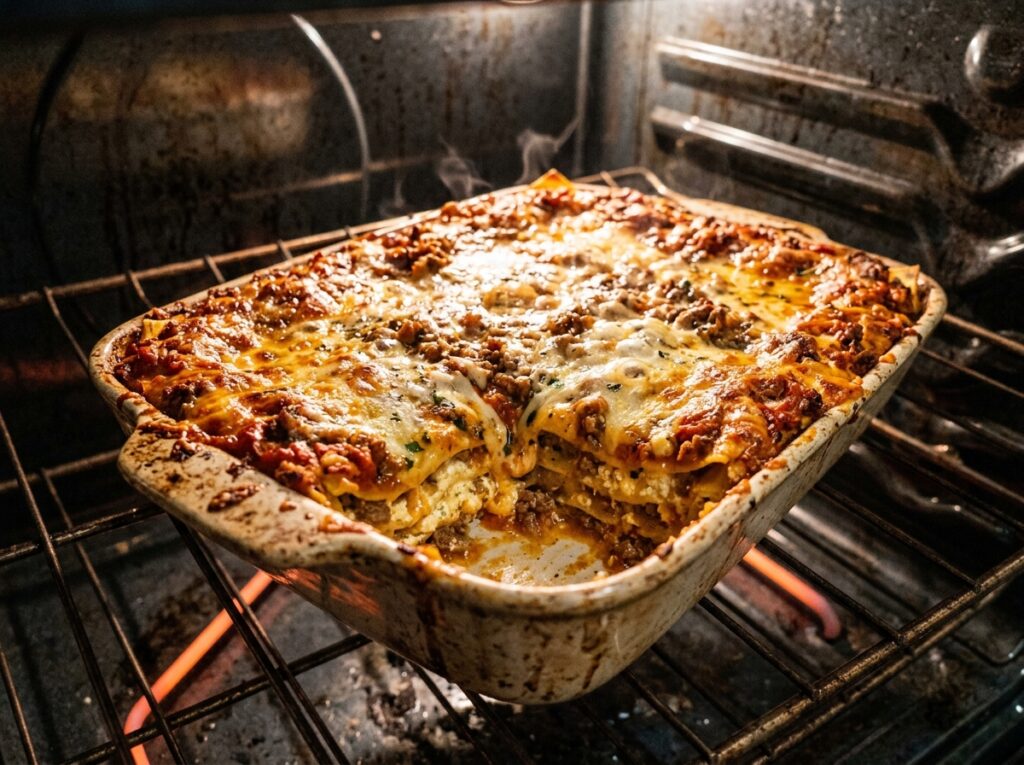
How Long to Bake Lasagna at 350 for Best Texture
A lasagna can look perfect on top and still be cold in the middle. That’s where most people get tripped up. If you’re trying to figure out how long to bake lasagna at 350, the usual answer is 50 to 60 minutes for a fresh 9×13 pan. But fridge-cold, frozen, deep, or extra-saucy lasagna can need a lot more time, and that’s where the real answer starts.
How Long to Bake Lasagna at 350: Quick Answer
For a standard 9×13-inch lasagna, baked at 350°F in a regular oven, you’ll usually need 50 to 60 minutes total if it’s freshly assembled. The best method is to cover it for most of the bake, then uncover it for the last 10 to 15 minutes so the cheese can brown a little.
That said, not every lasagna behaves the same way. A pan straight from the fridge needs more time. A frozen one needs a lot more. A thick, deep lasagna with lots of layers also takes longer than a thinner one.
Here’s the easy cheat sheet.
| Type of lasagna | Covered time | Uncovered time | Total time at 350°F |
|---|---|---|---|
| Fresh homemade, 9×13 | 40–45 min | 10–15 min | 50–60 min |
| Refrigerated, 9×13 | 50–60 min | 10–15 min | 60–75 min |
| Frozen, thawed overnight | 60–70 min | 10–15 min | 70–85 min |
| Frozen solid | 75–95 min | 10–15 min | 90–110 min |
| Smaller pan, like 8×8 | 30–35 min | 10 min | 40–45 min |
Quick answer:
If you only want one number, remember this: fresh lasagna at 350°F usually bakes in about 55 minutes.
Still, the clock alone won’t save you. Lasagna is a layered dish, and heat moves through it slowly. The top can fool you. The center is what matters.
Did you know?
A deep lasagna can take 10 to 15 minutes longer than a shallow one, even if both use the same pan size.
What Changes How Long Lasagna Needs?
A lot of recipes throw out one flat number. Real kitchens don’t work like that. Your bake time changes based on temperature, pan depth, ingredients, and even the dish you use.
Fresh, refrigerated, or frozen makes the biggest difference
This is the biggest factor by far.
A fresh lasagna starts closer to room temperature, or at least it isn’t ice-cold. Heat can move through it faster. A refrigerated lasagna starts dense and chilly. A frozen lasagna is basically a brick. The oven has to do a lot more work.
Think of it like warming a thick winter coat. The outside gets warm fast. The inside takes its sweet time.
If you made your lasagna the night before and stored it in the fridge, don’t expect the same 50-minute bake as a just-assembled pan. Plan for 60 to 75 minutes instead.
A frozen lasagna needs even more patience. For a full family-size pan, 90 to 110 minutes at 350°F is normal. Sometimes a very deep pan needs close to 2 hours.
Pan size and depth matter more than people expect
A smaller pan often bakes faster. That part seems obvious. The sneaky part is depth.
A shallow 9×13 lasagna with three light layers might be done near the 50-minute mark. A deep pan packed with sauce, ricotta, mozzarella, meat, and four or five layers can need much longer.
Here’s a good rule:
- Thin lasagna: check early
- Deep lasagna: expect extra time
You also want to pay attention to how tightly you packed the layers. If you pressed everything down and loaded it with sauce and cheese, you created a thicker mass for the heat to push through.
Covered vs uncovered changes the whole bake
Lasagna usually bakes best covered first, uncovered last.
Covering traps steam. That helps heat the center, softens the noodles, and keeps the top from drying out too soon. Uncovering at the end gives you that bubbly, slightly golden cheese layer everyone wants.
If you leave it uncovered from the start, the cheese can brown long before the middle gets hot. That’s how people end up with burnt edges and a cold center.
Use foil, not parchment, for this job. Foil holds in heat and steam much better. If you’ve ever wondered why one paper works and the other doesn’t, this quick look at the difference between butcher paper and parchment paper clears it up.
Pro tip:
Spray the underside of your foil with a little cooking spray so the melted cheese doesn’t stick when you remove it.
Noodle type, sauce, and fillings can add or cut time
Not all lasagna noodles act the same.
Boiled noodles are already softened, so they mostly need time to heat through and settle into the sauce. No-boil noodles need moisture to soften as they bake. If your sauce is too thick or you skimp on it, the noodles may stay firm even after the timer goes off.
Ingredients also change the bake.
Spinach holds water. Mushrooms release water. Extra sauce makes the pan heavier and slower to heat. Dense meat layers add time too.
If you’re making a turkey version instead of beef, brown the meat before it goes into the pan. Don’t rely on the lasagna bake time to cook raw ground meat safely. If you need help with that step, here’s a simple guide on how long to cook ground turkey.
Your oven and baking dish can change the result
Home ovens aren’t always exact. Some run hot. Some run cool. That’s why one person swears lasagna is done in 50 minutes while another needs 70.
The dish matters too.
A metal pan heats faster than a glass dish. Glass holds heat well once it gets hot, but it usually takes a little longer to get there.
Warning:
Don’t move a very cold glass dish straight from the fridge into a fully heated oven unless the manufacturer says it’s safe. Let it sit out while the oven preheats for about 20 to 30 minutes. That small pause can help avoid thermal shock.
Using a convection oven? Start checking a little early. Convection often cooks faster because the hot air keeps moving.
How to Bake Lasagna at 350 Step by Step
You don’t need a fancy method. You just need a calm, reliable one.
For a fresh homemade 9×13 lasagna
Here’s the easiest way to bake it at 350°F.
- Preheat your oven to 350°F. Put the rack in the middle.
- Cover the pan with foil. Tent it slightly so it doesn’t sit right on the cheese.
- Bake covered for 40 to 45 minutes.
- Remove the foil and bake another 10 to 15 minutes.
- Check the center. You want bubbling sauce and a hot middle.
- Let it rest for 15 to 20 minutes before cutting.
That rest matters more than people think. Skip it, and your slices can slide apart on the plate.
A good real-life example? Say you assemble lasagna at 5:00 and want to eat at 6:15. Put it in by about 5:20, keep it covered until around 6:00, then uncover it to finish. By the time it rests, you’re right on time for dinner.
For lasagna straight from the fridge
A chilled lasagna needs a longer covered bake because the cold center slows everything down.
Plan on 50 to 60 minutes covered, then 10 to 15 minutes uncovered. In most kitchens, that means 60 to 75 minutes total.
If your pan is especially deep, start checking closer to the 70-minute mark instead of assuming it will be done sooner.
Letting it sit on the counter for 20 to 30 minutes while the oven heats can help. That won’t magically cut the bake in half, but it often gives you a more even result.
For frozen lasagna
Frozen lasagna is where people get impatient, and that’s usually where trouble starts.
At 350°F, a full frozen pan often needs 75 to 95 minutes covered, then 10 to 15 minutes uncovered. That gives you a total of about 90 to 110 minutes.
A few tips help a lot here:
- Keep it covered for most of the bake
- Use the middle rack
- Put a sheet pan underneath in case it bubbles over
- Check the center before you trust the clock
If you can thaw it overnight in the fridge, do it. That cuts the total time and heats the pan more evenly.
Store-bought frozen lasagna can be a little different. Brands use different pan sizes, sauces, and starting temperatures. If the package gives its own timing, treat that as your base and use the center temperature as your final check.
What about lasagna that uses no-boil noodles?
No-boil noodles work well at 350°F, but they need enough moisture.
Keep the lasagna covered long enough for steam to do its job. Use a sauce that’s a little looser than you would for boiled noodles. If the top looks done but the noodles still feel firm in the center, cover it again and give it another 10 minutes.
A dry lasagna almost always traces back to one of two things: not enough sauce or too much uncovered time.
The best tool for checking doneness
A knife test helps, but a thermometer helps more.
Insert it into the center, not just near the edge. You’re looking for a hot middle, not just bubbling corners. If you want a refresher on placement and reading, this quick post on how to read a meat thermometer makes it easy.
Pro tip:
Aim for 165°F in the center, especially for chilled, frozen, or meat-based lasagna.
How to Know Your Lasagna Is Done
The top layer doesn’t tell the full story. The center does.
Look for these signs
A fully baked lasagna usually shows a few clear signals:
- The sauce is bubbling around the edges
- The center looks hot, not pale or still
- The cheese is fully melted and lightly golden
- A knife slides into the middle without hitting hard noodle layers
- The center reaches about 165°F
You don’t need every sign to look dramatic. You just want the whole pan to look alive, not only the corners.
What internal temperature should lasagna be?
For a reliable finish, 165°F in the center is a smart target.
That number matters most for refrigerated, frozen, leftover, or meat-filled lasagna. As of 2026, USDA food safety advice still uses 165°F as the key reheating temperature for leftovers and mixed dishes. It’s a solid benchmark if you want both safety and a properly heated center.
A fresh vegetarian lasagna may technically be hot enough a little earlier, but 165°F is still a very useful target because it tells you the middle is truly heated through.
Why resting matters so much
Lasagna keeps settling after it leaves the oven.
Right out of the oven, the sauce is boiling, the cheese is loose, and the layers haven’t had time to hold together. Cut it too soon and it spreads across the plate.
Give it 15 to 20 minutes. You’ll get cleaner slices, better texture, and fewer burned mouths.
Did you know?
The rest time doesn’t just help the shape. It also helps the flavor feel more balanced because the layers stop sliding around and start acting like one dish.
Common Lasagna Timing Problems and Fixes
Lasagna can go wrong in a few predictable ways. The good news? Most problems are easy to fix once you know what caused them.
The top is brown but the middle is still cold
This happens all the time.
Usually, the pan was uncovered too early, or the lasagna started very cold. The cheese browned fast, but the center didn’t catch up.
Put the foil back on and bake another 10 to 15 minutes. Check the center again. If the pan came from the fridge or freezer, don’t be surprised if it needs more than one extra round.
A browned top is nice. A hot center is dinner.
Your lasagna came out watery
Watery lasagna doesn’t always mean it needed more time.
Sometimes the issue starts before the pan hits the oven. Common causes include:
- Too much sauce
- Undrained ricotta or cottage cheese
- Wet spinach or mushrooms
- Not enough rest time after baking
Say you pull out the pan, cut it right away, and sauce floods the plate. That doesn’t always mean “undercooked.” It often means “cut too soon.”
Next time, squeeze moisture from vegetables, don’t overdo the sauce, and let the finished lasagna rest properly.
The edges are dry
Dry edges usually point to too much uncovered baking or not enough sauce near the outer noodles.
Cover the pan longer next time. Make sure the noodles at the edges have sauce touching them. Lasagna dries out from the outside in, so exposed corners are the first place to suffer.
A light foil tent helps a lot here.
The noodles still feel firm
Firm noodles usually mean one of three things happened:
The lasagna needed more time, the sauce was too thick, or the noodles didn’t have enough moisture to soften.
Cover it back up, add a few spoonfuls of warm sauce around the edges if needed, and keep baking for another 10 minutes. This issue shows up more often with no-boil noodles than with pre-boiled ones.
You baked it “long enough” but it still felt off
Recipe times are only estimates.
If your pan was deeper, your oven runs cool, or you added extra meat and cheese, the printed time may not fit your dish. That’s why experienced cooks don’t trust the timer alone. They use the timer to start checking.
Once you’ve baked lasagna a couple of times in your own oven, you’ll learn its rhythm pretty fast.
Leftovers, Storage, and Reheating
Lasagna is one of those foods that can taste even better the next day. The layers settle, the sauce thickens a bit, and the slices cut cleaner.
How long does leftover lasagna last?
Once cooked, don’t leave lasagna sitting out for hours. Refrigerate it within 2 hours for food safety.
In the fridge, leftover lasagna usually keeps well for 3 to 4 days. In the freezer, it’s best within about 2 to 3 months for quality, though it may stay safe longer if continuously frozen.
Store slices in airtight containers, or cover the pan tightly with foil or a lid.
How to reheat lasagna without drying it out
For the best texture, reheat it in the oven at 350°F.
A single slice usually takes about 20 to 30 minutes, loosely covered with foil. A bigger portion or several slices together may need a bit longer. If it looks dry, add a spoonful of sauce before reheating.
Microwaves are faster, but the oven gives you a more even result.
If 350°F is your go-to oven temp for weeknight meals, you might also like our simple timing guides for bake chicken breast at 350 and bake salmon at 350.
4. FAQ Section
How long do you bake lasagna at 350 covered?
For a fresh 9×13 lasagna, bake it covered for 40 to 45 minutes. If it’s been in the fridge, plan on 50 to 60 minutes covered. Frozen lasagna usually needs 75 to 95 minutes covered before you uncover it for the final browning.
Should lasagna be baked covered or uncovered?
Start covered, then finish uncovered. Covering helps the center heat through and keeps the top from drying out. Uncovering for the last 10 to 15 minutes gives you a better cheese topping.
Can I bake lasagna at 350 from the fridge?
Yes, and it works well. A refrigerated lasagna usually needs 60 to 75 minutes total at 350°F. If you’re using a glass baking dish, let it sit out for a short time while the oven preheats so it isn’t ice-cold going into the heat.
What temperature should lasagna be in the middle?
Aim for 165°F in the center. That’s the safest and most reliable target, especially for meat-based, refrigerated, frozen, or leftover lasagna.
How long should lasagna rest before cutting?
Let it rest for 15 to 20 minutes. That gives the layers time to settle, so your slices hold together better and the sauce doesn’t run everywhere.
5. Conclusion
If you remember one range, make it this: fresh lasagna at 350°F usually takes 50 to 60 minutes, with more time for chilled or frozen pans. Still, the timer is only part of the story. Look for bubbling edges, a hot center, and give it a solid rest before slicing.
Your next step is simple: bake it covered first, check the middle instead of the top, and use a thermometer once or twice until you know your oven. After that, you won’t be guessing anymore.