How to Get Rid of Sulfites in Wine — A Practical Guide
That stubborn headache after a glass of red wine? Those random sniffles or that flushed feeling across your cheeks? There’s a decent chance sulfites are the culprit. Nearly 10% of asthmatic adults report some level of sensitivity to sulfites, according to the Cleveland Clinic, and plenty of non-asthmatic wine lovers notice the effects too.
Here’s what most people don’t realize — every single bottle of wine contains sulfites. Yes, even that “organic” bottle your friend swears by. The difference is really about how much sulfite is in there and whether your body can handle it comfortably.
The good news? You don’t have to give up your evening glass. There are practical, tested ways to reduce or remove sulfites from wine right at home before you pour. Some take seconds, others need a few minutes, but none of them require a chemistry degree. Let’s walk through what actually works — and what’s just marketing noise.
What Are Sulfites and Why Are They in Your Wine?
Before you try removing something, it helps to know what you’re dealing with.
Sulfites — technically sulfur dioxide (SO₂) — are chemical compounds that act as preservatives. Winemakers have used them for literally centuries, dating back to Roman times, to prevent wine from turning into vinegar. They stop oxidation and kill off unwanted bacteria and wild yeasts that could spoil the flavor.
Here’s the part that surprises most people: yeast naturally produces sulfites during fermentation. So even if a winemaker adds zero extra sulfites, the wine will still contain some. The FDA requires any wine with more than 10 parts per million (ppm) of sulfites to carry the “contains sulfites” label, and most conventional wines range between 25–150 ppm.
A quick breakdown of typical sulfite levels:
- Red wine: 50–80 ppm (lower because tannins act as natural preservatives)
- White wine: 80–120 ppm
- Sweet/dessert wines: Up to 150–200 ppm
- Organic wine (US standard): Below 10 ppm, no added sulfites
So if you’ve noticed that red wine bothers you less than white, this could be why. Red wines generally carry fewer sulfites to begin with.
Do Sulfites Actually Cause Wine Headaches?
This deserves its own section because there’s real confusion here.
The “red wine headache” is one of the most debated topics in food science. While sulfites definitely cause reactions in sensitive individuals — especially those with asthma — researchers at UC Davis have pointed out that many foods contain far more sulfites than wine. Dried fruits, for example, can have sulfite levels 5 to 10 times higher than a glass of wine. If you can eat dried apricots without any issues but wine wrecks you, sulfites might not be your only trigger.
Other possible contributors include histamines, tannins, tyramine, and alcohol itself. A 2019 study published in the European Journal of Clinical Nutrition found that histamines in red wine were more strongly linked to headache responses than sulfites.
Does this mean you should ignore sulfites? Absolutely not. If you know you’re sulfite-sensitive, removing them makes a real difference. But if you’re trying to fix wine headaches and sulfite removal doesn’t help, you’ll want to explore those other triggers too.
How to Remove Sulfites from Wine: Methods That Actually Work
Alright, let’s get to the practical stuff. Here are the most effective ways to reduce sulfites in your wine, ranked from simplest to most involved.
Hydrogen Peroxide — The Quick Chemistry Fix
This is probably the most effective DIY method, and it’s backed by actual chemistry. When you add a tiny amount of food-grade 3% hydrogen peroxide to wine, it converts sulfites (SO₂) into hydrogen sulfate (SO₄), which is essentially harmless.
Here’s how you do it: add one drop of 3% hydrogen peroxide per glass of wine (roughly 6 ounces). Stir gently and wait about 30 seconds. That’s it.
The chemical reaction is clean and complete. The sulfites are neutralized, and the hydrogen peroxide breaks down into water and oxygen — nothing harmful left behind.
⚠️ Warning: Only use food-grade 3% hydrogen peroxide. Never use the higher concentrations sold for industrial purposes. And stick to one drop per glass. More isn’t better here — too much peroxide can oxidize the wine and mess with its flavor profile.
Some wine enthusiasts cringe at this method because, yes, you are technically altering the wine’s chemistry. But if you’re choosing between a headache and a tiny chemical tweak, most people make the practical choice.
Aerating and Decanting — Let the Air Do the Work
You know how wine “opens up” after sitting in a glass for a while? Part of what’s happening is that volatile sulfur compounds are escaping into the air. Sulfites are partially volatile, meaning they’ll slowly dissipate with exposure to oxygen.
Decanting your wine for 15–30 minutes before drinking can reduce free sulfite levels by roughly 30–40%. Pouring it back and forth between two containers (a technique sometimes called “hyperdecanting”) speeds this up.
You can also use a wine aerator — those handheld gadgets you pour wine through. They force air through the wine quickly and can reduce sulfites in seconds rather than minutes. Brands like Vinturi and Vintorio are popular options that cost under $25.
Will aeration remove all sulfites? No. Bound sulfites — the ones chemically attached to other compounds in the wine — won’t leave just because of air exposure. But for mild sensitivity, this method is often enough to make a noticeable difference.
If you’re interested in other ways simple kitchen techniques can make a big impact, you might enjoy reading about how to reheat steak properly — another case where a small method change dramatically improves the result.
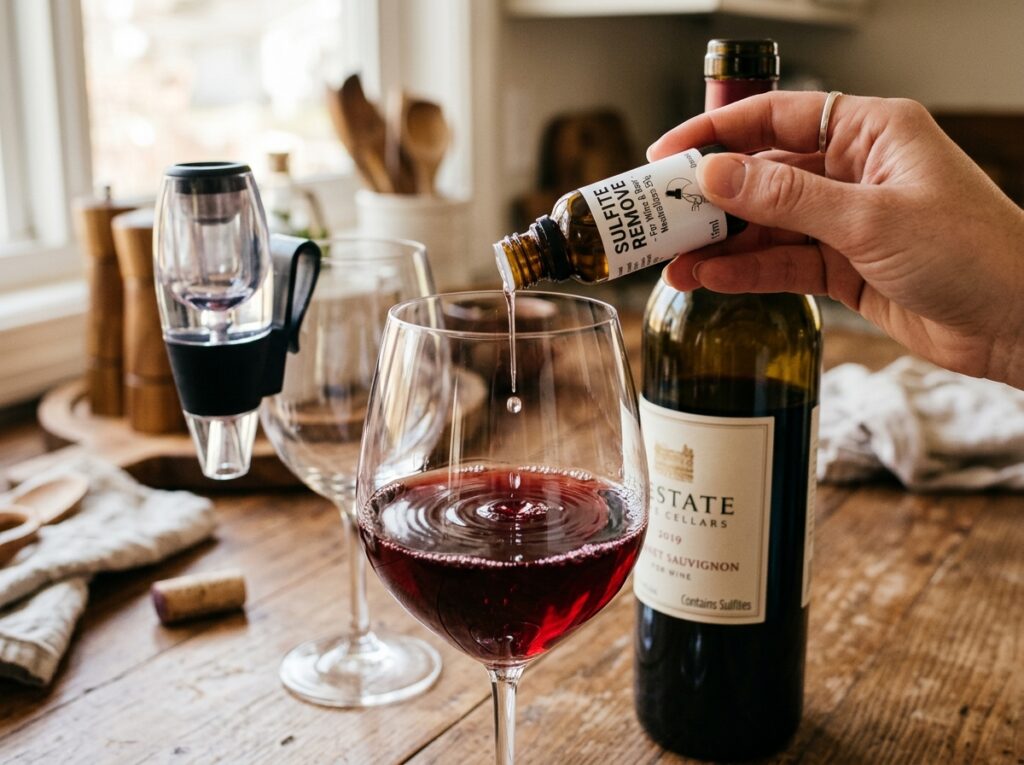
Sulfite-Removing Drops and Wands
The market has responded to the sulfite concern with a range of commercial products. The two main categories are drops you add to your wine and wands you stir into your glass.
Sulfite drops (like “SO2GO” or “Sulfite Gone”) typically contain hydrogen peroxide or ascorbic acid (vitamin C) in carefully measured doses. They work on the same principle as the DIY hydrogen peroxide method, but they’re pre-measured so you don’t have to worry about adding too much. A bottle usually costs around $10–$15 and treats 50+ glasses.
Wine wands (like “The Wand” by PureWine) are filter sticks coated with an absorbent material. You swirl them in your glass for about 3 minutes, and they claim to remove both sulfites and histamines. They’re single-use, which makes them more expensive per glass, but they’re incredibly convenient — especially at restaurants or events where you can’t exactly whip out a bottle of hydrogen peroxide.
Do they work? Independent testing has shown measurable sulfite reduction with both types. The drops tend to be more thorough for sulfite removal specifically, while the wands offer the added benefit of reducing histamines too.
Adding a Splash of Citrus — The Vitamin C Method
Ascorbic acid (vitamin C) reacts with sulfites and neutralizes them, similar to hydrogen peroxide. Some people simply squeeze a small amount of lemon juice into their glass or add a tiny pinch of pure ascorbic acid powder.
The trade-off is obvious: this changes the taste. A few drops of lemon in a crisp white wine or rosé? Honestly, not bad — some people even prefer it. In a full-bodied red? Yeah, that’s going to be a flavor clash.
If you want to try this without the citrus flavor, food-grade ascorbic acid powder (available at most health food stores) is your best bet. About a pinch (roughly 25–50 mg) per glass should do it.
Pro Tip: Ascorbic acid works best when added right before drinking, not hours ahead. It loses its effectiveness when exposed to air over time, so don’t add it to a decanter and forget about it.
Choosing Low-Sulfite or No-Added-Sulfite Wines
Sometimes the best fix is prevention. If sulfites consistently bother you, adjusting your wine choices can reduce the problem before it starts.
Look for wines labeled “No Sulfites Added” or “NSA.” In the US, organic wines certified by the USDA can’t have any added sulfites, though they’ll still contain the naturally occurring ones (usually under 10–20 ppm). European organic standards are a bit different — they allow limited sulfite additions, so an EU organic wine might have more sulfites than a US organic one.
Natural wines are another option. These are made with minimal intervention, often with zero or very low added sulfites. They’re trendy right now, and you’ll find them at most specialty wine shops. Just be prepared — natural wines can taste quite different from conventional wines. Some people love the funky, earthy flavors. Others, not so much.
A few wine regions and grapes naturally tend toward lower sulfites:
- Italian reds (like Nero d’Avola or Barbera)
- Spanish Garnacha
- French Beaujolais (Gamay grape)
- Most biodynamic wines
Your local wine shop staff can usually point you toward low-sulfite options if you ask. It’s a more common request than you’d think.
What About Wine Purifiers and Filters?
In the last few years, wine purifier pitchers and bottle-top filters have entered the market. Brands like Üllo and PureWine’s Phoenix filter claim to remove sulfites as you pour, using food-safe polymer filters.
These devices work on selective sulfite filtration — they allow the wine’s flavors, aromas, and color to pass through while trapping sulfite molecules. Üllo, for example, uses a patented filter made with food-grade polymer that specifically targets free sulfites.
Are they worth the investment? If you drink wine regularly and sulfite sensitivity is a consistent problem, a $30–$50 purifier can pay for itself quickly compared to buying single-use products. User reviews are generally positive, with many people reporting fewer headaches and allergic symptoms.
The downside? These filters primarily target free sulfites, not bound sulfites. The distinction matters because bound sulfites are already attached to other molecules in the wine, and they’re less likely to cause reactions anyway. So for practical purposes, filtering free sulfites addresses the main concern.
If you’re someone who appreciates understanding the finer details of food and drink preparation, these products hit that sweet spot between science and everyday convenience.
Does Cooking with Wine Remove Sulfites?
Here’s a question that comes up a lot, especially from people who cook with wine regularly. If heat destroys bacteria and changes food chemistry, does it also eliminate sulfites?
Partially, yes. Heat causes sulfites to volatilize — they escape as gas during cooking. A wine-based sauce that simmers for 20–30 minutes will lose a significant portion of its free sulfites. The longer the cooking time, the more sulfites escape.
But here’s the catch: just like with aeration, bound sulfites are stubborn. They don’t break free easily, even with heat. So cooking reduces sulfite levels but doesn’t eliminate them completely.
For most people with mild sensitivity, cooking with wine causes zero issues. The combination of heat, dilution with other ingredients, and the relatively small amount of wine used in recipes means your exposure is minimal. If you have a serious sulfite allergy (not just sensitivity), you’ll want to talk to your doctor before using wine in cooking at all.
Speaking of cooking, if you use wine in baked dishes, knowing the right temperature and timing matters — much like when you bake lasagna at 350, where precision changes the outcome completely.
Red Wine vs. White Wine: Which Has More Sulfites?
This is worth addressing directly because it’s one of the most common questions people ask.
White wine almost always contains more sulfites than red wine. The reason is straightforward: red wine has tannins — those compounds that create that dry, slightly puckering sensation in your mouth. Tannins are natural antioxidants and antimicrobials. They do some of the preservation work that sulfites would otherwise handle, so winemakers don’t need to add as much.
White wine lacks tannins (or has very little), so it relies more heavily on sulfites for preservation. Sweet wines — both red and white — tend to have the highest sulfite levels because sugar creates a more hospitable environment for bacteria, requiring extra preservative.
If you’re sulfite-sensitive and don’t want to mess with removal methods, simply switching from white to red might solve your problem. A dry red wine like Cabernet Sauvignon or Tempranillo will typically have 30–50% fewer sulfites than a comparable white wine.
Storing Wine to Minimize Sulfite Impact
This angle doesn’t get enough attention. How you store your wine can affect how sulfites behave once you open the bottle.
Temperature matters. Wine stored in warmer conditions undergoes more chemical reactions, and sulfites bind faster to other compounds. That’s not necessarily bad — bound sulfites are less reactive and less likely to cause symptoms. But it also means the wine may have lost some of its protective sulfite buffer, leading to slight oxidation that can cause its own set of problems (off-flavors, flatness).
Store your wine in a cool, dark place between 45–65°F (7–18°C). Don’t leave opened bottles sitting out. If you’re going to finish a bottle over two evenings, re-cork it tightly or use a vacuum pump to remove excess air, and put it back in the fridge. This keeps both the sulfite levels stable and the wine tasting fresh.
If you’ve ever wondered about proper food storage timelines — like how long cooked rice lasts in the fridge — you already understand that storage conditions make or break the quality and safety of what you consume. Wine follows the same logic.
Who Should Be Most Careful About Sulfites?
Not everyone needs to worry about sulfites equally. For most healthy adults, the levels found in wine are completely fine. Your body naturally produces and processes sulfites every day as part of normal metabolism.
But certain groups should pay closer attention:
People with asthma are the most well-documented at-risk group. Studies have shown that sulfite exposure can trigger bronchospasms (airway tightening) in 3–10% of asthmatic individuals. If you have asthma and notice that wine makes your breathing feel tight, sulfites are a prime suspect.
People who lack sufficient sulfite oxidase — the enzyme that breaks down sulfites — may experience headaches, nausea, and flushing. This enzyme deficiency is rare but real, and it’s more common than most people think at a subclinical level.
People with existing histamine intolerance sometimes have overlapping sensitivity to sulfites. The two issues often get tangled together because their symptoms are similar — headaches, flushing, nasal congestion, and digestive upset.
If you suspect a genuine sulfite allergy (as opposed to sensitivity), get tested by an allergist. The distinction matters because a true allergy can involve serious reactions, while sensitivity is uncomfortable but not dangerous.
The Bottom Line: Which Method Should You Pick?
Your best sulfite removal method depends on how sensitive you are and how much effort you’re willing to put in.
If you have mild sensitivity and just want to take the edge off, aeration or decanting for 15–30 minutes is the easiest approach. No extra products needed, no flavor changes, and you’ll reduce free sulfites by a noticeable amount.
If your sensitivity is moderate, sulfite-removing drops or a product like Üllo give you more reliable, measurable reduction without much hassle. Keep a bottle of drops in your kitchen drawer — they last months and cost very little per use.
If you have significant sensitivity and want maximum reduction, combine methods. Decant the wine for 20 minutes, then add a sulfite-removing drop before pouring. Or choose a low-sulfite wine and run it through a purifier. Layering methods gets you the closest to sulfite-free without sacrificing too much flavor.
And if all of this feels like too much work? Just reach for a certified organic wine with no added sulfites and enjoy it without overthinking. Life’s too short to turn every glass of wine into a chemistry experiment.
FAQ
Can you completely remove all sulfites from wine?
Not entirely, no. You can remove or neutralize the added sulfites and most of the free sulfites, but naturally occurring sulfites (produced during fermentation) and bound sulfites are extremely difficult to eliminate completely. The practical goal isn’t zero sulfites — it’s reducing them enough that they don’t trigger symptoms.
Does letting wine breathe remove sulfites?
Yes, partially. Allowing wine to sit in an open glass or decanter exposes it to air, and some volatile sulfite compounds will dissipate. You can expect a 30–40% reduction in free sulfites after 20–30 minutes of aeration. Using a dedicated wine aerator speeds up the process.
Are sulfite-free wines truly sulfite-free?
No wine is 100% sulfite-free because yeast produces sulfites naturally during fermentation. Wines labeled “no sulfites added” or “sulfite-free” simply have no additional sulfites added by the winemaker. They’ll still contain trace amounts, typically under 10 ppm — well below the threshold that causes issues for most sensitive individuals.
Is hydrogen peroxide safe to add to wine?
When you use food-grade 3% hydrogen peroxide in the correct amount (one drop per 6 oz glass), it’s safe. The hydrogen peroxide reacts with sulfites and breaks down into water and oxygen. Just don’t exceed the recommended amount, and never use non-food-grade or higher-concentration hydrogen peroxide.
Do sulfite-removing products change the taste of wine?
Most quality sulfite-removing drops and filters are designed to have minimal impact on flavor. You might notice a very slight difference in particularly delicate wines, but for everyday drinking, the taste change is negligible. The hydrogen peroxide and vitamin C methods can alter flavor if you use too much, so careful dosing matters.
Your Wine, Your Way
Sulfites don’t have to stand between you and a glass of wine you actually enjoy. Whether you go the simple route with aeration, invest in a reusable purifier, or keep a bottle of drops in your kitchen, you’ve got options that genuinely work.
Start with the method that matches your sensitivity level and lifestyle. If you’re not sure how sensitive you are, try the least invasive approach first — decant a glass of red wine for 20 minutes and see if that alone makes a difference. You might be surprised at how small adjustments lead to a much better experience.
And remember, if you’re still getting headaches even after removing sulfites, it might be worth looking at histamines, tannins, or simply how the food you’re pairing with wine affects your overall response. Your body is telling you something — the trick is figuring out exactly what.