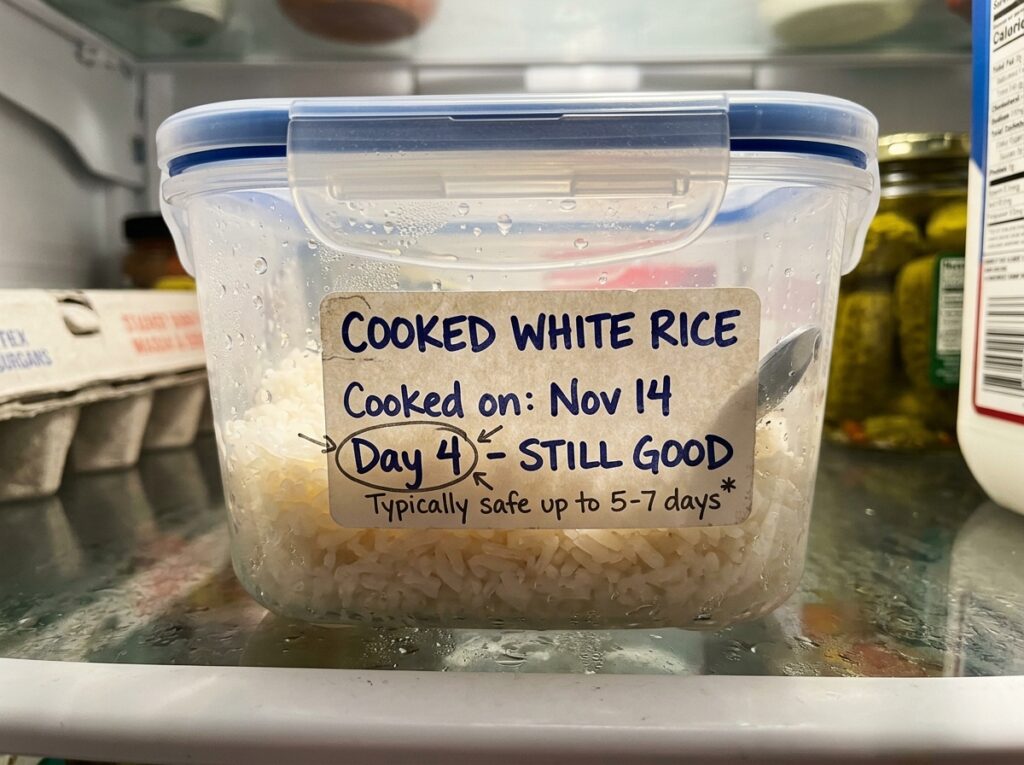
Cooked Rice in the Fridge: How Long Is It Safe?
Leftover rice looks harmless, but it can turn risky faster than most people think. If you’re staring at a container and asking how long does cooked rice last in the fridge, you probably want one clear answer, not mixed advice. Here it is: cooked rice usually stays safe in the fridge for 3 to 4 days if you cooled it quickly and stored it well. After that, it’s smarter to toss it than test your luck.
How long does cooked rice last in the fridge? The short answer
The safest rule is simple: cooked rice lasts 3 to 4 days in the fridge.
That’s the timeline backed by the USDA FoodKeeper guidance for leftovers stored at 40°F / 4°C or below. If your rice is older than 4 days, the safe move is to throw it out.
A lot of people push rice to day 5 or even day 6. Some get away with it. Some don’t. Food safety isn’t about guessing what might be okay. It’s about lowering the chance of food poisoning.
Quick facts:
- Fridge life: 3 to 4 days
- Counter time: 2 hours max
- If it’s over 90°F / 32°C: 1 hour max
- Reheat temp: 165°F / 74°C
- Best freezer window: 1 to 2 months for good texture
If you only remember one thing, remember this: day 5 is not the day to get brave with leftover rice.
Why some sites say 4 to 6 days
You’ll see mixed advice online. Some articles say 4 to 6 days. That’s one reason people get confused.
The difference usually comes down to two things. One, some writers focus on “quality” while others focus on “safety.” Two, not every source sticks closely to USDA guidance.
If you want the safer answer, use 3 to 4 days. That gives you a better margin, especially if you’re not totally sure how fast the rice cooled, how cold your fridge stays, or whether someone left the container out during lunch.
Plain rice vs rice meals
Plain white rice, brown rice, jasmine rice, and basmati rice all follow roughly the same fridge rule: 3 to 4 days.
Rice dishes can get trickier. A rice bowl with chicken, eggs, shrimp, vegetables, or sauce may still fit that 3 to 4 day window, but the extra ingredients add more chances for spoilage. If the dish smells off or sat out too long, don’t keep it just because the rice itself seems fine.
If you store a lot of leftovers, it helps to know the timing for other foods too. For example, here’s a useful guide on how long fried chicken lasts in the fridge.
Why leftover rice can turn risky fast
Rice has a reputation for being simple, cheap, and easy to save. All true. But food safety-wise, rice has one big catch.
The real issue: Bacillus cereus
Uncooked rice can contain spores of a bacteria called Bacillus cereus. Those spores can survive cooking.
Once the rice sits in the temperature danger zone—between 40°F and 140°F—the spores can wake up, grow, and produce toxins. That’s what makes leftover rice more serious than people expect.
You’ve probably heard stories of someone eating old takeout rice and getting sick a few hours later. That’s not kitchen drama. It happens.
The CDC has warned about Bacillus cereus in foods like rice and other starches. Symptoms can include vomiting, diarrhea, and stomach cramps. In most cases, people recover, but it can still ruin your day fast.
Reheating doesn’t fix every mistake
Here’s the part many people miss: reheating rice doesn’t always make it safe again.
Heat can kill many bacteria. But if bacteria already produced toxins while the rice sat out too long, reheating may not destroy those toxins. So if rice spent half the evening on the counter, blasting it in the microwave later doesn’t erase the problem.
Warning: If rice was left out for more than 2 hours, toss it. If the room was hot—think summer picnic, warm kitchen, buffet table—use 1 hour as your limit.
The same food safety clock applies to other leftovers too. If you want a good comparison, take a look at what happens with chicken left out overnight.
Why rice can fool you
Rice often looks and smells normal even when it isn’t a smart thing to eat.
That’s what makes it sneaky. A spoiled piece of meat may smell awful. Rice doesn’t always wave a red flag that clearly.
So if you’re thinking, “But it looks okay,” that alone doesn’t mean much.
What changes how long cooked rice lasts in the fridge
Not all leftover rice has the same story. Two containers can look identical, but one is fine and the other isn’t.
How fast you cooled it
Cooling speed matters a lot.
If you cooked rice at 7 p.m., ate dinner, and packed the leftovers by 7:45, great. If the pot sat on the stove until 10:30 because everybody forgot about it, that rice already had too much time at unsafe temperatures.
Think of the safety clock starting the moment the rice stops being steaming hot. The longer it lingers on the counter, the shorter its safe life becomes.
What’s mixed into it
Plain rice is one thing. A loaded rice dish is another.
Rice mixed with eggs, chicken, beef, shrimp, coconut milk, broth, or chopped vegetables can spoil faster in real-life conditions because every added ingredient brings its own moisture and bacteria risk.
A bowl of plain basmati rice is easier to judge than leftover shrimp fried rice from takeout.
If your meal prep includes chicken too, make sure the protein follows its own safety window. This guide on how long thawed chicken stays in the fridge can help you line things up.
Your fridge temperature
A fridge that stays at 40°F / 4°C or below slows bacterial growth. A warmer fridge doesn’t.
That sounds obvious, but a lot of home fridges run a little warmer than people think, especially if the door gets opened all day or the fridge is packed too tight for good airflow.
If you meal prep often, a simple fridge thermometer is worth it. It takes the guesswork out.
The container you use
A deep, tightly packed pot of rice cools slowly. A shallow container cools faster.
That’s why leftover rice does better when you portion it into smaller containers instead of sticking the whole pot in the fridge. Smaller portions chill more quickly and reheat more evenly later.
How to store cooked rice the right way
Good storage buys you safety and better texture. Bad storage gives you dry clumps at best and risky leftovers at worst.
The best way to cool and refrigerate rice
Use this simple routine after the meal:
- Move the rice out of the hot pot once you’re done serving.
- Spread or portion it into shallow containers.
- Let heavy steam escape for a short time, not for hours.
- Refrigerate within 2 hours of cooking.
- Label the container with the date if you won’t eat it the next day.
That’s it. No complicated kitchen tricks.
Pro tip: If you made a big batch for the week, divide it into single-meal portions right away. It cools faster, and you only reheat what you need.
Don’t wait for rice to cool all the way on the counter
A lot of people grew up hearing that hot food should never go into the fridge. That idea sticks around, but it often leads to food sitting out too long.
You don’t need to wait until rice turns cold at room temperature. In fact, that’s the risky move. Just portion it into shallow containers and get it chilled promptly.
If the container is huge and the rice is piping hot, split it into smaller portions first. That protects both the rice and the temperature inside your fridge.
Is the rice cooker “keep warm” setting safe?
Sometimes, yes. If the rice stays above 140°F / 60°C, it’s safer than rice sitting at room temperature.
Still, home rice cookers aren’t all the same, and quality drops if rice sits there too long. Once the meal is over, storing the leftovers in the fridge is usually the better move.
Did you know? Many cases of “fried rice” food poisoning happen because rice was left warm-ish for too long, not because rice is naturally unsafe.
Can you freeze cooked rice?
Yes, and freezing is a great backup if you won’t finish it in 3 to 4 days.
Freeze rice in airtight bags or containers after it cools. Flattening freezer bags helps save space and speeds up thawing.
Frozen rice stays safe much longer at 0°F / -18°C, though the texture is best if you use it within 1 to 2 months.
This works really well for meal prep. Cook once, refrigerate what you’ll eat soon, and freeze the rest.
How to tell if cooked rice has gone bad
Sometimes the answer is clear. Sometimes it isn’t. That’s why it helps to know both the obvious signs and the less obvious ones.
Signs you should toss it right away
Throw cooked rice out if you notice any of these:
- A sour, musty, or strange smell
- A slimy or unusually sticky surface
- Mold spots or discoloration
- A container that puffed up or built pressure
- Rice that sat out too long, even if it looks normal
That last point matters the most. Time abuse can make rice unsafe before visible spoilage shows up.
Smell isn’t a perfect safety test
A common misconception is that bad food always smells bad.
Sometimes it does. Sometimes it doesn’t.
Rice can be risky even without a terrible odor, especially if it spent too much time on the counter. So don’t rely on the sniff test alone.
Think of smell as a final warning sign, not a full safety system.
Texture changes can tell you a lot
Fresh leftover rice feels soft but separate. Rice that’s going bad may feel wet, gummy, or slimy. It may clump in an odd way that doesn’t match normal starchiness.
Dry rice isn’t always dangerous. Sometimes it just dried out in the fridge. Slimy rice is different. That’s a red flag.
If you’re checking several leftovers at once, it helps to learn how spoilage signs vary from food to food. Here’s a related guide on how to tell if a sweet potato is bad.
Don’t taste-test questionable rice
If you’re unsure, don’t take “just one bite” to find out.
That tiny taste can still make you sick. If the date is unclear, the storage was sloppy, or the rice seems even a little suspicious, toss it and move on.
Rice is cheap. A bad night is not.
Can you reheat cooked rice safely?
Yes, as long as the rice was stored safely in the first place.
Reheating safe rice is fine. Reheating unsafe rice is not a rescue plan.
Reheat rice until it’s hot all the way through
Aim for 165°F / 74°C if you want the food safety benchmark.
If you don’t use a thermometer, make sure the rice is steaming hot throughout, not just warm in the middle with cold spots around the edges.
Microwaves are famous for uneven heating. Stir halfway through, then keep heating until the whole portion is hot.
The best reheating methods
The microwave is the easiest option. Add a spoonful of water, cover the bowl loosely, and heat in short bursts. The water helps the rice steam instead of turning hard.
The stovetop works well too. Add a splash of water to a pan, cover it, and heat gently until the rice loosens and steams.
If you’re reheating frozen rice, you can often go straight from freezer to microwave. Just give it a little extra time and stir once or twice.
Try not to reheat the same rice over and over
Every round of cooling and reheating gives bacteria more chances to grow if the timing gets sloppy.
A better habit? Reheat only the amount you plan to eat.
That’s another reason single portions help so much. They keep the rest of the batch cold and untouched.
Cold rice from the fridge: safe or not?
Cold rice is okay to eat if it was stored properly and is still within the 3 to 4 day window.
That means a chilled rice salad or sushi-style bowl isn’t automatically a problem. The key is how fast it got refrigerated after cooking and how long it has been sitting there since.
If your rice bowl includes sauce, keep that in mind too. Fresh sauces and toppings may expire sooner. For example, storage times for condiments can be surprisingly short, so it helps to know how long salsa lasts.
Does the type of rice matter?
Yes for texture, a little for quality, and less than most people think for basic safety.
White rice, brown rice, jasmine, and basmati
From a food safety angle, plain cooked rice of most types lasts about 3 to 4 days in the fridge.
Brown rice may taste stale a bit sooner because it contains more natural oils than white rice. That affects flavor and texture more than the official safety window.
Jasmine, basmati, sushi rice, and plain long-grain rice all follow the same general fridge rule if they were cooled and stored correctly.
Fried rice and takeout rice dishes
Takeout rice deserves extra caution because you usually don’t know exactly how long it sat before you brought it home.
Once you get it home, refrigerate leftovers quickly. Don’t leave the carton on the coffee table all evening while you pick at it.
Fried rice with eggs, meat, or seafood may still fit the same 3 to 4 day rule in the fridge, but I’d stay on the earlier side of that window. If you can eat it within 1 to 3 days, even better.
Rice meal prep: a smarter way to handle the week
Here’s a practical example.
Let’s say you cook a big batch of rice on Sunday for weekday lunches.
Use Monday, Tuesday, and Wednesday portions from the fridge. Freeze Thursday and Friday portions the same day you cooked them. That way, you don’t reach Friday staring at a five-day-old container and talking yourself into it.
That’s the kind of small kitchen habit that saves money and keeps leftovers low-stress.
4. FAQ Section
FAQ
Can you eat cooked rice after 5 days in the fridge?
It’s not the safest choice. USDA guidance points to 3 to 4 days for cooked leftovers like rice. By day 5, the risk goes up, especially if the rice cooled slowly, sat out at any point, or your fridge runs warm. If you know it’s 5 days old, the better move is to throw it away.
How do you know if cooked rice is bad?
Bad cooked rice may smell sour, feel slimy, show mold, or look discolored. Still, don’t rely only on sight and smell. Rice can become unsafe from being left out too long even before obvious spoilage appears. If you’re unsure about the date or storage, don’t taste it. Toss it.
Can reheating rice make it safe again?
Only if the rice was stored safely to begin with. Reheating to 165°F / 74°C can kill many bacteria, but it may not destroy toxins already produced by Bacillus cereus if the rice sat at room temperature too long. So reheating is not a fix for badly stored rice.
Does brown rice last longer than white rice in the fridge?
Not really. Both usually stay safe for 3 to 4 days in the fridge. Brown rice may lose quality sooner because of its natural oils, so the flavor can turn faster. The safety rule stays about the same for both.
Is it safe to eat cold cooked rice from the fridge?
Yes, if the rice was cooled quickly, stored at 40°F / 4°C or below, and eaten within 3 to 4 days. Cold rice itself isn’t the problem. Poor storage is. If the rice sat out too long before refrigeration, skip it even if it’s cold now.
Can you freeze cooked rice?
Yes. Freezing works well if you won’t finish the rice within a few days. Cool it promptly, pack it in airtight containers or freezer bags, and freeze it. It stays safe much longer in the freezer, though the texture is usually best within 1 to 2 months.
Note: This article gives general food safety guidance, not medical advice. If you think you have food poisoning and symptoms feel severe, contact a healthcare professional.
5. Conclusion
Cooked rice doesn’t give you a huge safety window, so the best habit is also the simplest: use it within 3 to 4 days, cool it fast, and don’t trust old rice just because it looks fine. If you meal prep often, label the date and freeze extra portions early. And if the container in your fridge is already making you debate with yourself, that’s usually your answer. Toss it, cook fresh next time, and save yourself the risk.