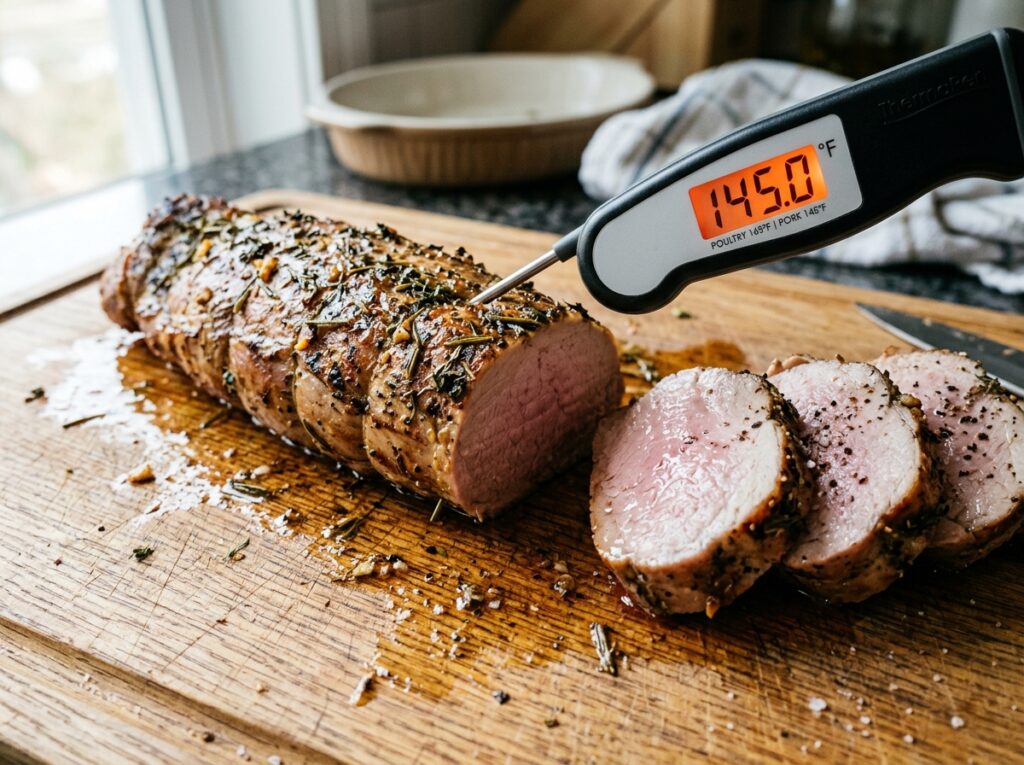
Internal Temperature for Pork Tenderloin at 145°F
Pork tenderloin doesn’t need to hit 160°F to be safe. That old habit is why so many people end up with dry, tight, disappointing slices and wonder what went wrong. The right internal temperature for pork tenderloin is 145°F (63°C) with a 3-minute rest, and that one number changes everything. If you want pork that stays juicy, lightly pink in the middle, and still fully safe, the trick is knowing where to check the temp and when to pull it off the heat.
Quick answer: Cook pork tenderloin until the center reaches 145°F, then let it rest at least 3 minutes. For the best texture, many home cooks pull it at 140 to 142°F and let carryover heat bring it up the rest of the way.
2. What Is the Safe Internal Temperature for Pork Tenderloin?
The short answer
The safe internal temperature for pork tenderloin is 145°F (63°C), followed by a 3-minute rest.
That’s the standard for whole cuts of pork from the USDA Food Safety and Inspection Service. Pork tenderloin falls into that group, along with pork chops and pork roasts.
So if your thermometer reads 145°F in the center, and you let the meat rest, you’re in the safe zone.
What that number really means
A lot of people hear “145°F” and still hesitate. They expect pork to be white all the way through. That’s old kitchen memory talking.
At 145°F, pork tenderloin can still have a faint blush of pink. That doesn’t mean it’s raw. It means you cooked a lean cut properly instead of taking it too far.
One thing to remember: this rule applies to whole-muscle pork tenderloin, not ground pork. Ground pork should go to 160°F (71°C) because the meat has been mixed and handled differently.
Quick fact: Pork tenderloin and pork loin are not the same cut. They may share the same safe final temperature, but tenderloin cooks much faster because it’s smaller and leaner.
2. Why 145°F Is the Sweet Spot
Why people still overcook pork tenderloin
Pork carries a lot of old baggage in home kitchens. Plenty of people still cook it as if 160°F is the only safe finish.
That older habit stuck around from outdated recipes, old family rules, and years of hearing pork should never look pink. The problem is simple: pork tenderloin is a very lean cut, so it dries out fast.
Think of it like chicken breast’s moodier cousin. It can go from juicy to chalky in a short window.
At 145°F, the meat stays tender and moist. Push it to 155°F or 160°F, and the muscle fibers squeeze out more moisture. That’s when you get slices that look fine at first, then feel dry the moment you chew.
Resting changes the final result
The number you see when you pull the tenderloin out of the oven isn’t always the number you end up eating.
That’s because of carryover cooking. The heat sitting on the outside keeps moving toward the center for a few minutes after you remove the meat from the oven, grill, or pan.
With pork tenderloin, the internal temp often rises about 3 to 5 degrees while it rests. A hard sear or very hot grill can push it a little more.
That’s why many cooks pull it at 140 to 142°F, then let it rest until it lands near 145°F.
Pro tip: Don’t pull it at 130°F and hope for a miracle. Pork tenderloin is too small to coast up 10 or 15 degrees like a huge roast might.
Why the rest matters beyond safety
Resting isn’t just about numbers. It helps the juices settle back into the meat.
Slice too soon, and those juices run onto the cutting board instead of staying in your dinner. Give it even 5 minutes, and the texture improves a lot.
The USDA says 3 minutes is the minimum rest for safety. In real kitchens, 5 minutes is often better for tenderness and cleaner slices.
3. How Do You Check Pork Tenderloin Temperature the Right Way?
Use the right thermometer
If you cook pork tenderloin often, a digital instant-read thermometer is one of the best kitchen tools you can own.
It beats guessing by color, cutting into the center, or pressing the meat with your finger and hoping your instincts are right.
If you want help using one properly, this guide on how to read a meat thermometer makes the process much easier.
A thin-tip thermometer works best here because tenderloin isn’t very thick. Big probes can miss the true center.
Where to insert the probe
Always check the thickest part of the tenderloin.
The easiest way is often to insert the thermometer from the side, not straight down from the top. That helps the sensor sit right in the center of the meat, where the last part finishes cooking.
The ends of a tenderloin taper off and cook faster. If you test there, you’ll get a reading that looks done long before the center actually is.
A good habit is to check more than one spot near the middle, especially if the tenderloin has an uneven shape.
Small mistakes that throw off your reading
A few simple errors can give you a false reading.
If the probe touches the pan, the grill grate, or a hot skillet surface, the number can jump way above the actual meat temperature.
If the tip barely reaches the center, you may read the hotter outer layer instead of the coolest part.
And if you wait until you think it must be done before checking, you’re often already too late.
Start checking early. For many average tenderloins, that means taking the first reading when you think you’re about 10 degrees away from your target.
What if your thermometer seems off?
Thermometers can be wrong. It happens more than people think.
If yours gives odd readings all the time, test it in a glass of ice water. It should read close to 32°F (0°C). If it doesn’t, recalibrate it if your model allows that, or replace it.
A bad thermometer can ruin pork tenderloin faster than a bad recipe.
4. How to Cook Pork Tenderloin to 145°F Every Time
A simple method that works
You don’t need fancy technique here. You need a solid method and a little timing awareness.
- Prep the meat. Pat the tenderloin dry, trim any silver skin if needed, and season it. If one end is much thinner, tuck that tail under and tie it so it cooks more evenly.
- Cook with fairly high heat. Oven roasting at 400°F to 425°F works well. So does searing in a skillet, then finishing in the oven. On a grill, use a hotter side for browning and a cooler side to finish.
- Check the temperature early. Don’t wait for a visual cue. Start checking before you think it’s done, especially with a 1 to 1.5 pound tenderloin.
- Pull, rest, and slice. Remove it around 140 to 142°F if you want it juicy, then rest it at least 3 minutes, ideally 5. Slice across the grain.
That’s the rhythm. Not complicated, but it works.
About how long does it take?
Time still matters, even if temperature matters more.
At 400°F, a pork tenderloin around 1 to 1.5 pounds often takes about 20 to 25 minutes. At 425°F, it may finish in 18 to 22 minutes. On a medium-high grill, many tenderloins take around 15 to 20 minutes, depending on thickness and how often you turn them. In an air fryer at 375°F to 400°F, you’ll often land in the 18 to 22 minute range.
Those are rough ranges, not promises.
Your oven may run hot. Your tenderloin may be thicker than average. A sugary marinade may brown the outside fast while the center still needs time. A fridge-cold tenderloin can take a little longer than one that sat out briefly while you prepped dinner.
If you want a fuller timing breakdown, this guide on pork tenderloin in oven at 400 is a helpful next step.
A real-life example
Say your tenderloin has been roasting at 400°F for 21 minutes, and the center reads 141°F.
That’s usually your cue to pull it.
Rest it 5 minutes, then check again if you want to be extra sure. A lot of the time, it will settle right around 145°F. If it only reaches 143°F, give it another minute or two of heat.
That’s much better than waiting until it hits 148°F in the oven, then watching it coast up to 152°F on the counter.
5. What Does Pork Tenderloin Look Like at Different Temperatures?
Can pork tenderloin be pink?
Yes. Pork tenderloin can be slightly pink in the middle and still safe.
That single point confuses a lot of people, so it’s worth saying plainly: pink does not automatically mean undercooked.
If you want a deeper look at that question, this article on can pork tenderloin be pink explains why the color can stay rosy even when the temperature is safe.
A simple doneness picture
Here’s a practical way to think about it:
- 135 to 140°F: deeper pink center, very juicy, still under the standard target
- 145°F after resting: pale pink or blush in the middle, juicy, safe
- 150 to 155°F: faint pink or mostly white center, firmer texture
- 160°F and above: white or tan center, noticeably drier
That little blush at 145°F is exactly where many people find the best texture.
Why color can fool you
Meat color depends on more than heat.
Pigment in the meat, called myoglobin, can keep pork looking pink even after it reaches a safe temperature. Marinades can also affect color. So can smoking, lighting in your kitchen, and even the way the meat was packaged.
That’s why color is a weak safety test.
Warning: Clear juices don’t prove pork tenderloin is done. Meat can run clear before the center is safe, and it can still look pink after it’s fully cooked.
Did you know? A nicely cooked pork tenderloin often looks a little pinker than people expect. That usually means you nailed it instead of overcooking it.
If you’re serving pregnant people, older adults, small children, or anyone with a weaker immune system, don’t rely on looks at all. Use a thermometer and follow USDA guidance closely.
6. Common Mistakes That Ruin Pork Tenderloin
Cooking by time alone
A recipe can say “roast for 22 minutes,” but your oven and your piece of meat may tell a different story.
Time is useful for planning. It’s not the final judge.
The same tenderloin can finish early on one sheet pan and late on another. That’s why the thermometer matters more than the clock.
Ignoring carryover cooking
You worked hard to hit the right number. Don’t lose it in the last five minutes.
If you leave the tenderloin in the oven until it reads 145°F, it may keep climbing during the rest and land in the upper 140s or low 150s.
That’s still safe. It just won’t be as juicy.
Slicing right away
This one gets people all the time.
You pull the meat, it smells great, and you want dinner on plates right now. So you slice immediately. Then the board fills with juice.
A short rest fixes that. Even 5 minutes makes a difference.
Trusting the outside color
A browned crust looks done. Sometimes it is. Sometimes it isn’t.
If your tenderloin has sugar in the glaze, paprika in the rub, or dark grill marks from high heat, the outside can look finished long before the middle reaches the target temperature.
Don’t let the crust talk you into overconfidence.
Confusing pork tenderloin with other pork cuts
Pork cut names can be sneaky.
Pork tenderloin is long, narrow, and lean. Pork loin is much larger and thicker. They are not interchangeable for cook time.
Even other pork cuts behave very differently. If you’re making chops, check this guide to the internal temperature for pork chops. If you’re cooking a shoulder-style cut for pulled pork, the target is a whole different story, and this internal pork butt temp guide explains why.
The safe number for whole pork cuts may match on paper, but the way those cuts cook and feel is not the same at all.
7. FAQ
Is pork tenderloin done at 145°F?
Yes. Pork tenderloin is done and safe at 145°F (63°C) as long as you let it rest for at least 3 minutes. That’s the USDA guideline for whole cuts of pork. Many cooks remove it from the heat at 140 to 142°F so it finishes at 145°F during the rest.
What temperature should I pull pork tenderloin from the oven?
For the best texture, pull it around 140 to 142°F in the thickest part, then let it rest. The temperature usually rises a few degrees after cooking. If you wait until it hits 145°F in the oven, it may end up slightly drier by the time you serve it.
How long should pork tenderloin rest?
Rest pork tenderloin for at least 3 minutes, which covers the USDA safety guidance. For better juiciness and easier slicing, 5 minutes is a smart target. If it was seared hard or cooked very hot, a rest of 5 to 8 minutes can work well.
Can pork tenderloin still be pink at 145°F?
Yes, it can. A pale pink center at 145°F is normal and still safe. Color alone doesn’t tell you whether pork is done. Always trust the thermometer over the look of the meat.
Is pork tenderloin the same as pork loin for cooking temperature?
They share the same safe final temperature of 145°F with a rest because both are whole cuts of pork. Still, pork tenderloin cooks much faster than pork loin because it’s smaller and leaner. If you treat them the same for timing, you’ll usually overcook the tenderloin.
8. Conclusion
If you remember just one number, make it 145°F.
That’s the safe internal temperature for pork tenderloin, and it’s also the point where this cut stays juicy instead of drying out. Pull it a few degrees early, check the thickest part with a good thermometer, and give it a short rest before slicing.
Do that once or twice, and pork tenderloin stops feeling tricky. Next time you cook it, trust the temperature more than the color on the plate, and you’ll get better results every single time.