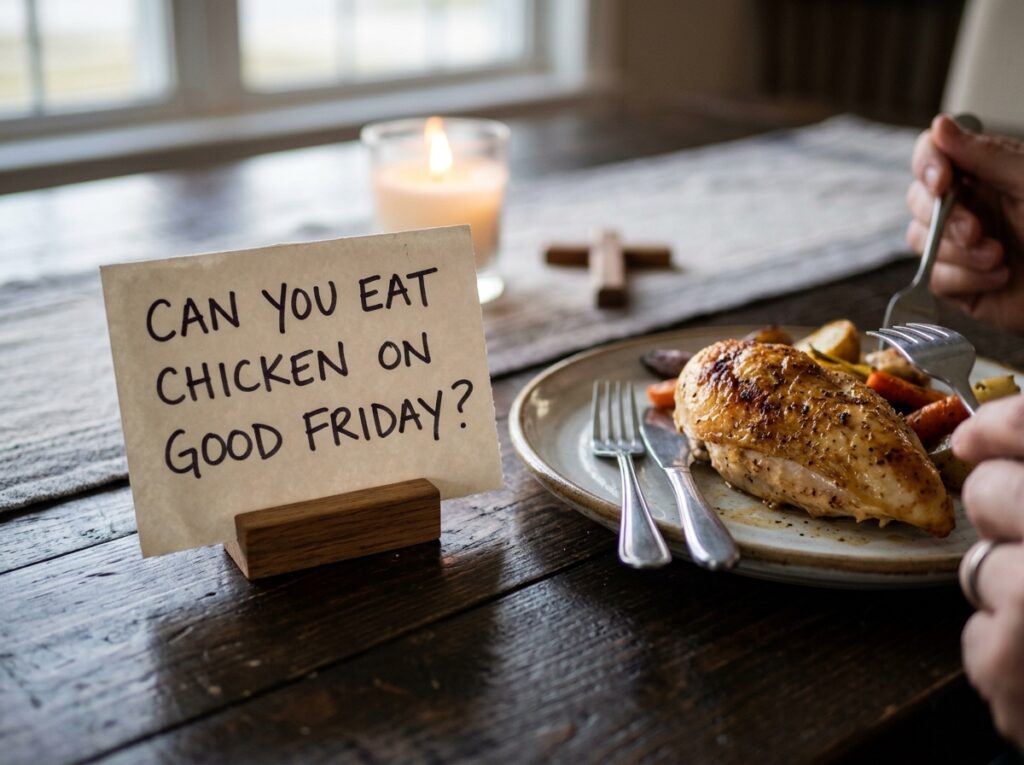
Can You Eat Chicken on Good Friday as a Catholic?
If you observe Catholic Good Friday abstinence, you should not eat chicken on Good Friday. Chicken is poultry, and poultry counts as meat in this setting.
For many Catholics, Good Friday is also a day of fasting, not just skipping meat. That means the day carries a little more weight than an ordinary Friday lunch choice. It’s tied to prayer, penance, and remembering the crucifixion of Jesus Christ.
Quick fact: As of 2026, the standard rule in the Latin Catholic Church has not changed. Catholics age 14 and older are expected to abstain from meat on Good Friday. Catholics age 18 to 59, if able, are also expected to fast.
If you’re trying to sort out the bigger season too, this guide on can you eat chicken during Lent helps explain how Good Friday fits into the rest of Lent.
The one thing most people want is a clear yes-or-no answer. Here it is again: If you’re keeping Good Friday the Catholic way, skip the chicken.
Why Good Friday Food Rules Exist
Good Friday is about more than the menu
Good Friday is the Friday before Easter. For Christians, especially Catholics, it marks the suffering and death of Jesus on the cross. That’s why the day is treated with more seriousness than a normal Friday.
The food rule isn’t there to make lunch annoying. It’s meant to be a small act of sacrifice. Think of it like a visible reminder. Every time you have to pause and say, “No, not that today,” you remember why the day matters.
A lot of families grew up with this without knowing the reason. They knew the habit, not the meaning. Fish fry on Friday. No burgers. No chicken sandwiches. Once you know the “why,” the rule feels less random.
Fasting and abstinence are not the same thing
People mix these up all the time.
Abstinence means not eating meat.
Fasting means eating less than usual.
For Roman Catholics, Good Friday is usually both:
- Abstinence from meat for those 14 and older
- Fasting for those 18 to 59, if they’re able
In everyday Catholic practice, fasting often means one full meal and two smaller meals that together don’t equal a second full meal. Water and medicine don’t break the fast.
Did you know? In the Latin Catholic calendar, Ash Wednesday and Good Friday are the two main universal days of both fasting and abstinence.
That’s why people often feel more cautious on Good Friday than on another Friday in Lent. The day carries both rules at once.
Does Chicken Count as Meat on Good Friday?
Yes, chicken is meat in church practice
This is the big confusion.
Some people think the rule is only about red meat like beef or pork. That’s not right. In Catholic practice, chicken, turkey, beef, pork, lamb, and other meat from warm-blooded animals are all off-limits on Good Friday.
So if your lunch options are grilled chicken wrap, turkey sandwich, or burger, all three miss the mark for Catholic abstinence.
Common misconception: “Chicken is just poultry, not meat.”
That may sound fine in casual speech, but it doesn’t work for Good Friday. In church rules, poultry still counts as meat.
Why fish is usually allowed but chicken isn’t
This part confuses people because it feels backward. Chicken seems lighter than steak, so why is fish okay and chicken not?
The answer is tradition. Catholic abstinence has long drawn a line between the flesh of land animals and birds and foods like fish and seafood. So tuna, salmon, shrimp, cod, and similar foods are commonly allowed, while chicken is not.
It’s not a nutrition rule. It’s a church practice.
A simple way to remember it: if it’s poultry or meat from a land animal, don’t eat it on Good Friday if you’re observing the Catholic rule.
What about eggs, cheese, and dairy?
For Roman Catholics, foods like eggs, milk, cheese, butter, and yogurt are generally allowed on Good Friday. That’s why cheese pizza, mac and cheese, grilled cheese, or an egg dish may still fit the day.
That surprises a lot of people. They assume Good Friday means “no animal products at all.” That’s not the normal Catholic rule.
Still, other Christian traditions may be stricter. Some Eastern Orthodox Christians avoid not just meat, but also dairy and eggs during stricter fasting periods. So don’t assume every church follows the same pattern.
What about chicken broth or chicken stock?
This is where things get a little gray.
In traditional Catholic moral teaching, abstinence usually focuses on the flesh meat itself, not always small amounts of broth or seasoning. That said, many Catholics choose to avoid chicken broth, chicken stock, and chicken gravy on Good Friday too, just to keep the day simple and avoid edge cases.
If you want the easiest rule to follow, go with this: skip obvious chicken and skip foods flavored with chicken if you’re unsure.
Warning: Restaurant soups, rice dishes, stuffing, and sauces often contain chicken stock even when there’s no visible meat in the bowl.
Hidden chicken shows up more than you think
You don’t always see the problem right away.
A “vegetable soup” may use chicken stock.
A Caesar salad may come topped with grilled chicken by default.
A ramen bowl might have chicken broth even if it looks meat-free.
A restaurant side dish may be cooked in chicken fat or stock.
That’s why simple meals work best on Good Friday. The fewer mystery ingredients, the better.
Does Every Christian Have the Same Rule?
Roman Catholics
If you’re a Roman Catholic, the answer is pretty direct: don’t eat chicken on Good Friday if you are bound by the rule of abstinence.
For most Catholics, this isn’t just a family custom. It’s part of the Church’s regular discipline tied to Lent and Holy Week.
Local bishops’ conferences can give practical guidance, and your parish may explain the rules in a simpler way during Lent. But the basic idea stays the same: Good Friday is meat-free.
Eastern Orthodox Christians
For Eastern Orthodox Christians, the practice is often stricter. Many Orthodox believers keep a fast on Good Friday that avoids meat and may also avoid dairy, eggs, and fish, depending on the tradition, local bishop, and personal spiritual guidance.
So if you’re Orthodox, chicken is usually not the only issue. The whole day may call for a much simpler table.
If you’re not sure what applies in your church, ask your priest or check your parish calendar. Orthodox fasting rules can differ by jurisdiction and by how strictly someone is keeping the fast.
Protestants, Anglicans, and other Christians
A lot of Protestant, Evangelical, Baptist, and nondenominational churches do not have a universal rule against chicken on Good Friday.
Some Christians in those traditions still choose to give up meat as a personal act of devotion. Others may fast from something else like sweets, social media, or a favorite meal. In some Anglican or Episcopal settings, members may observe Good Friday in a way that looks close to Catholic practice, though it can vary.
So if you’re asking, “Can I eat chicken on Good Friday?” the real follow-up is, “What does my church teach, and what am I trying to observe?”
A quick real-life example helps here. A Catholic family in Chicago may serve baked cod and potatoes. An Orthodox family may keep a very plain, almost vegan-style meal. A Baptist family may have no church rule at all, but still choose a simple dinner out of respect for the day.
Same calendar day. Different traditions.
What If You Ate Chicken by Mistake?
If it was an accident
A lot of people worry after the fact.
Maybe you grabbed a chicken salad without thinking. Maybe the soup had chicken stock and you only found out later. Maybe someone handed you food at work and you didn’t ask.
If it was a genuine mistake, don’t panic.
In Catholic moral teaching, accident and deliberate choice are not the same thing. Good Friday is meant to call you to prayer and repentance, not send you into a spiral over a sandwich.
If it’s bothering you, bring it up in confession or speak with a priest. That gives you a clear answer and some peace of mind.
If you knowingly chose chicken
If you knew the rule, knew it applied to you, and ignored it on purpose, that’s a different matter. The best next step is simple: be honest with yourself, bring it to prayer, and talk to a priest if you need guidance.
You don’t fix it by overreacting or trying to invent a punishment. Just take the day seriously and respond in a sincere way.
Who may be excused from fasting or abstinence?
Church rules are not meant to harm your health.
Here are common situations where the rule may not bind in the usual way:
- Children under 14 are not bound to abstain from meat.
- Adults under 18 and over 59 are not bound to the Good Friday fast.
- People who are sick or dealing with physical weakness may be excused.
- Those who are pregnant, nursing, or managing medical needs may need a different approach.
- Anyone with an eating disorder should follow medical care first and get pastoral guidance if needed.
Medical note: If fasting could harm your health, follow your doctor’s advice. If you want help applying the church rule to your situation, ask your parish priest.
Don’t miss the heart of the day
It’s easy to turn Good Friday into a technical food quiz. That misses the point.
The goal is not “I beat the rule.”
The goal is prayer, remembrance, humility, and sacrifice.
If you slipped, reset and keep the day with honesty.
Good Friday Meal Ideas That Still Feel Satisfying
Skipping chicken doesn’t mean settling for a sad plate of crackers. You’ve got plenty of solid options that still feel like a real meal.
Easy meat-free meals for Good Friday
Here are a few simple ideas that work well:
- Baked salmon with potatoes and a side salad
- Cheese lasagna or spinach lasagna
- Tuna melt with tomato soup
- Shrimp pasta with olive oil and garlic
- Grilled cheese, roasted vegetables, and fruit
If fish is on your menu, this guide on how to bake salmon at 350 makes dinner easy.
Want something cozy and filling? A meatless lasagna works really well, and this timing guide for baking lasagna at 350 can help you plan it.
Potatoes also save the day more often than people admit. They’re cheap, filling, and flexible. If you’re making a Friday side, here’s a quick guide on how long to boil potatoes.
A simple rule for eating out
If you’re going to a restaurant, make life easy on yourself. Pick something that clearly fits the day.
Fish tacos. Cheese pizza. Pasta primavera. Veggie sandwich. Baked salmon. Shrimp and rice.
Don’t play ingredient detective at the table if you can avoid it.
Pro tip: Ask one direct question before ordering: “Is this cooked with chicken stock or chicken broth?” That one sentence can save you from most mistakes.
If your family is mixed, plan ahead
A lot of homes aren’t all on the same page. Maybe one person is Catholic, one isn’t, and the kids don’t fully get the rule yet.
That’s normal.
In that case, cook one base meal that works for everyone. Pasta, fish, baked potatoes, soup, bread, salad, or cheese-based dishes usually keep the peace.
Then, if you want to save chicken for the next day, do that. If Saturday or Easter dinner is your chicken night, this guide on baking chicken breast at 350 can help once Good Friday has passed.
Keep it simple, not fancy
Good Friday is not really the day to build a giant “look how creative I am” feast. A plain, thoughtful meal often fits better.
Bread. Soup. Fish. Potatoes. Salad. Fruit. Pasta.
That kind of meal feels grounded. It also keeps the day focused where it belongs.
4. FAQ Section
FAQ
Can Catholics eat chicken on Good Friday?
No. If you are a Roman Catholic who is bound by the rule of abstinence, you should not eat chicken on Good Friday. Chicken counts as meat, just like beef, pork, or turkey.
Does chicken count as meat on Good Friday?
Yes. In Catholic practice, chicken is poultry, and poultry counts as meat for Good Friday abstinence. The rule is not limited to red meat.
Can you eat eggs or cheese on Good Friday?
For Roman Catholics, yes. Eggs, milk, cheese, and other dairy foods are generally allowed on Good Friday. Some other Christian traditions, especially Eastern Orthodox practice, may be stricter.
Can you eat chicken broth on Good Friday?
This is a gray area for some people. Traditional Catholic abstinence usually focuses on the meat itself, but many Catholics choose to avoid chicken broth, stock, and gravy too. If you want the simplest path, skip them.
What if you accidentally ate chicken on Good Friday?
If it was a real mistake, don’t panic. Accidentally eating chicken is not the same as knowingly ignoring the rule. If you feel uneasy about it, talk to a priest or mention it in confession.
Do all Christians avoid chicken on Good Friday?
No. Roman Catholics usually do. Eastern Orthodox Christians often keep even stricter fasts. Many Protestant and nondenominational Christians do not have a universal church rule against chicken on Good Friday, though some still choose to avoid meat as a personal practice.
Can you eat chicken on Good Friday if you’re sick or pregnant?
If fasting or food restrictions could affect your health, your health comes first. People who are sick, pregnant, nursing, or dealing with certain medical conditions may be excused from the usual practice. Follow your doctor’s advice and ask your priest if you want guidance for your situation.
5. Conclusion
If you’re observing Good Friday in the Roman Catholic way, the answer is simple: don’t eat chicken. It counts as meat, so it doesn’t fit the day’s abstinence rule. Fish, eggs, dairy, pasta, potatoes, and other meat-free meals are usually fine.
If you belong to another Christian tradition, check what your church teaches instead of guessing from someone else’s custom. And if you’re ever stuck between “technical rule” and “honest faith,” go with the choice that keeps the day reverent and clear. For most people, that means one easy next step: skip the chicken, keep the meal simple, and let the day point you back to its meaning.