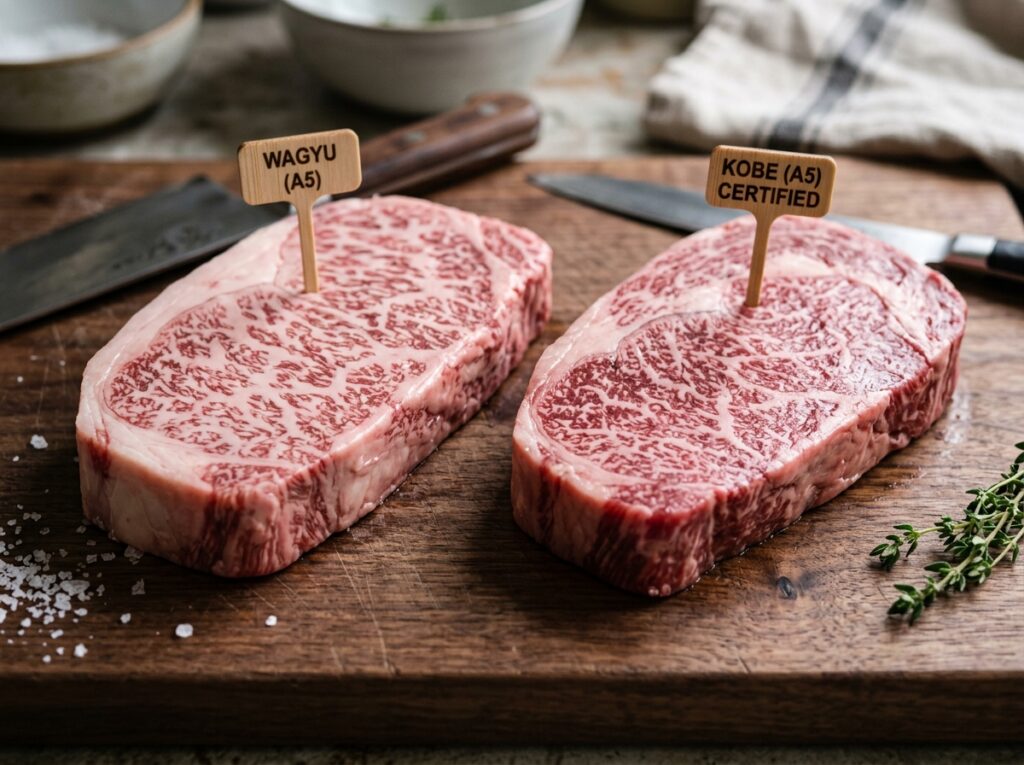
Wagyu and Kobe Beef — A Honest Side-by-Side Look
Only about 3,000 to 5,000 cattle per year qualify as authentic Kobe beef — out of millions of cattle raised across Japan. That tiny number should tell you something. If you’ve seen “Kobe beef” on menus at dozens of restaurants in your city, something doesn’t quite add up, right?
The Wagyu vs Kobe beef debate is one of the most misunderstood topics in the food world. People use these names interchangeably all the time, and honestly, that confusion isn’t their fault. Restaurants, butcher shops, and even some online retailers blur the lines between these two terms — sometimes on purpose.
Here’s the thing: all Kobe beef is Wagyu, but not all Wagyu is Kobe. That single sentence changes everything about how you shop, order, and spend your money on premium beef. And once you understand why, you’ll never look at a fancy steak menu the same way again.
Let’s break this down properly — the origins, the grading, the taste, the price, and most importantly, what you should actually order the next time you’re ready to splurge.
What Exactly Is Wagyu Beef?
The word “Wagyu” literally translates to “Japanese cow.” Wa means Japanese, and gyu means cattle. Simple enough. But the term covers a lot more ground than most people realize.
Wagyu isn’t a single breed. It’s an umbrella term for four specific Japanese cattle breeds: Japanese Black (Kuroge), Japanese Brown (Akage), Japanese Shorthorn, and Japanese Polled. Among these, Japanese Black is the dominant breed, accounting for roughly 90% of all Wagyu production. It’s the breed most responsible for that signature marbling Wagyu is famous for.
What makes Wagyu special isn’t just genetics — it’s what those genetics produce. Wagyu cattle have a unique biological ability to develop intramuscular fat — the fat that runs within the muscle fibers rather than sitting around them. That’s the marbling you see, those white streaks weaving through the red meat like tiny rivers. And that marbling is what creates the melt-in-your-mouth texture people lose their minds over.
Now here’s where it gets interesting. Wagyu cattle are raised in multiple countries today. You’ll find Wagyu programs in the United States, Australia, the United Kingdom, and several other countries. American Wagyu, for example, is typically a crossbreed — usually Japanese Black crossed with Angus cattle. Australian Wagyu follows similar crossbreeding practices, though some Australian ranches raise full-blood Wagyu.
Quick Fact: Japanese-raised Wagyu and American Wagyu are very different products. Japanese Wagyu is often graded A5 (the highest possible grade), while American Wagyu typically doesn’t reach the same marbling levels because of crossbreeding and different feeding practices.
So when you see “Wagyu” on a menu or at a butcher shop, the first question you should ask is: where is it from? A domestic Wagyu burger and an imported A5 Japanese Wagyu strip steak are worlds apart — in flavor, texture, and price.
What Makes Kobe Beef So Special?
Kobe beef is Wagyu, yes. But it’s a very specific type of Wagyu with strict rules that make it one of the rarest and most tightly controlled beef products on the planet.
Kobe beef comes exclusively from Tajima-gyu cattle — a strain of the Japanese Black breed — raised in Japan’s Hyōgo Prefecture. The city of Kobe is the capital of Hyōgo Prefecture, and that’s where the beef gets its name. Think of it like Champagne: sparkling wine made in Champagne, France gets that designation. Everything else is just sparkling wine. Kobe beef works the same way.
But being from Hyōgo Prefecture and being a Tajima-gyu cow isn’t enough. The Kobe Beef Marketing and Distribution Promotion Association enforces a strict list of requirements before any beef earns the Kobe label. The cattle must be born, raised, and slaughtered within Hyōgo Prefecture. They must be a steer (castrated bull) or virgin cow. And the meat must achieve a Beef Marbling Score (BMS) of 6 or higher on Japan’s grading scale, along with meeting specific quality standards for meat color, fat quality, and carcass weight.
That’s why the numbers are so tiny. In a typical year, only a few thousand animals make the cut. To put it in perspective, Japan produced over 460,000 metric tons of beef in 2023, and Kobe beef represented just a sliver of that total.
Did you know? Genuine Kobe beef wasn’t even exported outside Japan until 2012. Before that, if you ate “Kobe beef” at a restaurant in New York or London, it wasn’t real Kobe. And even now, the amount exported is extremely limited. The Kobe Beef Association maintains a public list of certified restaurants and distributors outside Japan — and it’s a short list.
Wagyu vs Kobe Beef: The Key Differences That Matter
Alright, let’s put these two side by side and get specific. Because the differences between Wagyu and Kobe aren’t just about geography — they affect flavor, price, availability, and what you’re actually getting for your money.
Origin and Geography
Wagyu is a broad category. It can come from Japan, Australia, the United States, or anywhere else that raises Wagyu-breed cattle. There’s no single region it’s tied to.
Kobe beef is locked to one place: Hyōgo Prefecture, Japan. No exceptions. A Tajima-gyu cow raised in Hokkaido or Texas isn’t Kobe, even if the genetics are identical. The geographical restriction is absolute.
Breed Specifics
All four Japanese cattle breeds fall under the Wagyu umbrella. When you buy Wagyu, it could come from Japanese Black, Japanese Brown, or any crossbreed involving Wagyu genetics.
Kobe beef must come from the Tajima strain of Japanese Black cattle — a specific bloodline within an already specific breed. Think of it as a subset within a subset.
Grading and Quality Standards
Japanese Wagyu is graded on a scale that goes from C1 (lowest) to A5 (highest). The letter (A, B, or C) refers to yield — how much usable meat comes from the carcass. The number (1 through 5) refers to meat quality, which includes marbling, color, firmness, and fat quality.
Kobe beef must score at minimum a BMS of 6 (on a 1–12 scale) and meet quality grade 4 or 5. So while you can buy A3 or B4 Wagyu — perfectly good beef — you’ll never see a low-grade Kobe. Every piece of Kobe has already passed the highest quality filters.
American and Australian Wagyu use different grading systems entirely. The USDA grading scale (Select, Choice, Prime) doesn’t capture the marbling range of Japanese beef. A USDA Prime steak might score a BMS of 4 or 5. Japanese A5 Wagyu can hit BMS 10, 11, or even 12. The scales just aren’t comparable.
Marbling and Flavor Profile
Both Wagyu and Kobe deliver intense marbling, but the eating experience can differ depending on the source.
Japanese A5 Wagyu (Kobe or non-Kobe) has marbling so dense that the meat almost looks pink-white rather than red. The fat melts at a lower temperature than regular beef fat because it’s rich in oleic acid — the same monounsaturated fat found in olive oil. That’s why it literally dissolves on your tongue.
Kobe beef specifically tends to have a buttery, almost sweet flavor with an incredibly delicate texture. Many people describe it as the most tender beef they’ve ever eaten. Non-Kobe Japanese Wagyu from other regions — like Matsusaka or Ōmi beef — can rival Kobe in quality, and some Japanese beef enthusiasts actually prefer these lesser-known varieties.
American Wagyu tastes different. Because it’s usually a Wagyu-Angus cross, it has more “beefy” flavor with good marbling — better than USDA Prime, but not as intensely rich or buttery as full-blood Japanese Wagyu. If you enjoy a traditional steak experience with enhanced marbling, American Wagyu is an excellent sweet spot. It pairs especially well with classic preparations — a quality knife for precise steak cutting can really elevate the experience.
Price Comparison
Here’s where reality hits. Authentic Kobe beef is expensive — there’s no way around it. In Japan, a Kobe beef dinner at a reputable restaurant can run $200 to $500+ per person depending on the cut and portion. Imported Kobe in the US or Europe? Even more.
Japanese A5 Wagyu (non-Kobe) is also pricey, but typically 20–40% less than Kobe for comparable cuts. You’re paying a premium for the Kobe name and the certification process behind it.
American Wagyu is significantly more affordable. You can find American Wagyu steaks for $30 to $80 per pound depending on the cut, compared to $150 to $300+ per pound for imported Japanese A5. Australian Wagyu falls somewhere in between.
Pro Tip: If you’ve never tried high-end beef before, start with American Wagyu. It gives you a genuine taste of what enhanced marbling does to a steak without the financial commitment of Japanese imports. You can always work your way up.
How to Tell If You’re Getting the Real Thing
This is probably the most practical section of this entire article, because fraud is rampant in the premium beef market.
A 2016 investigation by Inside Edition found that several high-end restaurants in the US were selling beef labeled as Kobe that wasn’t Kobe at all. Some of it wasn’t even Wagyu. And the problem hasn’t gone away. With Kobe beef exporting only limited quantities to a handful of certified overseas distributors, the math simply doesn’t support how many restaurants claim to serve it.
Here’s how to protect yourself. If you’re buying Japanese Kobe beef, ask for proof of certification. Every authentic Kobe cut comes with a 10-digit identification number that traces back to the individual animal. The Kobe Beef Marketing and Distribution Promotion Association also lists certified restaurants and retailers on their official website. If the restaurant isn’t on that list, be skeptical.
For Wagyu in general, look for information about the breed percentage. “Wagyu-style” means nothing. “Wagyu-influenced” is equally vague. What you want is either full-blood Wagyu (100% Wagyu genetics) or F1 crossbred (50% Wagyu, 50% another breed, usually Angus). Reputable sellers will be transparent about this.
When you’re dining out and the menu says “Kobe burger” for $25 — that’s not real Kobe beef. A burger made from genuine Kobe ground beef would cost significantly more, and frankly, grinding Kobe into burger form would be a waste of everything that makes it special. You’re likely getting American Wagyu at best, or standard beef with creative marketing at worst.
At home, if you’re spending money on premium beef, invest in a reliable meat thermometer to cook it properly. There’s nothing worse than overcooking a $100 steak because you were guessing at the temperature.
How to Cook Wagyu and Kobe Beef at Home
If you’ve splurged on authentic Wagyu or Kobe, the last thing you want is to ruin it with the wrong cooking technique. And here’s something that surprises most people: you don’t cook these steaks the way you cook a regular ribeye or New York strip.
Less is more. The extreme marbling in Japanese A5 Wagyu means the fat content is very high. A thick 16-ounce A5 ribeye would actually be overwhelming — too rich, too fatty. That’s why in Japan, Wagyu and Kobe are typically served in smaller portions, often just 3 to 5 ounces per person.
The ideal cooking surface is a screaming-hot cast iron pan or a flat-top grill. You don’t need to add oil or butter — the beef’s own fat renders beautifully and provides all the lubrication you need. Sear each side for just 1 to 2 minutes for a thin-cut steak. You want a golden-brown crust with a medium-rare interior. Going past medium is a mistake with this beef — it melts the intramuscular fat too much and you lose the texture that makes it special.
Season simply. Salt and pepper. That’s it. Maybe a tiny finishing touch of flaky sea salt after cooking. Any heavy marinades or rubs would mask the delicate, buttery flavor you paid a premium for.
For American Wagyu, you have more flexibility. Because the marbling is lower than Japanese A5, you can treat it more like a traditional steak. Bigger portions work well, and it’s forgiving enough for grilling. If you’re already comfortable reheating steak properly, you’ll appreciate that American Wagyu holds up better as leftovers too, thanks to that extra fat content keeping things moist.
Warning: Don’t cook Japanese A5 Wagyu on a charcoal grill. The extreme fat content causes aggressive flare-ups, and you’ll end up with a charred, burnt mess instead of a delicately seared piece of beef. Stick with controlled, flat-surface heat.
Other Premium Japanese Beef You Should Know About
Kobe gets all the international attention, but Japan produces several other regional beef brands that compete at the same quality level — and some locals actually prefer them over Kobe.
Matsusaka beef comes from Mie Prefecture and is often called the “most luxurious” beef in Japan. Only virgin female cows qualify, and the marbling can rival or exceed Kobe’s. Matsusaka beef tends to have a slightly sweeter fat flavor, and it’s a favorite among serious Japanese beef connoisseurs.
Ōmi beef from Shiga Prefecture has the longest history of any branded Japanese beef, dating back over 400 years. It’s prized for its fine-grained marbling and delicate, mellow flavor.
Miyazaki beef from Miyazaki Prefecture on the island of Kyushu has won Japan’s national “Wagyu Olympics” (yes, that’s a real thing — the Zenkoku Wagyu Nōryoku Kyōshinkai) multiple times. It’s increasingly available for export and represents fantastic value compared to Kobe.
All three of these — Matsusaka, Ōmi, and Miyazaki — along with Kobe, are sometimes referred to as the “Big Four” of Japanese beef, though lists vary. The point is, if you’re fixated solely on the Kobe name, you might be missing out on equally stunning beef at a lower price point.
If you enjoy exploring different cuts of beef and their unique characteristics, branching into these regional varieties is the next natural step. Each one offers a slightly different eating experience, even though they all fall under the Japanese Wagyu umbrella.
Is Wagyu or Kobe Beef Worth the Price?
Real talk — this depends entirely on what you value and what you can afford.
If you’re a food lover who considers dining an experience, trying authentic Japanese A5 Wagyu (Kobe or otherwise) at least once is genuinely worth it. There’s nothing else in the beef world that tastes or feels quite like it. The sensation of a perfectly seared piece of A5 melting on your tongue is hard to describe until you’ve experienced it. It’s one of those rare foods that lives up to the hype.
But you don’t need to take out a second mortgage to enjoy great beef. American Wagyu offers a genuinely elevated steak experience at a fraction of the cost. It’s richer, more tender, and more flavorful than standard USDA Prime. For a special dinner at home or a nice restaurant meal, it’s a smart way to treat yourself without spending $300 on a steak.
And here’s something worth remembering: the best steak you’ll ever eat is the one that’s been sourced honestly and cooked properly. A beautifully prepared pork tenderloin at the right temperature can be more satisfying than a badly cooked A5 Wagyu. Technique matters just as much as the raw ingredient.
Where you shouldn’t spend money is on vaguely labeled “Kobe-style” or “Wagyu-blend” products at inflated prices. That’s where the premium beef market preys on confusion. Know what you’re buying, ask the right questions, and you’ll always get your money’s worth.
FAQ
Is Kobe beef the same as Wagyu?
Not exactly. Kobe beef is a specific type of Wagyu — it comes from Tajima-gyu cattle raised exclusively in Japan’s Hyōgo Prefecture and must meet strict grading requirements. All Kobe is Wagyu, but most Wagyu is not Kobe. The relationship is similar to how all bourbon is whiskey, but not all whiskey is bourbon.
Why is Kobe beef so expensive?
Scarcity drives the price more than anything else. Only a few thousand cattle per year qualify for the Kobe designation. The strict breeding, raising, and grading requirements limit supply dramatically. Add the cost of importing it from Japan — with all the certification and cold-chain logistics involved — and you’re looking at one of the most exclusive food products on the market.
Can I buy real Kobe beef in the United States?
Yes, but your options are limited. Authentic Kobe beef has been available for export to the US since 2012, but only through a small number of certified distributors and restaurants. The Kobe Beef Marketing and Distribution Promotion Association publishes a list of authorized sellers. If a retailer or restaurant isn’t on that list, proceed with caution.
What does A5 mean in Wagyu grading?
The “A” refers to the yield grade — how much usable meat the carcass produces (A is the highest). The “5” refers to the meat quality grade, which evaluates marbling, color, firmness, and fat quality on a scale of 1 to 5. So A5 is literally the best of the best — maximum yield and maximum quality. Within A5, the Beef Marbling Score (BMS) can range from 8 to 12, with 12 being the most intensely marbled.
Is American Wagyu real Wagyu?
It depends on the breeding. American Wagyu is typically a cross between Japanese Wagyu genetics (usually Japanese Black) and domestic breeds like Angus. Some American ranches do raise full-blood Wagyu cattle, and that beef can be extraordinary. The key is transparency — reputable producers will tell you the exact breed percentage and lineage.
Your Next Move
The difference between Wagyu and Kobe beef isn’t as complicated as the food world makes it seem. Wagyu is the big category — a family of Japanese cattle breeds known for exceptional marbling. Kobe is one very specific, very exclusive member of that family, with strict rules about where it’s raised, what breed it comes from, and how it’s graded.
Whether you start with a beautifully marbled American Wagyu steak for a weekend dinner or save up for an authentic A5 experience at a certified restaurant, you’re stepping into a world of beef that genuinely tastes different from anything at your usual grocery store. Just make sure you know what you’re paying for. Ask about origin, breed percentage, and certification. A little knowledge goes a long way when there’s this much money — and this much flavor — on the line.
And if you’re building out your skills with premium cuts of meat like chuck roast and shoulder roast, working with high-quality Wagyu is a natural progression. Start simple, cook with care, and let the beef do the talking.